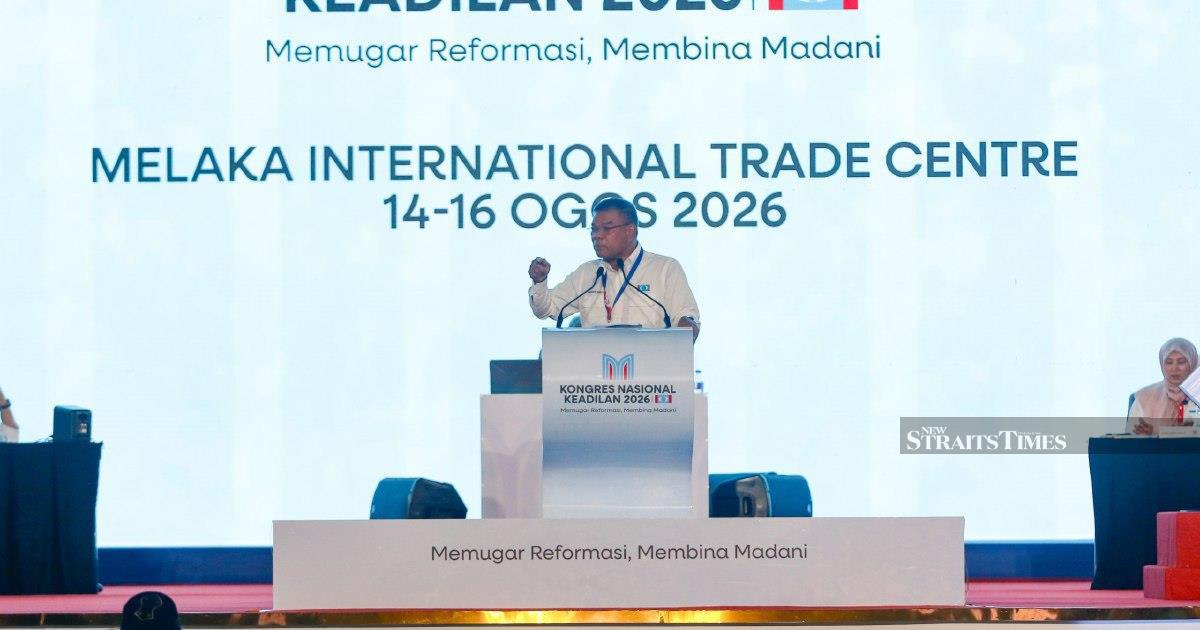
PKR vice-president Datuk Seri Saifuddin Nasution Ismail has urged Malaysians to view the nation's corruption crisis through the lens of ethics and institutional accountability, rather than allowing it to become entangled in divisive racial and religious narratives. Speaking at Ayer Keroh, the senior politician argued that framing graft as a technocratic and moral challenge—rather than a sectarian or communal issue—is essential if the country is to make genuine progress in its ongoing anti-corruption drive. His intervention arrives as Malaysia continues to grapple with a series of high-profile corruption scandals that have eroded public trust in government institutions and raised questions about the impartiality of enforcement mechanisms.
The observation reflects growing concern within political circles about the tendency of stakeholders to exploit anti-corruption messaging for partisan advantage. When graft allegations become proxy battles along ethnic or religious lines, they can undermine the legitimacy of investigations and corrode social cohesion. By contrast, a framing centred on institutional integrity and ethical governance allows anti-corruption efforts to command broader public support and reduces the likelihood that enforcement will be perceived as selective or politically motivated. This distinction matters enormously for a multiethnic, multireligious democracy like Malaysia, where perceptions of fairness and even-handedness are foundational to institutional credibility.
Saifuddin's remarks also carry weight because PKR, as a component of the Pakatan Harapan coalition that came to power in 2018 on an anti-corruption platform, has particular stakes in how the issue is prosecuted. The coalition's original legitimacy rested significantly on promises to tackle graft impartially and restore institutional independence. Yet subsequent political upheaval, including the collapse of that government in 2020 and the rise of the Perikatan Nasional administration, complicated the narrative. Critics argued that anti-corruption efforts became selective, targeting opposition figures while allegedly shielding those allied with the ruling coalition. Such perceptions, whether justified or not, highlight why maintaining a clear moral and governance focus is so vital.
The risk of instrumentalising anti-corruption work for political purposes extends beyond Malaysia's immediate political contest. In Southeast Asia more broadly, numerous governments have faced accusations of using graft investigations to neutralise political rivals while leaving allied figures untouched. The Philippines, Thailand, and other regional neighbours have all confronted challenges in establishing truly independent anti-corruption agencies and prosecutors. Malaysia's experience—and Saifuddin's call for restraint—underscores a wider regional challenge: how to build institutional safeguards robust enough to withstand political pressure and elite capture.
Malaysia's corruption indices have long troubled governance experts. The country ranks below regional peers like Singapore and Brunei on Transparency International's Corruption Perceptions Index, and domestic investigations have uncovered systematic misappropriation across government agencies, statutory bodies, and state enterprises. Some analysts attribute this partly to institutional vulnerabilities that make anti-corruption agencies susceptible to political interference. Stronger institutional insulation, clearer procedural rules, and broader stakeholder buy-in—precisely what Saifuddin appears to advocate—are prerequisites for more effective enforcement.
The moral framework Saifuddin proposes is not merely rhetorical. It implies that anti-corruption action should focus on the conduct itself, the misuse of public resources, and breaches of public trust, irrespective of the ethnicity or religion of those implicated. It suggests that enforcement decisions should rest on evidence and legal principle rather than factional calculation. Such an approach also acknowledges that corruption afflicts all communities and that perpetrators span ethnic and religious boundaries. Malaysian society includes corrupt and honest individuals across all demographic groups, and anti-corruption credibility depends on treating all equally.
For the Malaysian public, tired of both actual graft and the perception that enforcement is weaponised, Saifuddin's intervention speaks to a broader yearning for political maturity. Surveys consistently show that Malaysians rank corruption among their top concerns, yet they also express disillusionment when graft-fighting appears to serve narrow partisan ends. A depoliticised, principled approach to anti-corruption could restore institutional legitimacy and shift public conversation away from ethnic and religious grievances toward shared national interests in transparency and accountability.
Implementing this vision, however, requires more than exhortation. It demands structural reforms: strengthening the independence of the Malaysian Anti-Corruption Commission (MACC), insulating prosecutors from political pressure, clarifying investigative protocols, and ensuring that senior figures across party lines face equivalent scrutiny. It also requires all major political actors to resist the temptation to selectively invoke anti-corruption concerns when convenient. Saifuddin's fellow politicians, across the political spectrum, will need to demonstrate that they genuinely embrace a governance-centred approach rather than merely endorsing it rhetorically.
The timing of these remarks also merits attention. With Malaysia's political landscape fragmented and realignments possible before the next general election, the conversation about how anti-corruption is prosecuted will intensify. Saifuddin's framing offers one template: elevate the discussion above sectarian point-scoring and toward genuine institutional reform. Whether the broader political establishment proves willing to follow suit will be a measure of whether Malaysia's anti-corruption agenda can transcend its current divisive character and become a genuine force for national renewal.

