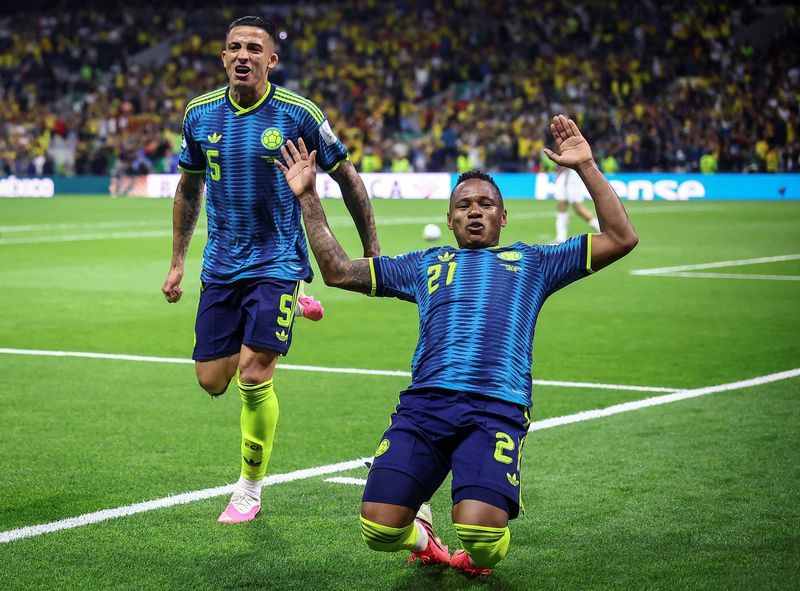
Colombia will pursue a second consecutive victory in their World Cup campaign when they encounter DR Congo on Tuesday, hoping to extend their Group K dominance and move closer to securing knockout-stage qualification. The South American outfit made an impressive start with a 3-1 triumph over Uzbekistan, though the margin of victory concealed significant defensive vulnerabilities that emerged during a troublesome second-half performance. A positive result against DR Congo would virtually guarantee Colombia's passage into the Round of 32 and could potentially clinch top spot in the group, particularly if Portugal stumble against the Uzbeks in their concurrent fixture.
Nestor Lorenzo's tactical approach has leaned heavily on the attacking prowess of Bayern Munich's Luis Diaz, who provided both a goal and an assist in the opening match while earning the player-of-the-match accolade. The Colombian forward's pace, technical ability, and direct running proved decisive against Uzbekistan, piercing defensive lines that the South Americans would ordinarily expect to dismantle with greater ease. However, Lorenzo faces the challenge of elevating the contributions of captain James Rodriguez, whose impact remained muted during the victory over the Central Asians as Colombia frequently bypassed midfield construction in favour of swift transitions through Diaz.
DR Congo arrives in this fixture emboldened by an outstanding performance against one of the tournament's favourites, having earned a 1-1 stalemate with Portugal that marked their return to the World Cup stage after nearly five decades of absence. The African nation last participated in the tournament as Zaire in 1974, making this qualification a historic moment for Congolese football. Yoane Wissa's goal symbolised more than just a levelling strike; it represented a statement of intent from a nation whose football infrastructure has been severely tested by chronic underfunding and continental competition struggles.
The tactical blueprint that Sebastien Desabre's side employed against Portugal revealed a carefully organised defensive structure capable of absorbing Portugal's attacking ambitions while maintaining lethal efficiency during counter-attacking transitions. This compact approach is likely to resurface against Colombia, though the Colombian side's attacking complexity presents a markedly different examination than the Portuguese possession-heavy model. Where Portugal attempted to dominate territorial control, Colombia favour penetrative runs and verticality, which may either expose DR Congo's defensive shape or provide the African nation with additional opportunities to exploit gaps through rapid breaks.
Lorenzo has already signalled his awareness of the tactical challenge ahead, noting that DR Congo's transition-oriented system poses considerable difficulties for his side. In comments following the Uzbekistan match, the Argentine coach highlighted how his team's defensive lapses could be exploited by opponents capable of executing swift movements from deep positions. The coach specifically pointed to sequences where DR Congo's long-ball strategy and rapid counter-attacks would demand sharper defensive positioning and anticipation from Colombian defenders who occasionally appeared caught between pressing and retreating during their opening contest.
Beyond tactical considerations, Lorenzo identified a concerning pattern in Colombia's attacking play during their victory over Uzbekistan. The side's dominance in possession occasionally became counterproductive, with the team drifting backwards into patterns of sterile passing rather than decisive finishing. This observation underscores a deeper concern for the Colombian coaching staff: the need to convert territorial advantage into genuine scoring opportunities with greater consistency and ruthlessness. Against a well-drilled DR Congo defence, such inefficiency could prove costly, particularly if the African nation succeeds in slowing Colombia's tempo and forcing their opponents into predictable patterns.
The atmosphere within the stadiums may also influence proceedings, as Colombian fans have already demonstrated their capacity to transform neutral venues into home environments. During the Uzbekistan match at Mexico City's Estadio Azteca, thousands of Colombian supporters in yellow shirts created an intimidating backdrop for their opponents and buoyed their own players throughout. With Colombia's tournament base in Guadalajara and another significant portion of the Mexican-based Colombian diaspora expected to attend Tuesday's fixture, this home advantage could provide psychological and emotional benefits that supplement the tactical preparations conducted on the training ground.
For DR Congo, a positive result would represent a monumental achievement in their World Cup return and would leave them in genuine contention for the knockout stages alongside both Colombia and Portugal in a genuinely competitive Group K. The Congolese players, many of whom earn modest salaries in European leagues or struggle to secure consistent international exposure, would derive immense pride and professional validation from progressing beyond the group phase. Coach Sebastien Desabre's continued emphasis on defensive solidity and transition efficiency represents a pragmatic approach suited to his squad's technical limitations compared to their opponents.
Colombia's recent tournament history demonstrates their capability to reach latter stages when their attacking talent aligns with strategic discipline, yet they have simultaneously shown vulnerability against organised defensive blocks that prevent their creative players from finding rhythm. The challenge Lorenzo faces is orchestrating a performance that combines possession control with clinical finishing while simultaneously tightening defensive organisation. Three points against DR Congo would represent substantial progress toward their World Cup ambitions, yet the manner of the victory will prove equally instructive as it reveals whether the Colombian coaching staff can correct the vulnerabilities exposed against Uzbekistan before confronting more sophisticated opponents in the knockout stages.

