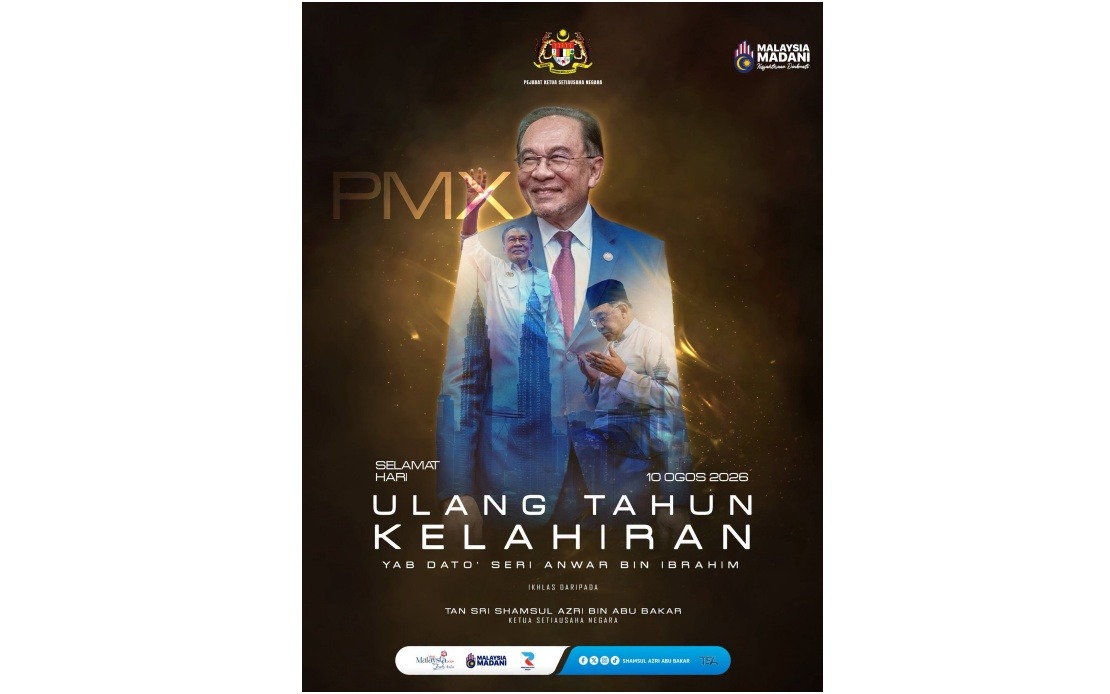
Prime Minister Datuk Seri Anwar Ibrahim received official birthday greetings from Malaysia's highest-ranking civil servant on August 10 as he turned 79 years old. Chief Secretary to the Government Tan Sri Shamsul Azri Abu Bakar extended warm wishes to the nation's leader, marking another year in what has been an eventful tenure since Anwar's appointment as Prime Minister in November 2022.
Tan Sri Shamsul Azri's public acknowledgement came through a Facebook post, where he not only congratulated Anwar but also framed the occasion as an opportunity to reaffirm the civil service's commitment to supporting the government's broader agenda. The Chief Secretary's message carried particular significance given his role as the highest-ranking administrative official in the country, effectively serving as the bridge between the political leadership and Malaysia's sprawling bureaucratic apparatus. His words underscored the institutional nature of government support for the Prime Minister's initiatives.
Beyond ceremonial courtesy, Tan Sri Shamsul Azri's statement emphasised the civil service's dedication to what he termed the "aspirations and reform agenda of the public service for the people and the country." This phrasing suggested continuity in the government's push toward administrative modernisation and efficiency, themes that have featured prominently in policy discussions throughout Anwar's premiership. The Chief Secretary's invocation of divine blessing reflected Malaysia's multicultural governance approach, where religious acknowledgement remains common in official communications.
The Prime Minister's Office complemented the Chief Secretary's message with a separate video tribute circulated on Facebook, employing language that captured the philosophical underpinning of the administration's work. The message stated: "Efforts continue, the trust is fulfilled, and to Allah SWT we place our trust." This formulation emphasised both the ongoing nature of governmental labour and the idea of accountability to both the public and divine providence, a framing consistent with how Malaysia's political leadership has articulated its mandate.
At 79 years old, Anwar Ibrahim represents one of Southeast Asia's longest-serving political figures, having spent decades navigating Malaysia's complex political landscape before reaching the nation's highest executive office. His journey has included periods of significant trial and transformation, making his current role as Prime Minister particularly symbolically resonant for many observers of Malaysian politics. The timing of his birthday also falls within a period where his administration has been grappling with substantial policy challenges and economic considerations affecting ordinary Malaysians.
The Malaysia MADANI social media account, representing the government's flagship initiative bearing its name, added its own celebratory message to the chorus of birthday wishes. The MADANI platform, which encompasses the government's vision for prosperity and inclusivity, wished that Anwar would "continue to be blessed with the strength to contribute to and work tirelessly for the country and the nation." This language connected the Prime Minister's personal wellbeing with the success of the government's primary policy framework, suggesting that public officials view his health and energy as instrumental to advancing their collective agenda.
The orchestrated nature of these birthday greetings from multiple government institutions reveals how Malaysian political culture formalises acknowledgement of senior leadership. Rather than spontaneous personal messages, these statements represent carefully considered communications from major government entities, each calibrated to reinforce particular aspects of the administration's narrative. The Chief Secretary's emphasis on civil service support, the PMO's focus on trust and perseverance, and MADANI's connection between the Prime Minister's wellbeing and national policy goals each served specific communicative purposes.
For Malaysian observers and regional analysts, such public moments offer insights into institutional relationships and government messaging priorities. The participation of the civil service leadership in particular carried weight, as it signalled administrative continuity and bureaucratic support for the political leadership. In Malaysia's Westminster-influenced system, maintaining strong relationships between the elected government and the professional civil service remains essential for effective policy implementation.
Anwar Ibrahim's tenure as Prime Minister has coincided with significant developments in Malaysian politics, including shifting coalition dynamics and attempts to strengthen institutional governance. At 79, his ability to lead remains a subject of periodic public discussion, making the birthday wishes carrying themes of health and continued strength more than merely courteous. The emphasis on his physical capacity and mental acuity reflected broader questions about leadership succession and institutional stability that permeate Malaysian political discourse.
The broader regional context also deserves consideration. As one of Southeast Asia's major economies, Malaysia's political stability and the effectiveness of its government directly influence regional dynamics. Birthday tributes to an aging leader, particularly one who has experienced both dramatic rises and falls in Malaysian politics, carry implicit messages about succession planning and the continuity of governance frameworks that matter beyond Malaysia's borders.

