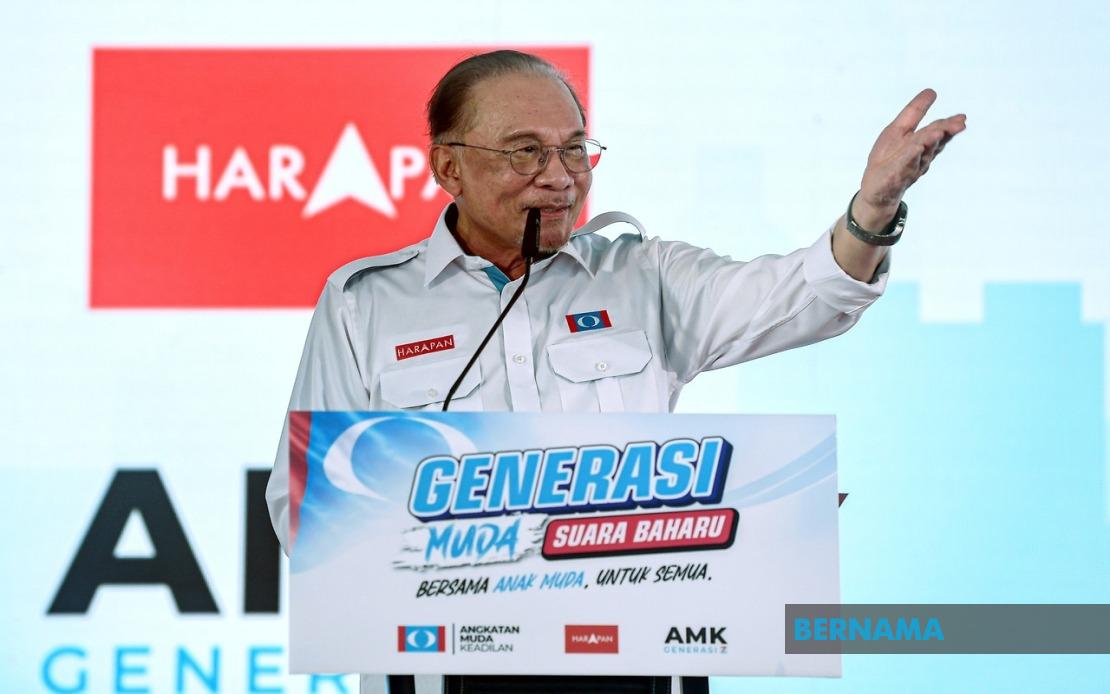
Prime Minister Datuk Seri Anwar Ibrahim has made a direct appeal to Malaysia's younger generation to select political leaders based on their capacity to forge national unity rather than exploit ethnic and religious fault lines. Speaking at the Generasi Muda Suara Baharu programme in Petaling Jaya on July 24, Anwar stressed that the calibre of political leadership chosen today will fundamentally shape the nation's trajectory across economic development and education for years to come.
Anwar's remarks represent a deliberate pivot away from what he characterises as the "old politics" that has long dominated Malaysian political discourse. He explicitly rejected the longstanding practice of weaponising fear across ethnic lines, singling out divisive narratives that pit Malays against Chinese, Chinese against Indians, and Indians against Dayak communities. The Prime Minister framed this rejection as foundational to genuine reform, suggesting that generational change in political values must precede structural transformation within the system itself.
The emphasis on Gen Z leadership reflects broader concerns within government circles about the political engagement of younger voters who came of age after the 1998 Reformasi movement. Unlike their predecessors who mobilised around specific watershed moments, today's youth cohort operates within a more fragmented media environment and demonstrates different patterns of political participation. Anwar appears to be attempting to channel this generation's idealism toward his vision of a corruption-free, ethnically harmonious Malaysia, framing such objectives as intrinsically linked to economic prosperity and educational advancement.
Anwar identified anti-corruption and anti-racism campaigns as the defining pillars upon which a new leadership class should be built. By foregrounding these twin imperatives, he implicitly acknowledges that Malaysia's political legitimacy crisis stems not merely from policy failures but from deeper institutional integrity concerns and unresolved questions about inclusive governance. This positioning allows him to address multiple constituencies simultaneously—those disillusioned by high-profile corruption cases and those frustrated by ethnic-based politics—while maintaining that both challenges are interconnected rather than separate policy domains.
The Prime Minister also articulated a cautionary note about the pace and nature of change, distinguishing between passionate calls for reform and sustainable, strategically-executed transformation. His warning against merely "screaming here and there" while achieving no tangible outcomes reflects frustration with activist approaches that generate noise without institutional impact. This suggests a tension within Anwar's own thinking: he seeks to energise youth participation while simultaneously advocating for measured, calculated reform efforts that respect existing power structures and procedural constraints.
Evidential to Anwar's optimism about Malaysia's direction is his observation of improved inter-ethnic collaboration among the current younger cohort, particularly in major urban centres where Chinese, Indian, Sabahan, and Sarawakian young people work alongside Malay peers with reportedly reduced communal suspicion. He interpreted these everyday interactions as harbingers of a fundamental political realignment, one in which younger voters might deprioritise identity-based voting patterns in favour of performance-based evaluation of leaders. This interpretation, however, requires qualification given the persistent salience of ethnoreligious identity in Malaysian electoral behaviour and the countervailing evidence from recent polls suggesting continued polarisation.
The Suara Baharu Generasi Muda initiative, which the Prime Minister indicated would expand to every district nationwide, represents an institutional attempt to operationalise this youth-oriented messaging at grassroots level. Rather than relying solely on top-down communication through traditional media or parliamentary platforms, the programme seeks direct engagement with young voters in their local communities. This decentralised approach acknowledges that appeals to national unity resonate differently depending on local economic conditions, community grievances, and existing political networks operating below the national spotlight.
For Malaysian observers, Anwar's framing of the leadership question carries immediate practical implications. His call for leaders "capable of embracing the strength to unite the country" implicitly critiques both the previous Mahathir-era governance model and the more recent Perikatan Nasional administration, each of which he associates with either autocratic centralisation or ethno-nationalist mobilisation respectively. By positioning his own administration as the antidote to these approaches, Anwar seeks to establish himself as the embodiment of his own leadership prescription—though sceptics note that governance under his watch has featured continued ethnic-majority privilege in policy and repeated invocations of Islam's constitutional position.
The generational dimension Anwar emphasises has particular resonance across Southeast Asia, where demographic transitions toward youth-majority populations are accelerating in countries including Indonesia, Philippines, and Bangladesh. Malaysian youth, many of whom possess exposure to global digital networks and international education, potentially represent a constituency more receptive to post-nationalist political appeals than their parents' generation. However, this potential remains contingent on whether material conditions—employment, housing, education quality—improve sufficiently to validate Anwar's implicit promise that unity-focused leadership delivers better outcomes than competition over ethnic entitlements.
Anwar's inclusion of Communications Minister Datuk Seri Fahmi Fadzil in the programme signals coordinated messaging discipline across the Cabinet, suggesting that the unity-and-reform narrative enjoys institutional backing beyond the Prime Minister's personal advocacy. This institutional embedding increases the likelihood of sustained messaging and resource allocation toward youth engagement, though it may also constrain the programme's perceived independence and authenticity among younger voters already sceptical of top-down political initiatives.
The implicit challenge underlying Anwar's exhortation concerns whether Malaysia's institutional architecture—which embeds ethnic representation mechanisms, religious establishment protections, and federalism structured around state-level identity politics—can genuinely accommodate the post-ethnic leadership model he advocates. Transforming political culture requires not merely generational replacement but also constitutional and legal frameworks that no longer privilege ethnic-based organisation as the default political form. Without addressing these structural constraints, even widespread youth adoption of Anwar's unity message may prove insufficient to produce the systemic change he envisions.

