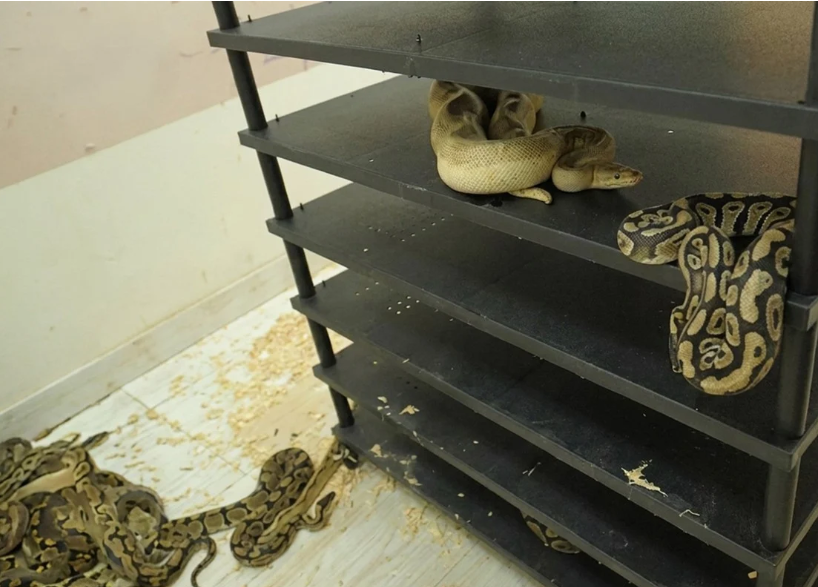
A seemingly ordinary apartment in Taizhou, Zhejiang province, was hiding one of China's more unusual crimes: the illicit breeding of 309 protected pythons. The discovery of this massive operation came about through a chain of events that began innocuously in March 2024, when a senior citizen stumbled upon a stray python at the base of a local mountain. What might have seemed like an isolated wildlife encounter instead unravelled into a network of illegal reptile trafficking that authorities say caused serious harm to endangered species protections.
The initial report by the elderly resident triggered an investigation that would reveal the complexity of modern wildlife crime in China. Officers quickly theorized that the snake had escaped captivity rather than migrating naturally to the area, given that pythons are not indigenous to the region and typically remain dormant during early spring months. The investigative team's next insight proved decisive: they consulted a professional reptile specialist who explained that pythons require consistently warm and humid conditions to survive and reproduce, meaning any breeder would necessarily consume substantial quantities of electricity to maintain temperatures between 20 and 30 degrees Celsius year-round.
This technical detail became the investigative linchpin. Police methodically cross-referenced electricity consumption records for residents living near where the snake had been discovered, searching for households with usage patterns inconsistent with typical domestic needs. This systematic approach led them to a man surnamed Guo, who lived alone and was unemployed. The profile fit the emerging picture: someone with ample time and motivation to dedicate themselves entirely to reptile cultivation, yet financially disconnected from conventional employment. The electricity consumption data provided the probable cause officers needed to deepen their inquiry.
Surveillance and further investigation revealed Guo's accomplice, a man named Di, who regularly visited the suspect's residence. Detectives observed Di making frequent trips to local courier collection points to retrieve packages destined for Guo's address. Upon examination, these parcels contained thousands of live white mice purchased through online channels. When police contacted the online sellers, they confirmed that such bulk purchases of small rodents are characteristic of customers maintaining exotic pet collections, particularly reptiles requiring regular feeding. The mice served as the primary sustenance for the snake operation.
Digital footprints further corroborated the illegal breeding enterprise. Guo had posted photographs of snakes on social media platforms and made oblique references to selling pythons. Perhaps believing he operated in relative anonymity, he failed to conceal evidence of his commercial activities. Bank records exposed the financial dimension of the scheme: Guo and Di had successfully sold approximately 80 pythons to customers, with transaction documentation showing Di alone had sold two specimens to another individual for 1,000 yuan. These sales transactions violated multiple provisions of Chinese law, which strictly prohibits the commercial breeding, sale, and transport of Grade Two protected animals without explicit government authorization.
When police executed a search warrant on Guo's flat, they encountered a scene that shocked even the investigating officers. The apartment had been wholly converted into a reptile facility. Guo had confined himself and his furniture to a single bedroom while repurposing the two remaining bedrooms and the entire living room as snake enclosures. Plastic boxes were stacked vertically throughout the space, each containing one or more pythons. This arrangement reflected the degree of obsession and planning that had gone into the operation. Officers seized a total of 309 pythons from the residence, which were subsequently transferred to a local zoo for care and assessment.
Guo himself revealed the origins of his illegal enterprise during police questioning. He explained that he had purchased his first four pythons in 2014 and had since dedicated himself to understanding reptile genetics and breeding techniques. His statement that he considered himself a "creature creator" capable of cultivating pythons in various colour morphs indicated his pride in the technical aspects of the work. Yet this passion for serpentine husbandry operated entirely outside legal frameworks designed to protect species whose global populations are threatened by illegal trafficking and habitat loss.
The investigation expanded to encompass a broader smuggling network. Police identified Deng, a shop owner who had sold the original four pythons to Guo a decade earlier, as another participant in the illegal trade. Authorities discovered 47 additional pythons at Deng's residence, bringing the total number of animals seized across all three suspects to 436 specimens. Market valuations placed the entire operation at over 30 million yuan, approximately US$4.4 million, underscoring the substantial financial incentives driving wildlife trafficking in China's underground economy.
The case carries significant implications for understanding wildlife crime in the digital age. Traditional smuggling networks once relied on concealment and physical distribution chains, but modern operators leverage online platforms for both acquiring supplies and conducting sales, leaving digital trails that sophisticated law enforcement can follow. The electricity consumption angle demonstrates how enforcement agencies increasingly employ indirect investigative methods to identify illegal operations that might otherwise evade detection. Police cannot easily observe what occurs within residential spaces, but the tell-tale signatures of industrial-scale operations—abnormal utility usage, frequent deliveries, or unusual financial transactions—provide investigative entry points.
Chinese law treats violations of protections for Grade Two endangered species seriously, with maximum prison sentences reaching five years under the Criminal Law. The specific sentences for Guo, Di, and Deng were not disclosed in official reports, though all three received jail time. The case underscores China's commitment to prosecuting wildlife trafficking, particularly given international concern about illegal reptile trade destabilizing wild populations of pythons and related species. For Southeast Asian nations that share biodiversity concerns with China and often serve as transit points for wildlife trafficking, this operation illustrates both the sophistication of modern smuggling networks and the potential effectiveness of technology-assisted law enforcement.
The 309 pythons recovered from Guo's apartment represent animals removed from an illegal breeding cycle that would likely have continued expanding had the initial discovery of that stray snake not prompted investigation. The case also highlights how dedicated wildlife enthusiasts can become criminals when their passion operates outside regulatory frameworks—frameworks that exist specifically because uncontrolled breeding and trade threaten species survival at global scale. As Southeast Asia confronts escalating wildlife trafficking pressures, the Taizhou case demonstrates that detection and prosecution, though resource-intensive, remain possible when enforcement agencies employ creative investigative approaches and leverage available data sources.

