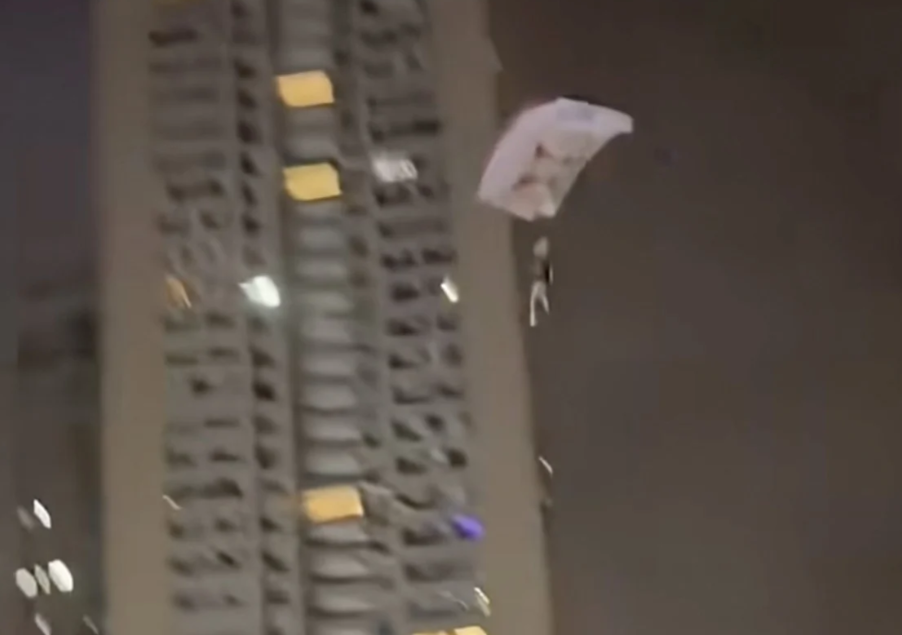
A 23-year-old skydiver in southwestern China has faced legal consequences after performing an unauthorised parachute jump from the roof of a residential building—an increasingly common trend among social media influencers seeking online attention through dangerous and unlawful activities. The incident, which occurred in Chenghua district of Sichuan province on June 30 at 11pm, saw the individual identified as Ren launching himself from the top of a high-rise apartment complex with a parachute. He documented the act and shared footage online the following day, hoping to generate engagement and expand his audience across leading social platforms.
Police investigations into the incident revealed that Ren's primary motivation was commercial rather than recreational. With approximately 60,000 followers accumulated under the online persona "Parachute Coach Kakaxi," he sought to capitalise on his platform by performing increasingly risky and illegal stunts. The footage he later distributed showed the gravity of his transgression—his parachute descent brought him dangerously close to residential buildings, trees, and other structures in densely populated areas where innocent civilians could have been struck or injured. Such proximity to buildings and vegetation transformed what might otherwise be an extreme sport into a genuine public hazard.
Authorities moved swiftly to address the violation. The Chenghua district police authority classified Ren's conduct as seriously disturbing public order and endangering public safety, initiating formal detention procedures. Under China's administrative detention system, he was subject to custody lasting up to 15 days for his infractions. Beyond immediate detention, the consequences extended to his digital presence—police imposed a social media ban on his accounts, effectively removing his platform for future content distribution and undermining his capacity to monetise his online persona.
The police clarification following the incident underscored the regulatory framework governing skydiving activities throughout China. Authorities emphasised that parachuting operations require explicit governmental authorisation and may only occur within specially designated zones approved for such activities. Downtown areas, residential towers, bridges, and other locations with concentrated population density are strictly off-limits for unauthorised aerial activities. Violations of these restrictions carry severe penalties designed to deter future infractions and protect public safety across urban environments.
Further investigation into Ren's background and qualifications revealed troubling discrepancies between his online claims and actual credentials. Although his social media profile identified him as a parachute coach, police verification confirmed he had never obtained the requisite coaching licence. This lack of formal qualification meant he was operating without any recognised expertise or official sanction, compounding the legal and safety violations inherent in his actions. His prior conduct compounds the concern—records show another instance in May 2024 when he posted video content documenting a skydive from a residential building, suggesting a pattern of repeated, deliberate violations rather than an isolated incident.
Public response on mainland Chinese social media platforms reflected widespread alarm and frustration with Ren's behaviour. Internet commentators consistently highlighted the cascading risks his stunt created for innocent bystanders. One observer noted the fundamental irresponsibility of the act, pointing out that the danger extended far beyond Ren himself—pedestrians and residents in the vicinity faced genuine risk of serious injury or death if his descent had gone awry or if he had collided with structures or people below. This perspective underscored how individual recklessness in pursuit of online fame can distribute consequences across an entire community.
Other social media users expressed exasperation at the motivation driving such behaviour. Critics questioned how someone would undertake such hazardous action purely for digital engagement, viewing the decision-making process as fundamentally irrational and self-serving. The emphasis on "high online traffic" as justification struck many as insufficient moral or practical grounds for actions that endangered multiple lives. A third category of commentary focused on the adequacy of the punishment imposed, with some netizens arguing that 15-day detention might be insufficient to prevent copycat incidents and calling for more stringent penalties to raise the cost of violation.
Ren's case exemplifies a broader pattern affecting China's digital ecosystem where influencers engage in increasingly extreme and dangerous conduct to maintain audience engagement and generate content in a saturated online marketplace. This phenomenon is not isolated to extreme sports but manifests across multiple categories of high-risk behaviour. In June of the same year, Zhejiang province authorities apprehended a driver who had filmed and posted video content showing himself operating a vehicle at 152 kilometres per hour on an expressway—significantly exceeding legal speed limits—while simultaneously wielding a mobile phone to capture footage. His punishment included deduction of nine points from his driving licence's annual 12-point allocation and a monetary fine of 250 yuan, equivalent to approximately US$35.
The broader historical context of such incidents reveals an alarming trajectory of escalation. In 2017, livestreaming personality Wu Yongning died from physical exhaustion while climbing a 260-metre-high building in Hunan province during a live-streaming broadcast. Wu had built an online following through extreme building-scaling activities performed without safety equipment or precautions, claiming his dangerous pursuits were motivated by financial need to fund his mother's medical treatment. His death underscored how the pursuit of online attention through life-threatening stunts can culminate in tragedy, yet the phenomenon continues unabated.
For Malaysian and Southeast Asian readers, Ren's detention serves as a cautionary narrative about the pressures and incentive structures embedded within social media platforms globally. As digital influence becomes increasingly monetised and competitive, individuals across the region face similar temptations to escalate content through dangerous or illegal behaviour. Regulatory frameworks and enforcement mechanisms like those China has implemented deserve scrutiny as other nations consider how to balance digital freedom with public safety obligations. The pattern suggests that education and public awareness about the genuine consequences of such activities—both legal and physical—may prove essential in discouraging imitation.
The incident also highlights the responsibilities of social media platforms themselves in moderating content that promotes dangerous activities and potentially glamorises illegal conduct. While China's approach involves substantial government intervention, democratic societies must grapple with finding effective alternatives that protect public safety without compromising fundamental freedoms. Ren's case demonstrates that the externalities of attention-seeking behaviour extend far beyond the individual performer, imposing risks on innocent bystanders and creating broader social costs that justify regulatory intervention across multiple jurisdictions.

