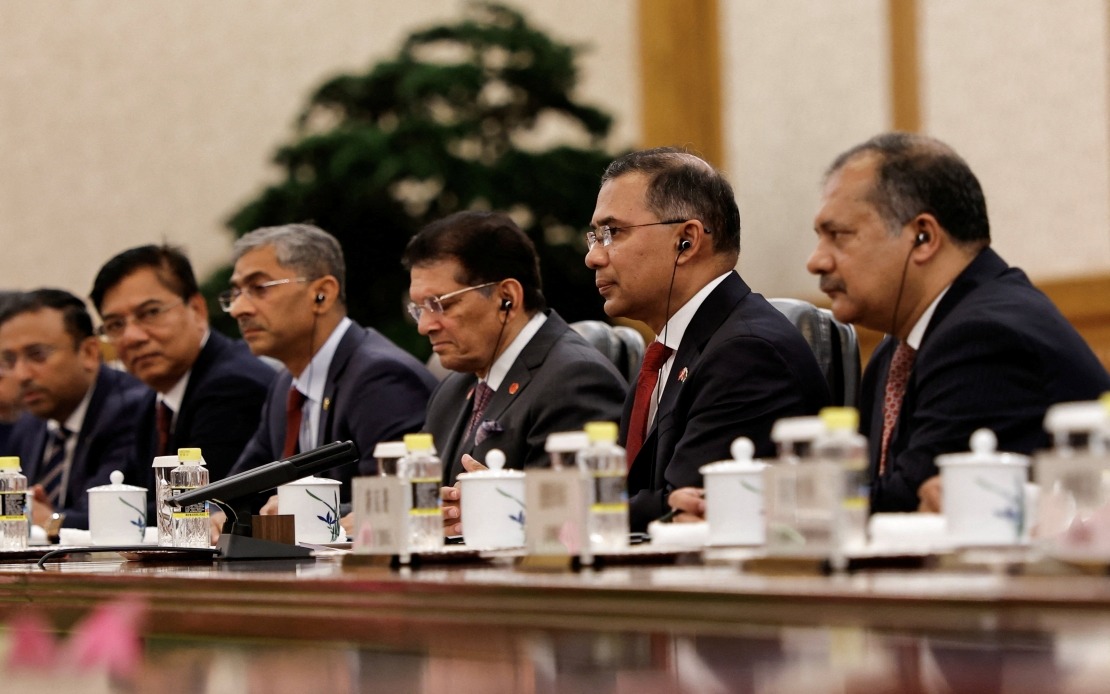
Prime Minister Tarique Rahman's recent state visit to China has yielded substantial economic dividends for Bangladesh, with twelve Chinese enterprises committing a combined US$9.2 billion across multiple strategic sectors. The proposed investments, unveiled during Rahman's June 22 to 26 trip to China, represent a significant deepening of bilateral economic ties and signal renewed Chinese confidence in Bangladesh as a major investment destination in South Asia. This development carries particular relevance for Malaysian policymakers and investors, offering insights into how neighbouring nations are positioning themselves within the expanding Chinese investment architecture.
The scope of the proposed Chinese investments reflects Beijing's multi-layered approach to deepening engagement with Bangladesh. Rather than concentrating resources in a single sector, the participating companies have distributed their commitments across energy infrastructure, transportation networks, logistics facilities, environmental technology, and manufacturing platforms. This diversification strategy aims to address Bangladesh's most pressing development bottlenecks while simultaneously creating export-oriented manufacturing bases that can serve broader regional and global supply chains. For Malaysia, which has similarly positioned itself as a manufacturing and logistics hub in Southeast Asia, the Bangladesh experience demonstrates how large-scale infrastructure financing can complement regional industrial policy.
The centerpiece of this investment wave involves significant port modernisation and industrial park development initiatives. Mongla Port, situated along Bangladesh's southwestern coastline, has become the focal point of enhanced bilateral cooperation. China Civil Engineering Construction Corporation has allocated US$650 million specifically for developing and operating the Mongla Port Economic Zone, which will incorporate warehousing facilities and integrated logistics infrastructure designed to facilitate rapid cargo handling and distribution across South Asia. This investment directly addresses Bangladesh's historical constraints in maritime trade logistics and positions Mongla as a potential gateway for Chinese manufactured goods destined for Indian and Southeast Asian markets.
Road infrastructure development constitutes the largest single investment commitment from the Chinese consortium. Sichuan Road and Bridge Group has proposed US$4.5 billion to develop the critical Dhaka-Chattogram highway corridor through a public-private partnership model. This arterial route connects Bangladesh's capital with its primary seaport and industrial hubs, making it essential for domestic freight movement and economic integration. The scope of this commitment underscores how Chinese investors view transportation networks not merely as infrastructure projects but as foundational elements enabling entire regional supply chain ecosystems. Malaysian stakeholders should note how this mirrors similar investments China has pursued throughout Southeast Asia, from Thai motorways to Laotian railways.
Environmental technology and green energy initiatives represent a significant secondary focus within the investment portfolio. Shanghai SUS Environment Company plans to commit US$890 million toward developing waste-to-energy plants that will simultaneously address Bangladesh's mounting urban waste challenges whilst generating electrical power. Separately, Huaxin Textile Industry Company Limited intends to establish a 200 megawatt captive solar power facility within the Payra economic zone, combined with investments in recycled cotton production and lithium battery manufacturing totalling US$190 million. These projects align with global sustainability pressures whilst creating manufacturing value chains that can export processed goods and renewable energy equipment to neighbouring markets.
Electronic waste management has emerged as a particular growth area within the investment framework. Zhongxin Environmental Protection Group has proposed establishing a US$1.65 billion e-waste processing facility at the Payra Port Industrial Zone. Given the exponential growth in electronic device consumption across South and Southeast Asia, centralised recycling and materials recovery operations can achieve significant economies of scale whilst generating raw material supplies for secondary manufacturing. This vertical integration strategy reflects how Chinese companies increasingly conceptualise industrial development, linking waste streams to resource recovery and manufacturing inputs.
The energy sector commitments extend beyond renewable generation into conventional resource development. China Future Energy Group Holding Limited has outlined a US$250 million project for gas field exploration and development, recognising Bangladesh's natural gas reserves as an underutilised energy asset. Combined with renewable generation capacity being added through solar and waste-to-energy systems, these investments position Bangladesh to achieve greater energy autonomy whilst reducing reliance on imported fuels. For Malaysia, where energy security represents a persistent policy concern, Bangladesh's diversified energy investment strategy offers instructive lessons in balancing conventional and renewable resources.
Logistics and supply chain infrastructure receive substantial attention throughout the investment package. SF Express, China's leading logistics operator, has committed US$180 million to develop cold-chain logistics and warehouse facilities near Mongla Port, approximately 230 kilometres from Dhaka. This investment specifically targets temperature-controlled distribution networks, suggesting that Chinese investors anticipate significant expansion in perishable goods trade from Bangladesh. Such infrastructure investments create multiplier effects throughout regional economies by enabling entire new export categories, from fresh agricultural products to pharmaceutical shipments.
Manufacturing capacity expansion constitutes another major investment component. Shenzhen Kaifa Technology plans to invest US$250 million in electric smart metre production, positioning Bangladesh as a supplier for regional electricity distribution modernisation programmes. Simultaneously, a coordinated industrial park initiative in Chattogram aims to develop export-oriented manufacturing clusters comparable to those operating successfully in Vietnam and Cambodia. These facilities can attract labour-intensive assembly operations whilst serving as gateway technologies for higher-value manufacturing segments.
Bangladesh's Commerce Minister Khandakar Abdul Muktadir has emphasised that these investments offer tangible pathways toward reducing Bangladesh's persistent trade deficit with China. Currently, Bangladesh imports substantially more Chinese goods than it exports, creating foreign exchange pressures. By developing manufacturing and processing capabilities within Bangladesh through Chinese investment, local enterprises gain access to imported raw materials, technical expertise, and established export channels. This model parallels how Malaysia has historically leveraged Chinese investment to develop export-competitive industries whilst maintaining technological knowledge transfer.
The joint communiqué issued following Prime Minister Rahman's visit explicitly committed both nations to strengthening cooperation in trade, e-commerce, industrial supply chains, and investment frameworks. This institutional commitment suggests that the US$9.2 billion in proposed investments represents merely initial commitments, with additional projects likely following as initial facilities commence operations and demonstrate returns. For Southeast Asian observers, the Bangladesh experience highlights how comprehensive state visits can catalyse substantial capital flows when host countries present coherent development strategies aligned with investor priorities.
These investments are anticipated to generate tens of thousands of employment opportunities spanning construction, manufacturing, logistics, and professional services sectors. Bangladesh's substantial labour force and relatively lower wage structures compared to developed Asian economies position the nation competitively for labour-intensive manufacturing operations. However, the quality and sustainability of these employment opportunities will depend substantially on technology transfer, skills development, and integration with local supply chains rather than mere assembly-line operations.
For Malaysian policymakers and investors, the Bangladesh investment wave demonstrates the continued centrality of Chinese capital in reshaping South and Southeast Asian economic geographies. Rather than viewing Chinese investment as monolithic, the diversity of participating companies, investment sizes, and sectoral focuses reveals how individual Chinese enterprises pursue tailored strategies suited to specific national development contexts. The Bangladeshi experience suggests that countries offering clear infrastructure development priorities, regulatory predictability, and significant market opportunities can attract substantial committed capital from multiple Chinese investors simultaneously.

