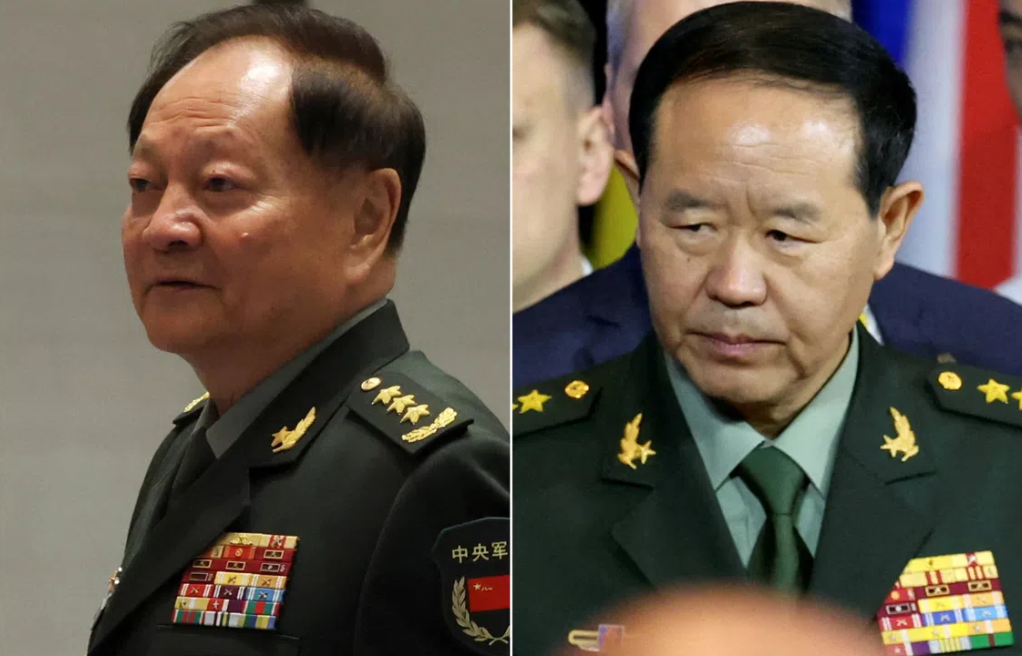
Beijing's removal of two senior military commanders from the state Central Military Commission on Friday marks another significant escalation in President Xi Jinping's relentless campaign to consolidate power and eliminate potential rivals within China's armed forces. The stepping down of Zhang Youxia and Liu Zhenli, announced by the Standing Committee of the National People's Congress after investigations into serious breaches of discipline and law, leaves the formerly seven-member commission with just two active members. The pruning of the military's highest echelon reflects the depth and scope of Xi's determination to reshape the People's Liberation Army in his image, a priority that has defined his leadership since he assumed command in 2012.
Zhang's removal carries particular significance given his standing as vice-chairman of the Central Military Commission and membership in the elite Politburo, making him one of the most powerful figures in the Chinese state apparatus outside Xi himself. As second-in-command on the military side, Zhang represented a potential alternative power centre, a reality that made his position increasingly precarious as Xi consolidated authority. Liu Zhenli, serving as chief of staff of the CMC's Joint Staff Department, occupied an equally critical operational role, responsible for coordinating military strategy and implementation across China's vast defence establishment. Their simultaneous removal signals that no institutional safeguard or seniority can insulate officials from Xi's reach when deemed a threat to his vision of party and military discipline.
The mechanics of their departure underscore the Byzantine nature of Chinese Communist Party governance, where parallel structures often mask the true locus of power. While the state CMC announced their removal on Friday through the parliamentary Standing Committee, Zhang and Liu have not been formally stripped of their positions within the Communist Party's own Central Military Commission—a distinction that matters in the opaque world of Chinese elite politics. This bifurcated approach offers technical deniability while achieving the practical outcome of removing them from functional authority, a common tactic in Beijing's purges. The method also preserves the appearance of institutional procedure, maintaining the facade of legal process rather than arbitrary dismissal.
The broader anti-corruption crusade targeting the military has been among Xi's most sweeping initiatives since coming to power, reflecting his recognition that a loyal armed force is essential to Communist Party rule. Over the past dozen years, the campaign has ensnared dozens of high-ranking officers, senior commanders, and defence ministry officials, dismantling networks and factions that accumulated power and influence during the tenure of his predecessors. The investigations have extended beyond simple corruption to encompass questions of political loyalty, factional alignment, and ideological commitment to Xi's vision of a disciplined, unified military apparatus subordinate to party control. Recent additions to the purge list included Lieutenant General Zhong Shaojun, former director of the CMC General Office, and General Ju Qiansheng, a previous commander of the military's Strategic Support Force, both positions affording access to sensitive operational and strategic information.
The inclusion of non-military figures in Friday's announcement demonstrates that the crackdown extends well beyond uniform-wearing officers into the civil-military complex and associated defence industries. Gao Shiwen, the former mayor of Nanchang in southern China, lost his parliamentary seat partly due to his background at China Aerospace Science and Technology Corporation, a state-owned defence conglomerate central to Beijing's military modernisation efforts. The involvement of defence industrial leaders suggests investigations into potential collusion between military procurement officials and arms manufacturers, a common vector for corruption in authoritarian defence establishments. This intertwining of military and civilian purges reflects Xi's determination to eliminate what he perceives as corrupt networks spanning both domains.
Separately, the Chinese People's Political Consultative Conference, Beijing's top political advisory body, stripped Zhao Zongqi of membership this week, adding another layer to the ongoing military purge. Zhao's previous command of the Western Theatre Command during the turbulent 2020 border clashes with India positioned him as a key figure in one of China's most significant military confrontations in decades. His removal from advisory positions suggests that even commanders who led operations considered important strategic initiatives cannot assume safety if deemed problematic to Xi's broader consolidation agenda. The timing of Zhao's expulsion alongside the CMC removals indicates a coordinated, high-level political offensive against multiple levels of the military hierarchy.
For Malaysian observers and Southeast Asian policymakers, these developments carry sobering implications about the trajectory of Chinese military politics and the stability of decision-making structures in Beijing. A military purged of experienced commanders and hollow of autonomous institutional authority may become either more controllable by civilian party leadership or potentially more unpredictable in crisis situations, depending on how new loyalists reshape strategic culture. The removal of figures with deep operational experience, particularly those involved in border conflicts, could affect how China recalibrates its approach to regional disputes and military posturing. Understanding that Xi's consolidation remains ongoing, with no clear succession framework established, raises questions about institutional continuity and potential instability within Beijing's defence establishment.
The decimation of the CMC membership reflects Xi's systematic dismantling of institutional checks on his authority. With only two active members remaining on a commission that once included diverse power centres, decision-making within China's highest military body has become increasingly personalised around Xi himself. This concentration mirrors his broader political strategy of eliminating alternative poles of influence within the party, security apparatus, and military. While this approach maximises Xi's immediate control, it also creates structural vulnerabilities if crises emerge requiring rapid institutional response or collective decision-making among trusted advisors. The absence of experienced voices in the highest military councils could affect the quality of strategic deliberation during emergencies or complex military challenges.
The investigation findings against Zhang and Liu, while officially attributed to discipline and legal violations, remain opaque to outside observers. Chinese official media rarely discloses specifics of high-level purges, preferring to announce removals as fait accompli without elaborating charges or evidence. This opacity makes it difficult to assess whether the purged officials genuinely engaged in corruption or whether they fell victim to political manoeuvres targeting factional rivals. The pattern of accusations against military officials—spanning financial impropriety, moral failures, and factional disloyalty—suggests a wide net deliberately cast to eliminate individuals whose loyalty or utility to Xi's agenda appears questionable. The systematic nature of the military purge indicates a fundamental restructuring of the PLA's leadership cohort according to Xi's specifications for trustworthiness and ideological alignment rather than mere housekeeping against isolated corrupt officials.

