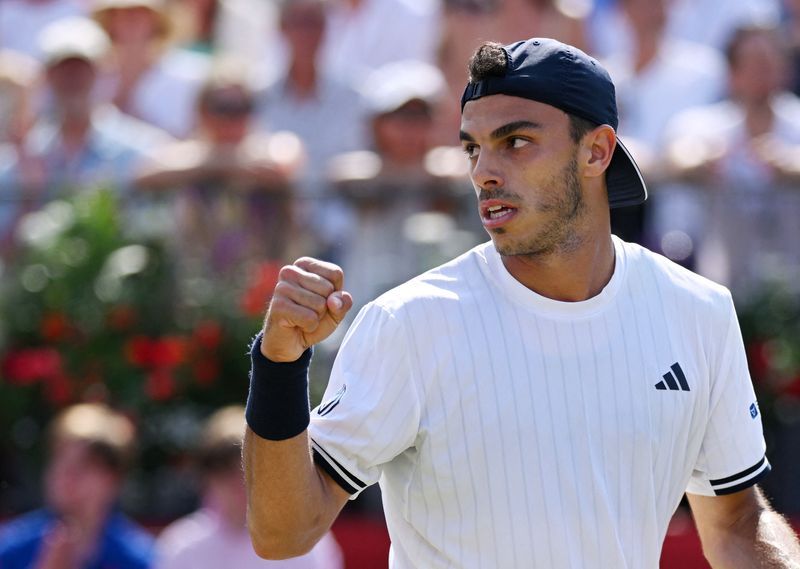
Argentine seventh seed Francisco Cerundolo has etched his name into Queen's Club history by capturing the tournament's most prestigious modern title, outlasting American Tommy Paul in a brutal three-hour-and-two-minute final on Sunday. The scoreline of 6-7(4) 6-4 6-3 belies the intensity of a match that pushed both competitors to their physical and mental limits on grass, a surface that demands precision, nerve, and unwavering concentration across multiple sets. For Cerundolo, the victory represents a watershed moment—his first ATP 500 title and confirmation that he belongs among tennis's elite competitors.
The path to glory tested Cerundolo's resilience in ways few championships do. Across his five matches at Queen's, he was forced into a deciding set four times, accumulating approximately twelve hours of court time in the process. This statistic alone underscores the tournament's competitive depth and Cerundolo's mental fortitude. The final itself became the longest in the venue's storied grass-court history, a distinction that speaks to how evenly matched these competitors were and how little separated victory from heartbreak.
Cerundolo squandered three match points while Paul served at 2-5 in the decisive third set, including one where the net cord betrayed him at a crucial moment. Such opportunities, when converted, typically seal matches decisively. The Argentine's inability to finish when positioned so advantageously would have haunted lesser competitors, yet he maintained composure and converted on his own serve in the subsequent game. The emotional release—collapsing to the court after striking a final smash—captured both the physical toll and psychological intensity of the encounter.
Making the achievement even more poignant, Cerundolo's father Alejandro witnessed the triumph from the stands. A man who has never travelled internationally due to aviophobia, Alejandro had only previously seen his son compete in Buenos Aires and Davis Cup matches. The timing was providential; he and Cerundolo's mother arrived just as their son built a commanding 5-3 advantage in the third set. "Coming from Argentina and winning my first ATP 500 at such an historical event, I could never imagine it," the champion reflected afterwards, his gratitude unmistakable. "I'm super happy and super proud of myself."
This victory extends Argentina's grass-court pedigree at Queen's, though it had been notably absent in recent decades at this particular tournament. Cerundolo becomes the nation's first champion at this venue, adding lustre to Argentina's substantial tennis legacy that includes numerous Grand Slam champions and notable grass-court specialists. The significance of this breakthrough cannot be overstated for a player whose career has often drawn comparisons to other emerging Latin American talents.
The quality of tennis throughout the final fluctuated according to the demands of the surface and the psychological ebbs and flows of a prolonged contest. Paul, the defending champion having won Queen's in 2024, commenced strongly by securing the opening set through a tiebreak after breaking Cerundolo's serve to love when the Argentine served for the set. Such aggressive tennis suggested Paul possessed the momentum and tactical clarity required to retain his title. The American held a service break in the second set, positioning himself well to control the match's trajectory.
Yet momentum in tennis remains perpetually volatile. Paul's intensity dipped perceptibly as the second set progressed, and Cerundolo capitalised with ruthless efficiency, clawing back the break and ultimately claiming the set to level the match. This reversal proved decisive psychologically, shifting confidence decisively towards the Argentine as they entered the final set. The third set became a contest of will and composure, with Cerundolo emerging as the fresher competitor despite the accumulated fatigue both players carried.
This represents Cerundolo's second grass-court title overall, his maiden coming at Eastbourne in 2023 when he also defeated Paul. That prior conquest indicated Cerundolo's suitability to grass-court tennis, a surface that exposes technical limitations and rewards aggressive serving and net play. The Eastbourne title hinted at potential; Queen's represents its fulfilment. The trajectory from promising talent to ATP 500 champion occurs gradually for most players, yet when it arrives, it often signals a player's entry into a new competitive tier.
Cerundolo's performance carries particular significance for Southeast Asian and regional readers examining emerging tennis talent globally. The rise of quality competitors from outside traditional tennis strongholds demonstrates how the sport continues globalising. His success challenges assumptions about which regions produce consistent challengers at elite levels. For Malaysian tennis observers particularly, Cerundolo's breakthrough offers instructive lessons about sustained development, mental resilience, and the importance of competing regularly at elevated levels to refine one's game.
The grass-court season remains crucial for shaping Wimbledon form, and Cerundolo's momentum heading into the Championships cannot be understated. Players rarely peak immediately before a Grand Slam; conversely, they enter with renewed confidence and understanding of their capabilities. Cerundolo must now navigate the peculiar challenge of maintaining form without over-racing, as multiple tournaments in quick succession on grass can extract physical penalties that affect performance when it matters most.
Looking forward, this Queen's triumph establishes Cerundolo among the tournament's recent champions worthy of serious consideration for future editions. The mental strength demonstrated in converting his fourth match point after squandering three prior opportunities epitomises championship tennis. Such pressure moments separate contenders from champions, and Cerundolo has now demonstrated he belongs in the latter category at least at ATP 500 level.

