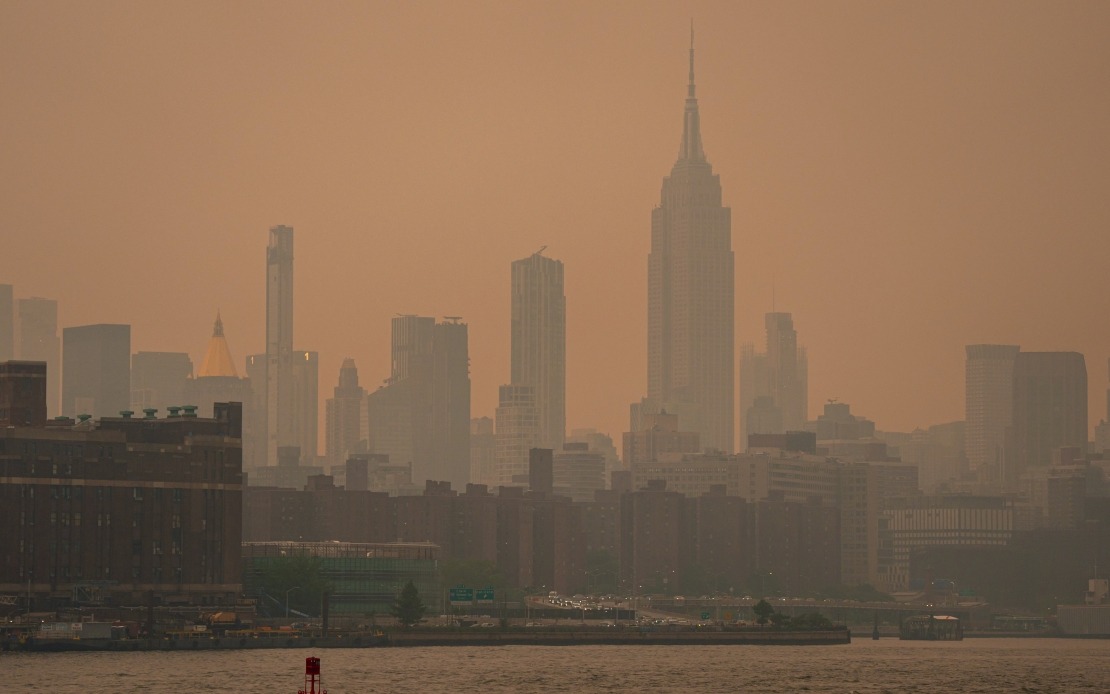
Mexican President Claudia Sheinbaum faced unexpected travel complications en route to the World Cup final in East Rutherford, New Jersey, as smoke from Canadian wildfires enveloped New York, significantly degrading air quality across the northeastern United States. Her originally scheduled flight from Cancún to New York encountered severe disruption, first facing a two-hour delay on Saturday before ultimately being cancelled due to hazardous atmospheric conditions caused by transboundary smoke drifting southward from major fires burning across Canadian provinces.
The disruption highlighted the broader environmental and meteorological challenges that cross-border wildfire smoke poses to regional travel and public health. The smoke blanketing the New York metropolitan area represented one of the more visible consequences of the Canadian wildfire season, affecting not only civilian air traffic but also the travel arrangements of a high-ranking government official. Rather than delay her attendance further, Mexico's government opted to deploy alternative transportation, arranging for Sheinbaum to fly to New York late Sunday morning using an aircraft operated by Mexico's Defence Ministry, ensuring her timely arrival at the sporting event.
The invitation itself carried diplomatic significance, particularly given the complex relationship between Mexico and the United States. Donald Trump, serving as host nation representative, extended a surprise invitation to Sheinbaum to attend the final alongside Canadian Prime Minister Mark Carney, positioning the event as a trilateral North American gathering. The gesture, while courteous on the surface, reflected the intricate diplomatic choreography required when major trade and security tensions simmer between neighbouring nations.
Trade disputes and border security concerns have created considerable friction between Mexico City and Washington in recent years, making high-level political engagement both necessary and potentially contentious. The World Cup final presented a rare opportunity for informal engagement between the leaders of the three host nations, away from the more formal structures of bilateral negotiations. Sheinbaum and Trump had met previously only once, during the tournament's draw ceremony held in Washington the previous December, suggesting that face-to-face interactions between the two leaders remained relatively limited despite the significance of US-Mexico relations.
The World Cup's trilateral hosting arrangement across Mexico, Canada, and the United States carried its own political implications. The participation of all three national leaders at the final underscored the tournament's role as a unifying force, even amid underlying tensions. For Mexico, attendance at the event demonstrated commitment to the shared North American hosting arrangement and signalled willingness to engage diplomatically with US leadership, notwithstanding ongoing disputes over trade policy and security cooperation.
The wildfire smoke phenomenon affecting Sheinbaum's travel also illustrated how climate-related environmental events increasingly impact diplomatic schedules and international travel patterns. The smoke, originating from Canadian wildfires hundreds of kilometres away, crossed international borders and altered the trajectory of high-level political movement. Such disruptions are likely to become more frequent as climate patterns shift, potentially affecting the reliability of transcontinental air travel during peak wildfire seasons.
From a Mexican perspective, the incident demonstrated the interconnectedness of North American environmental challenges. Smoke originating in Canada affected Mexico's ability to move its president through the United States, illustrating how environmental issues transcend borders and administrative jurisdictions. This reality underscores the need for enhanced regional cooperation on environmental monitoring, wildfire management, and air quality coordination across the three nations.
Sheinbaum's eventual arrival via Defence Ministry aircraft ensured Mexico maintained its presence at the sporting spectacle, avoiding any diplomatic implications that a cancelled attendance might have carried. The alternative arrangement demonstrated the flexibility and resources available to presidential travel operations when standard commercial routes encounter unexpected obstacles. The use of military transport for civilian leadership travel, while unusual under normal circumstances, reflected the extraordinary circumstances created by the environmental disruption.
The World Cup final itself served as a backdrop to these broader political and environmental narratives. Beyond the sporting competition, the event provided a venue for leaders of the three host nations to interact informally and assess their working relationships. For Sheinbaum, attendance represented an affirmation of Mexico's partnership in the continental hosting arrangement and her commitment to engagement with regional partners despite prevailing tensions.

