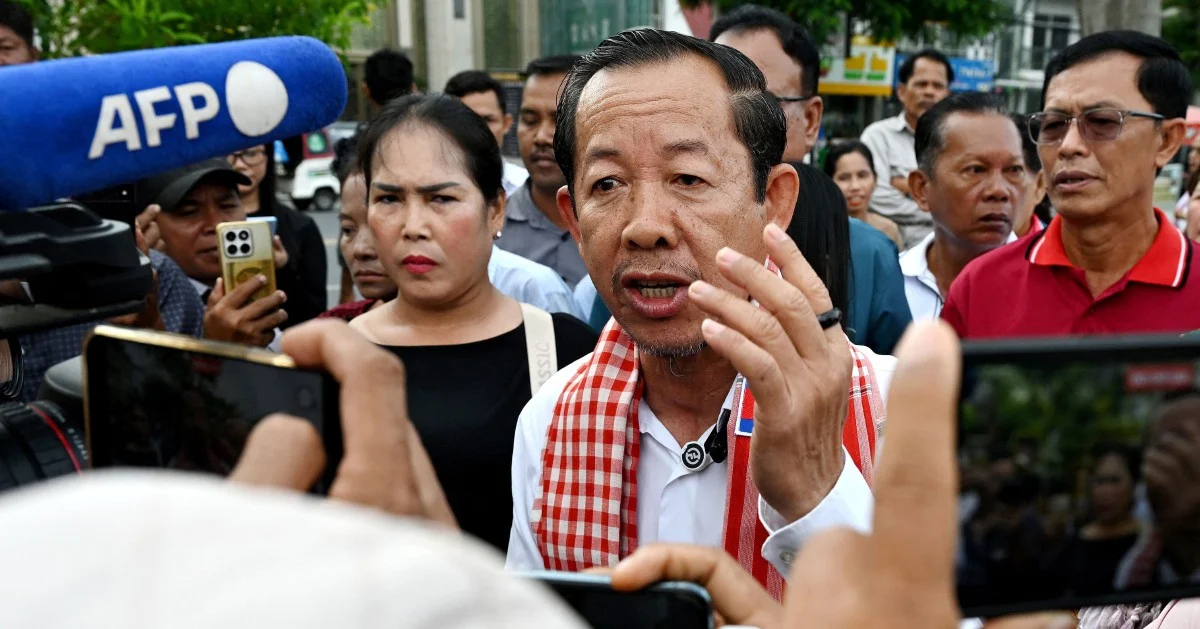
Cambodia's highest judicial body has delivered a partial reprieve to prominent opposition figure Rong Chhun by suspending a custodial sentence against him, yet simultaneously reinforced restrictions that bar him from electoral participation. The Supreme Court's decision, announced through his lawyer on Friday, crystallises Cambodia's complex legal landscape where political opponents face substantial obstacles to regaining their electoral voice, even when facing reduced penalties for underlying allegations.
The suspended prison term represents a modest procedural victory for Rong Chhun's legal team, suggesting that Cambodia's apex court found sufficient grounds to pause enforcement of the incarceration order. However, the court's simultaneous affirmation of the electoral prohibition reveals the depth of administrative restrictions placed upon him and underscores how judicial systems can be deployed to constrain political opposition beyond traditional sentencing mechanisms. The dual outcome reflects a pattern observed across Southeast Asia, where governments have increasingly utilised electoral disqualifications and candidacy bans as tools to reshape political competition without necessarily resorting to extended imprisonment.
For Malaysian observers monitoring regional democratic trends, Cambodia's approach deserves scrutiny. While Malaysia's own electoral ecosystem has faced criticism regarding gerrymandering and party funding advantages, Cambodia's explicit use of judicial mechanisms to prevent opposition candidates from contesting elections represents a more direct intervention in the mechanics of democratic participation. The maintenance of Rong Chhun's political ban, independent of sentencing outcomes, suggests that Cambodian authorities view electoral eligibility as a distinct governance tool rather than a consequence flowing naturally from criminal conviction.
Rong Chhun's profile within Cambodian politics extends beyond his parliamentary participation. His involvement in activism and political organising has made him a focal point for international observers tracking civil society constraints in Southeast Asia. The combination of imprisonment recommendations and electoral bars creates a chilling effect that extends beyond the individual politician to encompass broader questions about the viability of organised opposition activity in Cambodia. For regional analysts, the case demonstrates how multiple legal mechanisms—criminal statutes, electoral commissions, and constitutional provisions—can be coordinated to restrict political space even when individual components may face occasional judicial review.
The timing and nature of the Supreme Court's decision warrant contextual consideration. Cambodia's political system has undergone significant consolidation over recent decades, with the ruling Cambodian People's Party maintaining consistent electoral dominance. In this environment, opposition figures represent threats to established governance patterns, and restrictions on their political activities serve institutional preservation functions. Rong Chhun's continued exclusion from elections, despite his suspended sentence, illustrates how systems can maintain substantive political constraints while offering minor concessions on procedural matters.
Southeast Asian democracies and quasi-democracies occupy a spectrum regarding opposition restrictions, and Cambodia's position on that spectrum carries implications for regional democratic norms. Thailand's multiple constitutions and Myanmar's military interventions represent more overtly disruptive approaches, while Indonesia and Malaysia have generally preserved electoral systems allowing opposition participation, though with varying degrees of institutional fairness. Cambodia's approach—using legal mechanisms to surgically remove opposition candidates from electoral competition—represents an intermediate model that preserves formal democratic structures while substantially constraining their competitive function.
For international observers and regional civil society networks, the implications of Cambodia's judicial decisions extend beyond electoral mathematics. Political bans create long-term institutional memory that shapes opposition party capabilities and intergenerational leadership development. When experienced politicians cannot compete, opposition movements lose seasoned candidates and institutional knowledge, potentially weakening their future capacity to mobilise constituencies or develop sophisticated policy alternatives. Rong Chhun's barring from elections therefore represents not merely an individual setback but a cumulative constraint on Cambodia's opposition ecosystem.
The Supreme Court's handling of the sentence suspension versus electoral ban preservation also reflects deeper questions about judicial independence and institutional autonomy. If the court determined that imprisonment was sufficiently unjustified to suspend, the logic might suggest that underlying allegations were questionable or procedurally problematic. Yet the simultaneous upholding of political disqualification could indicate that electoral restrictions rest on separate constitutional or statutory grounds, potentially insulating them from challenge through standard criminal appellate processes. This legal architecture creates barriers that opposition politicians find difficult to overcome through conventional litigation.
For Malaysia's political stakeholders and civil society observers, the Cambodian precedent offers instructive lessons about how political systems can evolve toward constraint without dramatic ruptures or international intervention. Cambodia's approach demonstrates how institutional mechanisms—carefully layered through electoral law, party registration requirements, and judicial interpretation—can substantially reshape political competition trajectories. As Malaysian debates continue regarding electoral reform and democratic deepening, comparative perspective on neighbouring systems' restrictive mechanisms becomes increasingly valuable.
Looking forward, Rong Chhun's case will likely influence how Cambodian opposition movements mobilise around electoral participation and political strategy. If electoral bans prove immovable through legal challenge, opposition forces may redirect energy toward civil society organising, advocacy networking, and constituency building outside formal electoral frameworks. For regional observers, Cambodia's trajectory serves as a cautionary example of how democracies can experience gradual constraint through accumulated legal decisions rather than dramatic constitutional collapse, creating governance environments where formal institutions persist while substantive political participation narrows.

