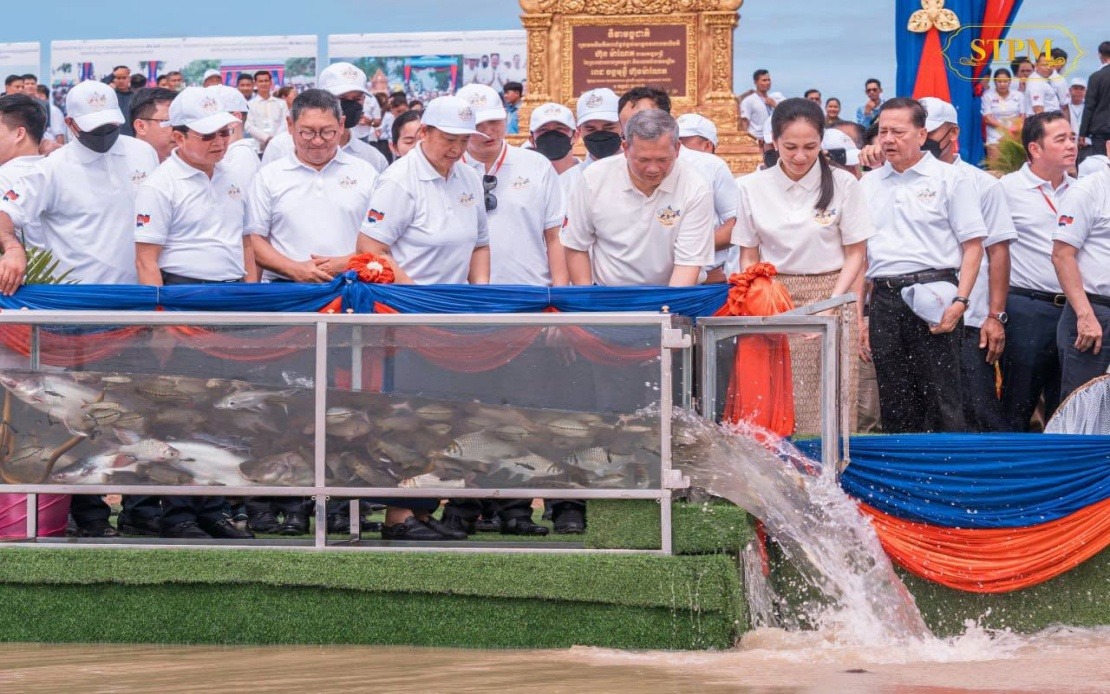
Cambodia's Prime Minister Hun Manet has moved decisively to protect the nation's fish stocks by directing authorities to crack down on illegal fishing operations in key spawning areas. Delivering remarks at the National Fish Day celebration held in Svay Rieng Province, Hun Manet underscored the urgency of safeguarding aquatic ecosystems, which remain fundamental to Cambodia's food security and the survival of thousands of fishing communities throughout the Kingdom.
The strategic importance of this initiative reflects a growing recognition across Southeast Asia that marine and freshwater resources face unprecedented pressure from both criminal exploitation and unsustainable fishing practices. Cambodia's fisheries sector has long been vulnerable to destructive techniques that compromise breeding cycles and deplete fish populations, threatening the economic foundation of rural populations who depend entirely on these resources for survival. The Prime Minister's intervention signals a shift toward more assertive governmental action, moving beyond rhetoric to concrete operational measures.
Central to Hun Manet's strategy is the mobilization of military units stationed around Tonle Sap, Southeast Asia's largest freshwater lake and a critical ecosystem for regional fish reproduction. Over the preceding two years, these armed forces have been engaged in combating natural resource crimes both on land and within territorial waters. However, Hun Manet revealed an important policy constraint: the government has previously relied heavily on military personnel to enforce environmental and fisheries regulations because the country lacks sufficient specialized law enforcement officers trained in natural resource crime investigation and prosecution. This capacity shortfall has forced Cambodia to deploy scarce military resources for civil law enforcement duties, straining defence budgets and diverting troops from border security responsibilities.
Acknowledging this systemic weakness, Hun Manet indicated that the government intends to reduce its dependence on military enforcement by building institutional capacity within civilian agencies. This transition reflects broader governance challenges facing Cambodia and neighbouring countries, where inadequate investment in specialized environmental enforcement creates opportunities for organized criminal networks to exploit aquatic resources with relative impunity. The Prime Minister emphasized that while military operations will continue, the long-term solution requires developing dedicated, professional law enforcement cadres capable of detecting and prosecuting fisheries crimes without requiring military intervention.
A particularly damaging practice that drew Hun Manet's direct condemnation is large-scale clam dredging, an activity that destroys aquatic habitats, destabilizes riverbeds, and eliminates breeding grounds for commercially important fish species. The Prime Minister ordered an immediate halt to such operations, recognizing that the short-term profits accrued by dredging operators impose catastrophic long-term costs on fishing communities and national food security. This reflects an emerging consensus in the region that destructive fishing technologies must be prohibited regardless of industrial pressures, as their ecological consequences far exceed any economic benefits.
Hun Manet's characterization of agriculture and fisheries as respectively "the nation's stomach" and "source of protein" encapsulates Cambodia's structural dependence on these sectors for basic nutrition and survival. Unlike more diversified economies, Cambodia cannot afford to sacrifice fisheries sustainability for short-term commercial gain. The aquatic sector employs hundreds of thousands of people directly and supports millions more through food chains and rural commerce. Degradation of this resource base would trigger not merely economic hardship but potential humanitarian crisis in rural provinces where alternative livelihoods are virtually nonexistent.
The timing of these directives during the National Fish Day celebration demonstrates governmental commitment to prioritizing aquatic resource protection at the highest political level. By framing enforcement against illegal fishing as a national priority worthy of prime ministerial attention, Hun Manet signals to both domestic and international audiences that Cambodia takes environmental stewardship seriously. This message carries particular significance given regional concerns about transnational fishing operations and foreign vessels exploiting Cambodian waters, issues that have strained diplomatic relations throughout Southeast Asia.
Protecting fish during breeding seasons emerged as a specific operational priority, as spawning periods represent critical windows when populations are most vulnerable to intensive fishing pressure. Strategic enforcement during these seasons can dramatically improve long-term stock recovery and ecosystem stability. However, implementing such seasonal protections requires sustained surveillance capacity and rapid response capabilities, resources that remain constrained in Cambodia despite recent improvements in environmental governance.
As a tangible demonstration of commitment to fisheries restoration, authorities released 1.5 million fish and other aquatic species into the Vai Ko River in Svay Rieng during the National Fish Day celebrations. These restocking operations, while symbolically important and potentially valuable for recovering depleted populations, require complementary enforcement to prevent poaching of released stock. Without effective protection against illegal fishing, restocking initiatives yield minimal long-term benefit, as introduced fish populations are simply harvested by criminal operators. This underscores why Hun Manet's enforcement directive is essential for realizing the benefits of restoration activities.
For Malaysian and broader Southeast Asian observers, Cambodia's struggle against illegal fishing and resource degradation offers instructive parallels. The region's shared aquatic ecosystems, migratory fish species, and transnational criminal networks mean that Cambodian enforcement challenges extend beyond its borders. Illegal fishing vessels operating from or supplied by neighbouring countries compound Cambodia's enforcement burden, requiring regional cooperation mechanisms that remain underdeveloped. Hun Manet's unilateral crackdown, while necessary, ultimately cannot succeed without coordinated regional action targeting the international criminal networks profiting from unsustainable extraction.
The structural challenge facing Cambodia—balancing immediate livelihood protection for rural fishing communities against ecosystem preservation for long-term sustainability—mirrors dilemmas confronting fisheries managers throughout Southeast Asia. As fish populations decline due to cumulative overfishing pressure, poverty among fishing communities intensifies, creating political pressure to relax enforcement. Hun Manet's determination to resist this pressure while simultaneously building civilian enforcement capacity represents a potentially important model for regional peers struggling with similar governance trade-offs.

