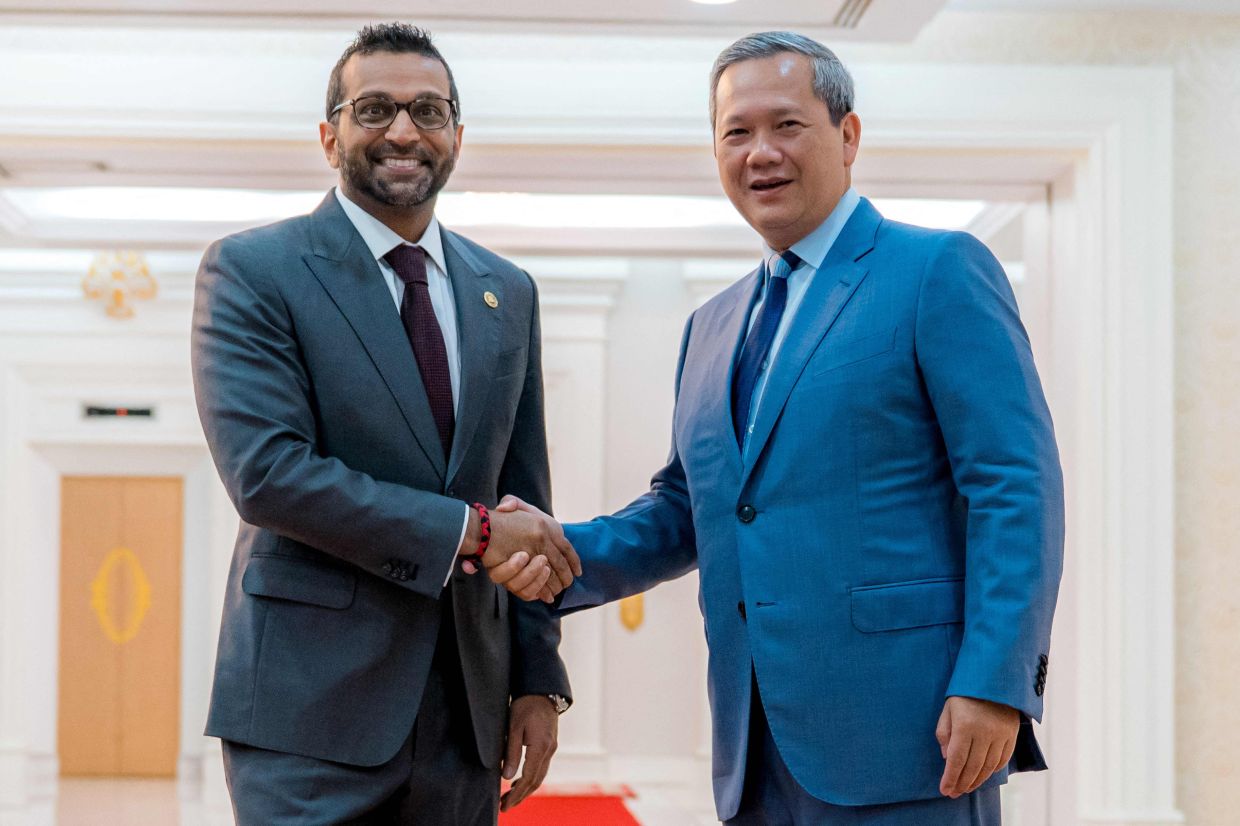
Cambodian Prime Minister Hun Manet has vowed to intensify crackdown efforts against transnational online scam networks operating throughout Southeast Asia, acknowledging that criminal enterprises are becoming increasingly difficult to dismantle as they adapt by restructuring into smaller, geographically dispersed units. Speaking this week to Bloomberg Television's Avril Hong, Hun Manet indicated that authorities have already dismantled over 670 illegal scam operations while simultaneously expanding collaboration with international law enforcement agencies, particularly highlighting a recent engagement with US Federal Bureau of Investigation Director Kash Patel.
The Cambodian government's commitment reflects growing international pressure on a region that has become synonymous with online fraud operations since the pandemic. Cambodia, Myanmar and Laos have emerged as principal hubs for sophisticated criminal enterprises that generate losses measured in billions of dollars annually. Hun Manet sought to position his administration as taking decisive action, declaring that "We will make Cambodia become an area that's not easy or worth to stay for scams," during remarks made Thursday at a televised interview.
Yet the prime minister's own assessment reveals the fundamental challenge facing regional authorities. As technology has matured and law enforcement has tightened around conventional scam compound locations, criminal networks have evolved their operational structure. "It's become more complex," Hun Manet acknowledged. "Technology has allowed them to work in a decentralised manner." This shift toward distributed operations makes traditional enforcement approaches—which rely on identifying and targeting physical locations—increasingly ineffective.
Hun Manet's rise to the premiership in August 2023 represented a significant transition in Cambodian politics, succeeding his father Hun Sen, who had dominated the country's political landscape for nearly four decades. The 48-year-old leader, a West Point graduate, has cultivated an image of technocratic governance while preserving the authoritarian structures that have enabled the Cambodian People's Party to maintain uninterrupted control since the overthrow of the Khmer Rouge in 1979. His father continues to exercise considerable influence as President of the Senate and party chairman, complicating assessments of how autonomous the younger Hun Manet's policy decisions truly are.
International scrutiny of Cambodia's scam ecosystem has intensified from multiple directions simultaneously. Both Washington and Beijing have directed pressure toward Phnom Penh, while human rights organizations and United Nations bodies have documented extensive links between scam compounds and human trafficking networks. These investigations have identified connections to elements within Cambodia's political and business establishment, suggesting that criminality at this scale could not persist without at least tacit support from powerful figures.
The US government has imposed sanctions against prominent Cambodian senators Ly Yong Phat and Kok An, citing their alleged involvement in orchestrating human trafficking, forced labor and cyber scam networks that specifically targeted American victims. Hun Manet characterised these designations as ongoing legal disputes being contested through judicial channels. He simultaneously claimed that state agencies were actively investigating officials implicated in scam operations, pointing to the dismissal and prosecution of military generals and provincial governors as evidence of governmental commitment to accountability.
Yet skepticism about the scope and seriousness of these enforcement actions remains widespread among international observers and human rights advocates. The United Nations Office on Drugs and Crime released a report this week estimating that combined losses from online scams across East Asia, Southeast Asia, Australia and New Zealand totalled approximately US$114 billion in the previous year alone. This staggering figure underscores the scale of the problem and raises questions about whether the 670 operations shut down thus far represent meaningful progress or merely cosmetic enforcement that creates an appearance of action without substantively disrupting criminal networks.
Beyond cyber crime, Hun Manet also addressed the unresolved border tensions with Thailand that have displaced over 20,000 civilians living in frontier provinces. A ceasefire has held since conflict erupted a year ago, though Hun Manet characterised the situation as fundamentally unstable. "It remains fragile because thousands of troops are still stationed face-to-face along the border," he stated, advocating for Bangkok to resume boundary demarcation discussions as essential to enabling displaced populations to return home.
The prime minister rejected Thai justifications for delaying land-border negotiations, specifically countering Bangkok's assertion that Cambodia's pursuit of UN maritime conciliation proceedings justified halting terrestrial demarcation talks. Hun Manet characterized this rationale as "inaccurate and a little bit unfair," emphasizing that land and maritime boundary matters remain legally distinct under bilateral frameworks governing the two nations. His insistence that these issues should progress separately reflects Cambodia's broader strategy of compartmentalizing disputes to prevent one unresolved matter from stalling progress on others.
For Malaysian readers, developments in Cambodia warrant attention for several interconnected reasons. Southeast Asian nations increasingly recognize that transnational criminal networks operating in one jurisdiction inevitably affect others through victim recruitment, money laundering channels and cross-border human trafficking pipelines. Malaysia itself has experienced cases where residents fell victim to scams coordinated from Cambodia, Myanmar or Laos, making regional enforcement cooperation essential. Moreover, the evolving sophistication of scam operations—shifting from centralized compounds to decentralized digital networks—suggests that Malaysian authorities must constantly adapt their investigative and prosecutorial approaches.
The broader implications extend to questions of governance and institutional capacity across Southeast Asia. If Cambodia struggles to effectively combat scam networks despite international pressure and high-level political commitments, the challenge for other regional governments becomes apparent. The fragmentation of criminal operations into smaller, technologically distributed units requires coordinated intelligence sharing, specialized cyber investigation capabilities, and international legal frameworks that remain inadequately developed. Hun Manet's acknowledgment that organized crime has become more complex implicitly admits that traditional enforcement methods require fundamental reimagining.
Looking forward, Hun Manet's statements suggest Cambodia intends to maintain a posture of active cooperation with international partners while preserving domestic political autonomy. The US-Cambodia intelligence sharing and FBI engagement represent meaningful developments, yet ultimate effectiveness will depend on whether Cambodian institutions genuinely prioritize disrupting scam operations or merely project commitment to satisfy international critics. For regional observers and potential victims across Southeast Asia, the gap between stated intentions and demonstrated results remains the critical measure of progress.

