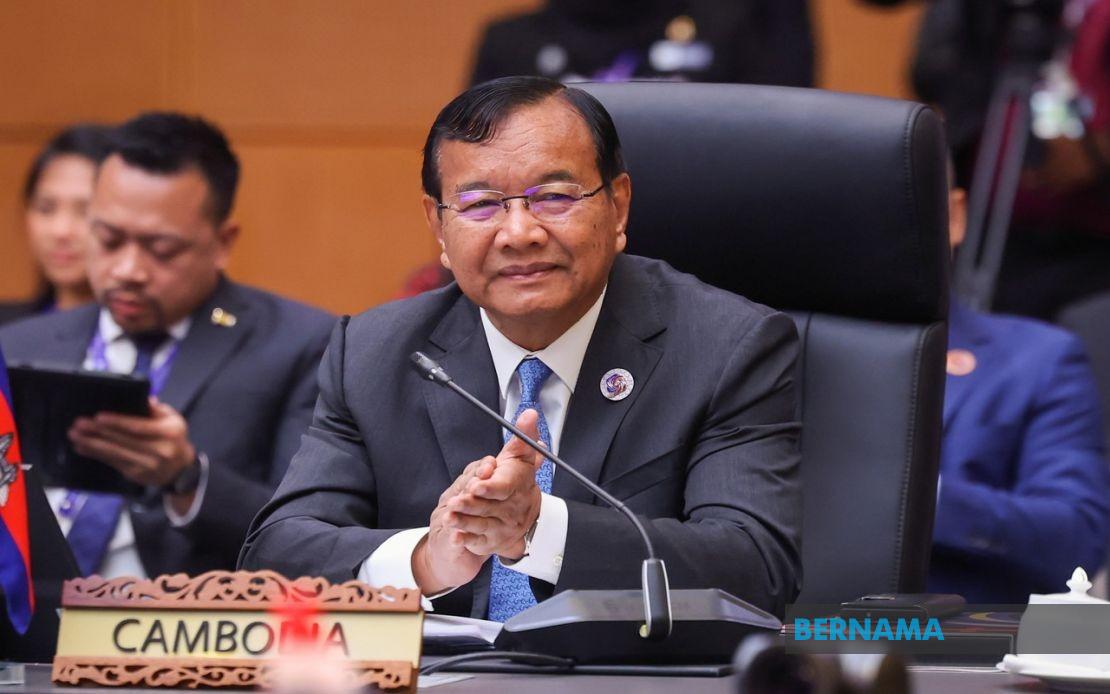
Cambodian Deputy Prime Minister and Minister of Foreign Affairs and International Cooperation Prak Sokhonn touched down at Kuala Lumpur International Airport on August 3 for a two-day official visit aimed at revitalising the longstanding partnership between Southeast Asia's two nations. His arrival at KLIA Terminal 1 at 1.48 pm marks a significant diplomatic engagement at a time when Malaysia and Cambodia are looking to deepen their economic and political cooperation across multiple sectors.
The timing of Sokhonn's visit comes as both countries are experiencing strengthened commercial relations. Malaysia and Cambodia have demonstrated remarkable trade momentum in 2025, with bilateral commerce expanding by 27.4 per cent year-on-year to reach RM5 billion, equivalent to USD1.17 billion. This robust growth underscores the growing commercial dynamism between the two nations and suggests that economic fundamentals are supporting deeper engagement at the ministerial level.
Beyond trade flows, Malaysia has established itself as a major source of foreign direct investment for Cambodia. As of 2024, Malaysia's cumulative investments in the Kingdom totalled USD3.20 billion across 162 registered projects, positioning Malaysia as Cambodia's third-largest foreign investor. This substantial economic presence reflects the confidence Malaysian enterprises have in Cambodia's investment climate and demonstrates the breadth of commercial ties that now undergird the diplomatic relationship.
Sokhonn was welcomed at the airport by Cambodian Ambassador to Malaysia Ouk Chandara and Datuk Rozainor Ramli, the Malaysian Government's chief ceremony officer. The formal reception set the tone for a visit that will involve high-level political engagement and technical discussions on matters affecting both nations. The deputy prime minister's first engagement will be a courtesy call on Prime Minister Datuk Seri Anwar Ibrahim, an important protocol courtesy that signals the priority Malaysia places on the relationship.
The centrepiece of Sokhonn's visit will be the 3rd Meeting of the Cambodia-Malaysia Joint Commission for Bilateral Cooperation, scheduled for August 4 in Kuala Lumpur. This institutional mechanism has proven instrumental in formalising cooperation frameworks and reviewing the implementation of previously agreed commitments. The third meeting will comprehensively assess progress on implementing the minutes from the second JCBC session and evaluate the status of bilateral agreements concluded between the two capitals.
During his stay, Sokhonn will engage in bilateral talks with Malaysia's Foreign Minister Datuk Seri Mohamad Hasan. These discussions are expected to cover a broad agenda encompassing trade facilitation, investment promotion, regional security concerns, and cooperation within multilateral forums such as the Association of Southeast Asian Nations. The bilateral channel provides an opportunity to discuss issues that may require political attention beyond the scope of the JCBC.
For Malaysia, the visit represents an opportunity to consolidate its position as a trusted economic and political partner for Cambodia. The Cambodian government's decision to dispatch its deputy prime minister underscores the country's commitment to strengthening ties with its neighbour and suggests that Phnom Penh views Malaysia as a key actor in its regional diplomacy and economic strategy.
The JCBC mechanism reflects the institutionalisation of the Malaysia-Cambodia relationship, moving beyond ad hoc diplomatic exchanges to structured, regular engagement across government ministries and agencies. Such institutional frameworks are essential for developing comprehensive bilateral policies that address shared challenges and unlock mutual opportunities in an increasingly integrated Southeast Asian region.
From Malaysia's perspective, deeper ties with Cambodia also advance the nation's broader regional ambitions. As ASEAN seeks to maintain relevance and cohesion amid great power competition and global economic shifts, bilateral relationships that demonstrate mutual commitment and shared interests reinforce the bloc's internal strength. Malaysia's investment presence in Cambodia and Cambodia's corresponding openness to Malaysian business interests represent concrete manifestations of regional integration.
The visit also occurs against the backdrop of Cambodia's development trajectory. As the country pursues industrialisation and infrastructure expansion, Malaysian investors and companies stand to benefit from access to opportunities across manufacturing, telecommunications, finance, and services sectors. For Cambodia, Malaysian investments bring capital, technology transfer, and employment, contributing to its development objectives.
Looking forward, the JCBC meeting will likely identify new areas for cooperation and set timelines for implementing fresh initiatives. Given the economic momentum both nations are experiencing, discussions may extend to emerging areas such as digital economy collaboration, green energy partnerships, and human resource development.
The visit underscores a broader pattern in Southeast Asian diplomacy where bilateral relationships are being deepened through high-level engagement and institutional mechanisms even as countries navigate complex geopolitical environments. For Malaysia and Cambodia, this approach has yielded tangible results reflected in trade growth and investment flows that benefit both populations.

