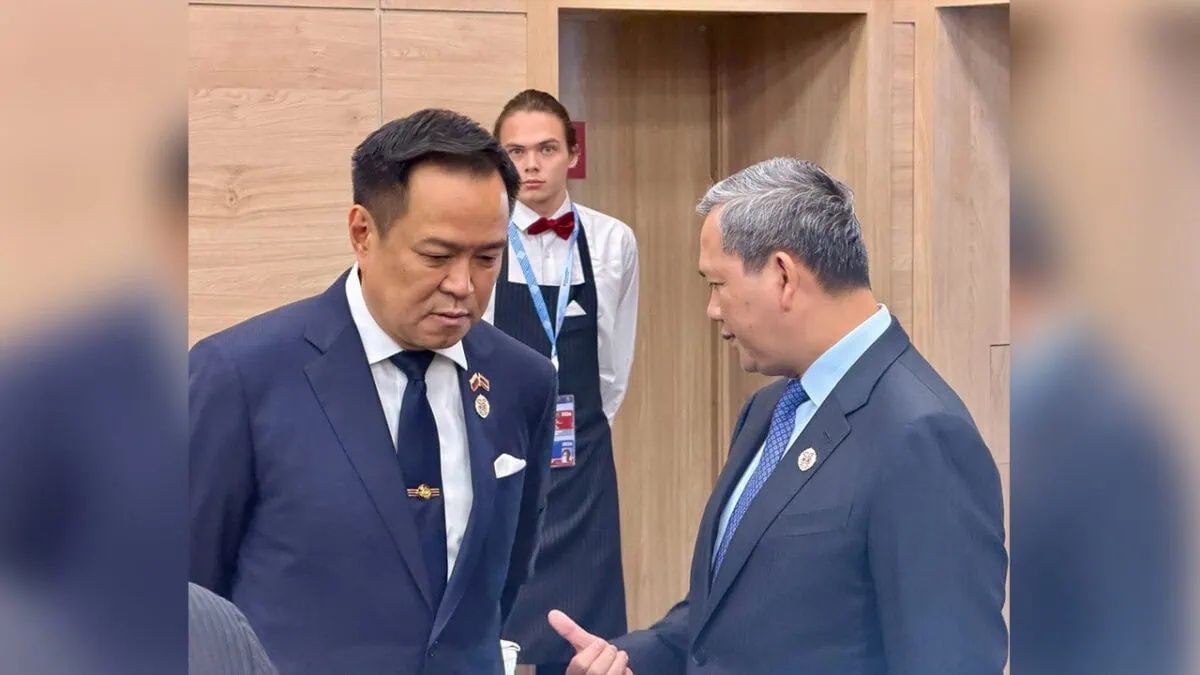
Cambodian Prime Minister Hun Manet has pressed Thailand to take concrete steps toward resolving their protracted boundary disputes by appointing a new head of the Joint Boundary Commission and proceeding with overdue border survey and demarcation activities. The appeal emerged from an impromptu conversation between Manet and Thai counterpart Anutin Charnvirakul during an Asean-Russia diplomatic engagement in Kazan, underscoring the persistence of territorial issues that have simmered between the two neighbours for years despite periodic diplomatic efforts to manage them.
In remarks posted on social media following the encounter, Manet reaffirmed Cambodia's stated position that it remains wedded to peaceful settlement of border questions and will continue working through established legal frameworks and diplomatic channels. He specifically referenced Cambodia's ongoing participation in compulsory conciliation procedures under the UN Convention on the Law of the Sea, a mechanism both nations have accepted as a means of addressing maritime boundary disagreements. For terrestrial boundaries, Cambodia has consistently signalled preference for resolving matters through direct bilateral negotiations conducted via the Joint Boundary Commission, operating within the parameters of existing bilateral agreements.
Manet's public statement carried a notably pointed request directed at Bangkok. He urged Thailand to complete the process of appointing its representative to head the Joint Boundary Commission and to commence joint survey operations and formal demarcation procedures without further delay. His reference to Point Three of a Joint Statement dated December 27, 2025, suggests there is an agreed framework already in place specifying expected timelines and procedural steps—yet apparent Thai inaction in appointing a commission chief represents a stumbling block preventing the mechanism from functioning effectively. The Cambodian premier framed this as essential to unlocking progress on land border matters that have remained unresolved across decades.
Thailand's account of the Kazan conversation differed in emphasis while conveying broadly similar substance. Prime Minister Anutin characterised the exchange as hurried and informal, noting that time constraints prevented extended dialogue. He colourfully described the meeting as amounting to leaders "pulling each other aside by the elbow" during the margins of the broader Russia-Asean programme, indicating the conversation was brief and unscheduled rather than a planned bilateral summit. This framing may have been intended to downplay any suggestion that Thailand faces external pressure regarding border matters or that the encounter represented a formal diplomatic démarche from Cambodia.
Despite Anutin's effort to minimise the significance of their interaction, he acknowledged that both leaders reaffirmed their mutual desire to avoid conflict and exchanged perspectives on available dispute resolution mechanisms. The Thai premier indicated Bangkok remains committed to the constellation of frameworks governing bilateral relations, including not only the Joint Boundary Commission and the UN maritime convention but also the General Border Committee. This layered institutional approach reflects the complexity of managing boundaries that encompass both land and sea demarcation challenges, each requiring different legal and diplomatic tools.
When pressed by journalists about whether the two leaders had discussed reopening land border crossing points, Anutin responded with some levity, effectively declining to engage seriously with the question. He remarked that he had deliberately avoided raising the matter, suggesting that any proposal to reopen checkpoints would provoke domestic political backlash from Thai constituencies. This candid observation reveals the domestic political sensitivities surrounding border management in Thailand, where sections of the public may view concessions on boundary matters as capitulation or weakness. The remark underscores how bilateral territorial issues become entangled with domestic politics in ways that constrain diplomatic flexibility.
The divergence in tone and emphasis between the two leaders' public statements, while not contradicting one another fundamentally, hints at differing perspectives on the urgency and direction of border negotiations. Manet's more direct call for Thai action on the Joint Boundary Commission chief appointment signals Cambodia's frustration with perceived delays, whereas Anutin's minimisation of the conversation's significance may reflect either genuine logistical constraints on Thailand's capacity to expedite the process or reluctance to appear to be capitulating to external pressure. Both framings, however, are compatible with a shared commitment to managing disputes peacefully rather than through confrontation.
Cambodia's overall approach to the border issue reflects strategic pragmatism shaped by asymmetrical power dynamics in the region. By simultaneously pursuing maritime conciliation under UNCLOS while maintaining that land boundaries should be resolved through the Joint Boundary Commission, Phnom Penh has adopted a dual-track strategy that leverages different legal frameworks suited to different geographic contexts. The UNCLOS conciliation track offers Cambodia recourse to international legal mechanisms when bilateral negotiation stalls, whilst the bilateral commission approach preserves Cambodia's agency in determining outcomes on land frontiers where its interests may diverge from those of larger neighbours.
The persistence of unresolved boundary questions between Cambodia and Thailand reflects broader regional patterns in which competing historical claims, strategic geography, and domestic political considerations make border demarcation technically and diplomatically complex. The fact that both nations maintain the institutional apparatus for negotiation—multiple committees and frameworks—alongside periodic high-level political engagement suggests recognition that sustained dialogue remains preferable to confrontation. Yet the apparent slowness of progress, evidenced by Manet's need to press for action on such a basic matter as appointing a commission chief, points to deeper impediments beyond mere bureaucratic delay.
For observers across Southeast Asia, including Malaysia, the Cambodia-Thailand border situation bears watching as a test case of whether regional mechanisms and bilateral diplomacy can successfully navigate territorial disputes without escalation. Malaysia itself navigates boundary questions with neighbouring states and has historical experience with compulsory conciliation and international frameworks for dispute settlement. The Cambodian and Thai experience with the Joint Boundary Commission, if successfully revitalised through appointment of leadership and resumption of technical work, could offer instructive lessons for managing similar challenges elsewhere in the region. Conversely, persistent inaction by either party would suggest that political and domestic constraints continue to outweigh the benefits of progress on boundary matters.
The Kazan encounter, while characterised by both sides as a brief informal exchange, therefore assumes significance as an indicator of political will to move forward on issues that have considerable domestic resonance in both nations. Cambodia's public appeal for Thailand to accelerate the process signals that patience may be wearing thin, and that Phnom Penh expects tangible movement within a defined timeframe. Whether Thailand responds by appointing the necessary Joint Boundary Commission chief and commencing survey work will become a measure of whether diplomatic frameworks genuinely function as mechanisms for resolving disputes or whether they serve primarily as holding patterns that defer difficult decisions indefinitely.

