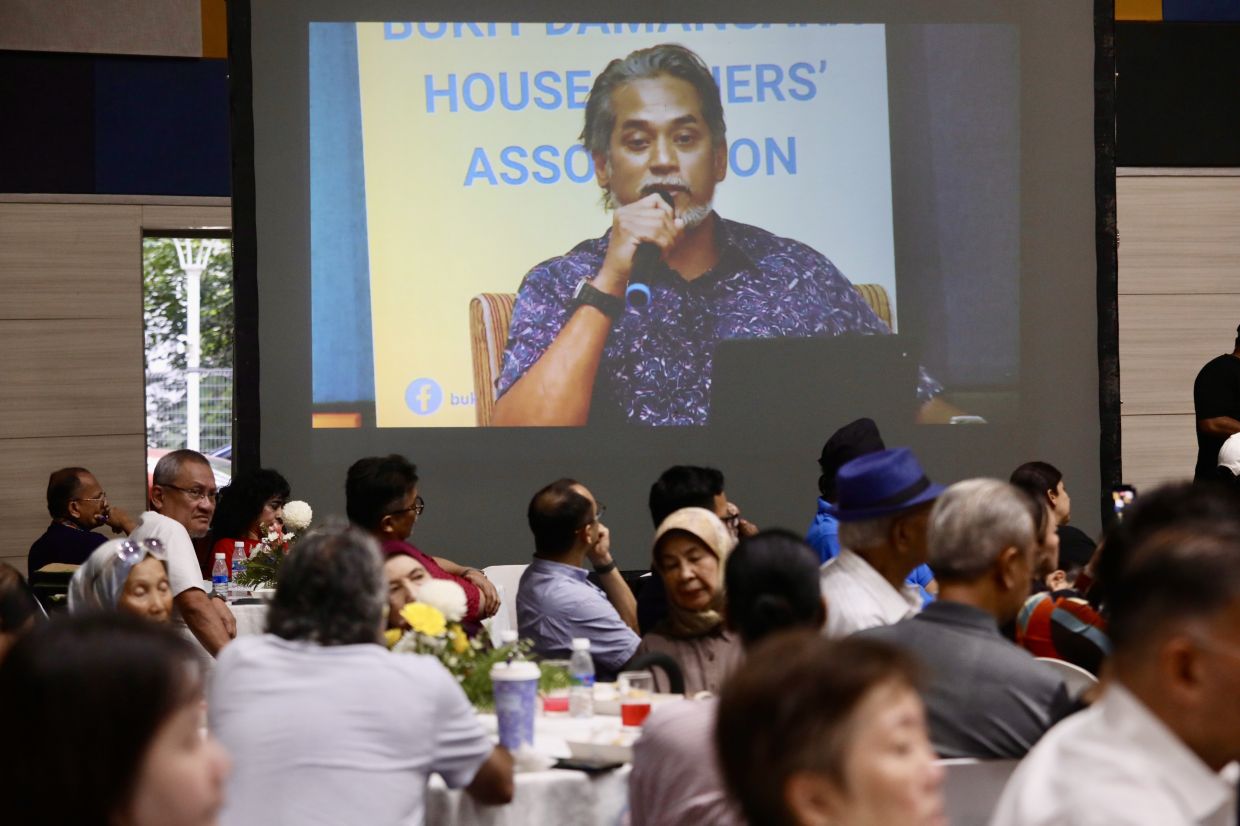
The Bukit Damansara Home Owners' Association convened a town hall dialogue where residents pressed the Kuala Lumpur City Hall to rescind a construction permit authorising the renovation of a semi-detached property to include an extra storey. The gathering, held at Pusat Komuniti Bukit Damansara and titled "Your Voice Matters", drew approximately 400 neighbourhood residents seeking direct engagement with decision-makers over the controversial project and other local infrastructure matters.
The session marked the inaugural town hall under newly elected association president Khairy Jamaluddin, who assumed office in early August and took an active moderating role in the three-hour dialogue. City Hall's Planning Department was represented by town planner executive director Rosli Nordin, while Brickfields deputy police chief Supt Ahmad Firdaus Mustafia Kamal attended to address traffic and security concerns. This multiagency presence underscored the complexity of development conflicts in densely populated residential zones where private renovation projects intersect with community amenities and neighbourhood character.
The central grievance crystallised around a semi-detached house slated for vertical expansion from two storeys to three. Resident A. Zakki articulated widespread opposition grounded in architectural preservation and construction impacts. He explained that City Hall had initially approved the project in December 2025, prompting local resistance that resulted in a stop-work order issued the following January. However, approval was reinstated approximately two months prior to the town hall, in June 2026, and construction had progressed to roughly ten per cent completion with structural pillars already in place at the site.
Zakki presented a petition signed by nineteen neighbouring households opposing the renovation, emphasising that the original double-storey design maintained visual and architectural consistency with adjacent properties. The expansion threatened that uniformity whilst creating tangible problems for immediate neighbours, including structural cracks appearing in adjoining residences as a consequence of ongoing building works. His remarks encapsulated a fundamental tension in urban residential management: the property owner's development rights versus community expectations regarding neighbourhood coherence and construction safeguards.
The permit controversy illuminates broader challenges facing Kuala Lumpur's residential zones, where aging neighbourhoods like Bukit Damansara contain properties whose individual modification can cumulatively alter streetscapes established decades earlier. Such conflicts are increasingly common across Malaysian metropolitan areas as property owners seek to maximise land value through vertical intensification whilst residents resist incremental changes that erode neighbourhood identity. The reversal of the initial stop-work order appeared particularly contentious, suggesting inconsistency in City Hall's enforcement or evolving interpretation of approval criteria.
Rosli acknowledged the residents' concerns and pledged that City Hall would monitor the issues arising from the renovation, though he provided no commitment regarding permit withdrawal. His measured response reflected institutional resistance to reversing approvals already issued, a posture that frequently frustrates residents who perceive decisions as unilateral and final. The impasse between administrative process and community expectation represents a recurring friction point in Malaysian local governance, where consultation mechanisms often trail rather than precede permit issuance.
Beyond the construction dispute, residents raised interconnected livelihood and safety issues reflecting the neighbourhood's pressures. Traffic congestion bracketing morning school drop-off hours—between 7am and 7.30am—and afternoon collection periods from 2pm to 4pm outside SK Bukit Damansara and Stella Maris International School Damansara generated daily disruption. Supt Ahmad Firdaus indicated that police were addressing the matter, though specifics remained vague. SK Bukit Damansara's Parent-Teacher Association chairman Ameirul Azraie Mustadza revealed that the association lacked financial resources to engage Rela community enforcement volunteers and had instead liaised with traffic police, requesting consistent rather than intermittent monitoring.
The traffic congestion challenge underscores how residential neighbourhoods housing schools become inadvertent transport nodes where parental behaviour creates bottlenecks. Double-parking outside school gates, though repeatedly discouraged, persists partly because alternative solutions demand either municipal investment or private funding unavailable to parent associations. This dynamic reflects the gap between community-identified problems and implementation capacity, a structural weakness in decentralised problem-solving models.
A separate concern emerged regarding water supply infrastructure, with residents reporting multiple pipe burst incidents throughout Bukit Damansara. The delegation requested that Air Selangor undertake comprehensive inspection and replacement of the ageing pipeline network. An Air Selangor representative acknowledged the bursts and indicated that pipeline replacement plans exist, though no timeline or commitment accompanied the acknowledgment. Ageing water infrastructure across Selangor metropolitan areas persistently generates service interruptions, and Bukit Damansara's situation reflects wider challenges confronting water utility management in suburbs where original infrastructure installed during initial development phases requires wholesale renewal.
Khairy characterised the town hall as bridging the gap between residents and administrators, framing it as an open forum enabling direct communication and solution identification. He committed to following up on resident concerns with relevant agencies to expedite problem-solving. This characterisation, whilst aspirational, reflects contemporary approaches to grassroots engagement where elected representatives position town halls as mechanisms for transparency and responsiveness. However, the genuine test lies in whether commitments translate into tangible outcomes—permit withdrawal, traffic enforcement, or pipeline replacement—or remain symbolic gestures affirming resident voice without substantive policy change.
The gathering itself represents a significant escalation in community mobilisation around the renovation permit, transforming a property-level dispute into a neighbourhood-wide advocacy campaign. The convergence of 400 residents around multiple grievances suggests that local concerns have reached critical mass sufficient to demand institutional attention. Whether this translates into reversed administrative decisions remains uncertain, but the episode demonstrates how residential associations increasingly function as countervailing forces to development pressures and service shortfalls, particularly in established neighbourhoods where residents possess sufficient collective capacity for organisation and articulation.

