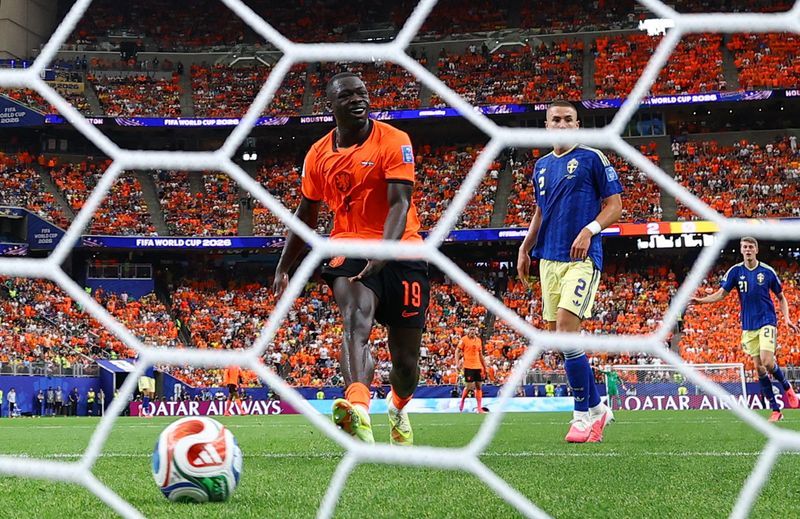
Ronald Koeman's substitution decisions during the Netherlands' opening World Cup match drew considerable scrutiny, with critics questioning the effectiveness of his tactical adjustments in a sluggish 2-2 draw with Japan in Dallas. Yet the Dutch coach silenced his detractors emphatically on Saturday, orchestrating a commanding 5-1 victory over Sweden in which his team's attacking prowess proved irresistible. The transformation in performance underscores how quickly public perception can shift in football, with Koeman moving from a cloud of doubt to widespread acclaim based entirely on a single tactical masterstroke: the decision to deploy Brian Brobbey as the primary striker.
Koeman himself acknowledged that his earlier in-game changes had failed to yield the intended results against the Japanese side, demonstrating the kind of candour that occasionally characterises high-level football management. However, his choice to build the offensive approach around the 24-year-old Brobbey proved utterly vindicated. The striker's clinical finishing in the opening 17 minutes provided the foundation for the Netherlands to take control of the encounter and ultimately secure a comprehensive victory that places them atop Group F standings.
Brobbey's pathway to this moment represents something of a redemption narrative within the squad hierarchy. The striker had occupied a peripheral role during the 2026 World Cup qualifying campaign, deemed surplus to requirements and subsequently overlooked in the selection process. Following a year away from the international setup, he received a recall to the squad this past March, an invitation that suggested Koeman was beginning to reassess his earlier judgment. The move proved prescient, as Brobbey's performances have demonstrated that time and competition experience can reshape even previously dismissed talents.
The catalyst for Brobbey's resurgence lies partly in his spell at Sunderland in the English Premier League, where consistent playing time has allowed him to develop the complete skill set required at the highest level. He has moved beyond the stereotype of a purely physical striker who relies on strength to dominate defenders. Instead, he has cultivated the nuance and positional intelligence that distinguishes elite forwards from merely adequate ones. His movement off the ball has sharpened considerably, with improved timing on runs and an enhanced ability to create separation in crowded penalty areas through intelligent positioning rather than brute force alone.
In remarks made at the Dutch training camp earlier this month, Brobbey articulated precisely how his development has progressed. He described himself as a more multifaceted player than his earlier incarnation, someone capable of contributions beyond direct confrontation with opposing defenders. His ability to time penetrating runs from deeper positions, to locate pockets of available space, and to adjust his positioning in relation to the movement of teammates has all improved markedly. These refinements represent the difference between a striker of promise and one ready for sustained prominence at international level.
The supporting cast surrounding Brobbey also enhances his prospects of fulfilling his potential. Cody Gakpo's positioning on the left flank creates consistent attacking opportunities, whilst Denzel Dumfries' overlapping runs from the right fullback position generate additional width and crossing opportunities. The inclusion of Crysencio Summerville as a newcomer to the squad provides further tactical flexibility, allowing Koeman to construct attacking scenarios tailored to Brobbey's strengths. Against Sweden, this ensemble cast functioned with impressive synchronisation, transforming Brobbey's movement into multiple goal-scoring opportunities that he converted with clinical precision.
The comparison to Memphis Depay carries particular weight, given that the veteran represents an institution within Dutch football. Depay holds the distinction of being the Netherlands' all-time leading goal scorer, an accolade that reflects decades of distinction at international level. However, his recent injury layoff has raised questions about whether he retains the sharpness and dynamism required to shoulder the primary attacking responsibility going forward. The national team has recognised for some time that succession planning represents an urgent requirement, given Depay's age and the natural progression of international careers.
Brobbey's emergence as a credible successor addresses this looming transition with tangible evidence of readiness. His two-goal contribution against Sweden demonstrated not merely the ability to finish opportune chances, but the hunger and focus that characterise truly committed players. He appears genuinely motivated to claim the position that Depay has occupied, approaching the opportunity with the intensity of someone acutely aware that his international career hung in the balance not long ago.
The broader implications for Dutch football extend beyond the immediate question of frontline personnel. Koeman's willingness to trust a player who had previously occupied the margins of his plans suggests a coach responsive to form and willing to admit earlier misjudgments. This flexibility in thinking may prove valuable as the tournament progresses, allowing the Dutch to adapt their approach according to opposition and circumstances. The emphatic victory over Sweden provides valuable momentum and confidence heading into subsequent group matches, whilst simultaneously establishing a clearer picture of the squad's attacking potential.
For Malaysian and Southeast Asian observers of international football, the Brobbey situation illustrates broader patterns in how elite European clubs and national teams develop talent. The interplay between domestic club football and international opportunity, the importance of consistent playing time in unlocking potential, and the willingness of coaches to reconsider earlier decisions all offer lessons relevant to regional football development. Brobbey's trajectory from international periphery to central role underscores how careers can be transformed through a combination of improved performance, genuine opportunity, and intelligent coaching decisions.

