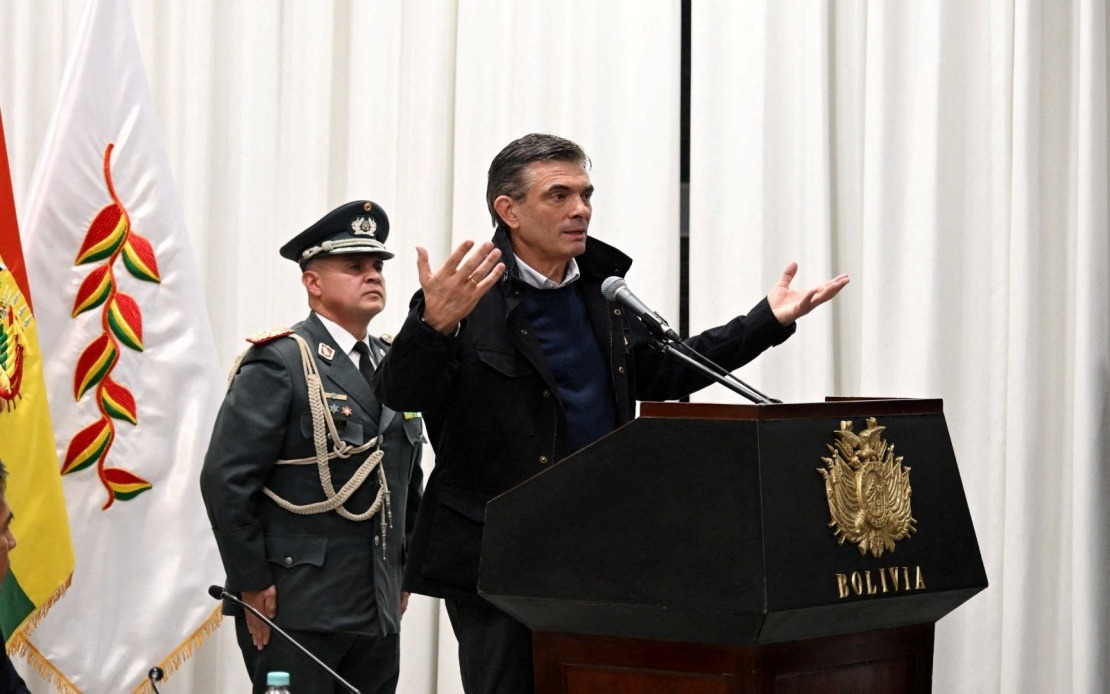
Bolivian President Rodrigo Paz has declared a state of emergency in response to an escalating political and economic crisis triggered by sustained anti-government protests and road blockades that have paralysed the country for more than seven weeks. The declaration, announced in a televised address on Saturday, represents a significant escalation in the government's response to mounting civil unrest and signals the imminent deployment of military forces to restore order and reopen critical supply routes nationwide.
The protests, which have gained substantial backing from workers' unions and farming organisations, fundamentally reflect public anger over deteriorating living standards and the broader economic pressures facing ordinary Bolivians. Demonstrators have been openly calling for Paz's resignation, viewing his administration as unable or unwilling to address the fundamental grievances driving widespread dissatisfaction. The coalition between organised labour and agricultural groups demonstrates how economic hardship has transcended traditional sectoral boundaries, uniting diverse constituencies around shared demands for political change.
The consequences of the blockade have become increasingly severe across Bolivian territory. Over the course of five weeks, critical shortages have emerged in food supplies, fuel reserves, and medical commodities in multiple regions, effectively strangling normal economic functioning. Beyond these immediate scarcities, the disruption has prevented routine commercial activity, halted transportation networks, and undermined the basic infrastructure that populations depend upon for subsistence and economic participation. The cumulative effect represents a systematic breakdown in the state's capacity to maintain essential services and maintain social stability.
Paz's public justification for the emergency declaration emphasised the humanitarian dimensions of the crisis. In his televised remarks, he characterised the blockades as holding ordinary citizens hostage, preventing them from working, accessing education, receiving healthcare, purchasing necessities, and providing for their families. This framing attempted to position the government as defending vulnerable populations against the coercive tactics of organised groups, shifting the narrative from economic discontent to questions of public order and citizen welfare. The rhetoric underscored how the political dispute has created genuine hardship for those caught between government authority and protest movements.
The state of exception declaration carries profound constitutional and practical implications. By invoking emergency powers, Paz has provided legal and administrative justification for deploying the military to physical locations where blockades are occurring. This authorisation transforms the military from a peripheral actor into an active participant in domestic politics, marking a threshold moment in how the crisis will unfold. Military deployment in civilian areas typically involves risks of escalated confrontation, potential violence, and deeper polarisation—dynamics that could either resolve the blockades or intensify the underlying political conflict.
For Malaysia and other Southeast Asian nations observing Bolivia's turmoil, the situation offers instructive parallels about the fragility of political stability when economic grievances accumulate unchecked. While Malaysia's institutional frameworks and economic conditions differ substantially from Bolivia, the pattern of organised labour and sectoral groups mobilising against government policies remains relevant. The Bolivian case demonstrates how sustained protest movements can effectively weaponise infrastructure—blockading roads, controlling supply chains—to impose tangible costs on broader populations and governments, potentially triggering authoritarian responses.
The blockade tactic itself represents a sophisticated form of political leverage that extends beyond traditional protest demonstrations. By targeting transport corridors and supply networks, protest organisers create pain points that affect civilians regardless of their political alignment, potentially generating pressure on governments from multiple directions simultaneously. This strategy has proven effective in Bolivia because it makes the costs of inaction visible and immediate, forcing political actors toward resolution rather than indefinite stalemate. Understanding these dynamics proves valuable for policymakers across the region seeking to anticipate and address potential conflict escalation.
The underlying economic conditions fuelling Bolivian discontent—rising living costs and widespread economic pressure—represent challenges confronting numerous developing economies throughout the Global South. Inflation, currency depreciation, and limited economic growth create zero-sum political environments where different groups compete fiercely for resources and government support. Bolivia's situation suggests how such economic stress, when coupled with political institutions perceived as unresponsive or illegitimate, can rapidly metastasise into systemic crises that threaten state capacity itself.
Military deployment to manage civilian unrest introduces significant uncertainty into Bolivia's immediate political trajectory. The declaration provides governmental authority for security force action, but the actual implementation of such action remains subject to multiple variables—military leadership decisions, ground-level commander discretion, protest movement response, and international observation. Historical precedents from the region suggest that military interventions in protest situations can either rapidly suppress mobilisation through show of force or alternatively trigger broader civilian defiance that emboldens opposition movements and deepens societal division.
The timing and scope of the military response will prove crucial in determining whether this emergency declaration represents a temporary expedient to reopen blockaded routes or a precursor to sustained security-focused governance. If the military succeeds in clearing blockades within days or weeks without significant violence, the crisis might gradually de-escalate toward negotiation. Conversely, prolonged military operations against entrenched protest movements could solidify the opposition's narrative about governmental authoritarianism, potentially expanding rather than contracting the political crisis.
Regional observers should monitor whether other governments or international institutions intervene diplomatically to encourage negotiation alongside security measures. The Organisation of American States, neighbouring countries, and international human rights bodies typically engage with internal crises of this magnitude, potentially providing alternative pathways to resolution. How Paz's government responds to such external pressure, alongside managing internal security operations, will shape both the immediate outcome and Bolivia's longer-term political stability.

