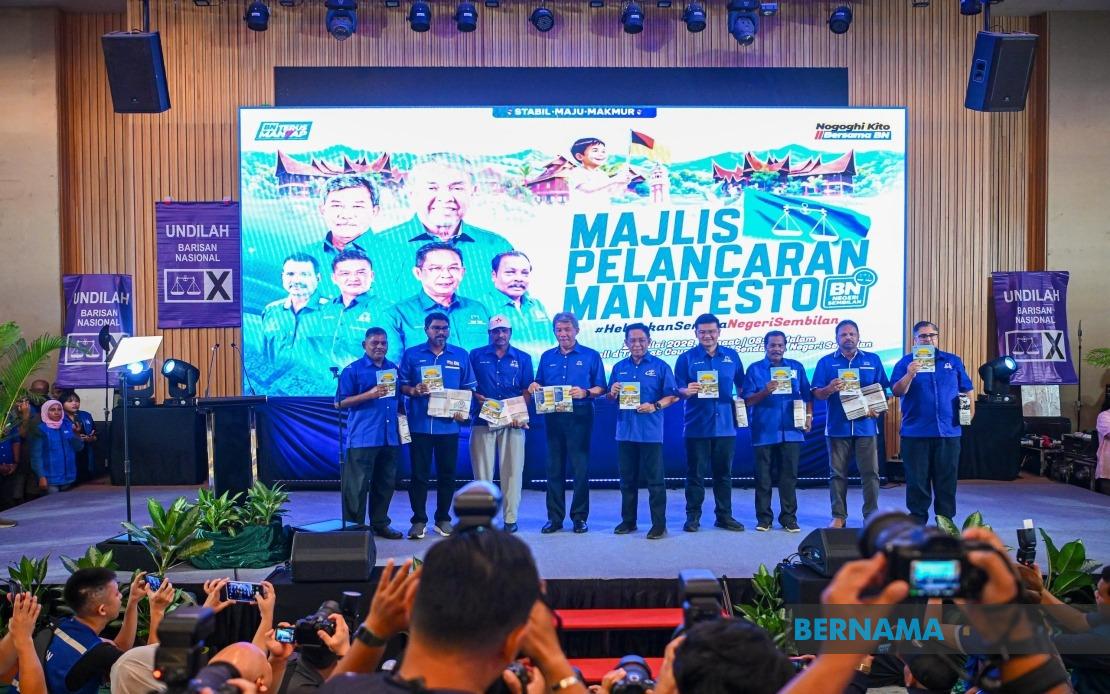
The Barisan Nasional coalition unveiled its campaign blueprint for the 16th Negeri Sembilan State Election in Seremban on July 24, presenting a comprehensive nine-pillar manifesto designed to address the state's development priorities over the coming term. The strategy encompasses interconnected policy areas spanning economic expansion, social welfare improvement, and infrastructural advancement, signalling BN's intent to position itself as a custodian of broad-based prosperity across the state.
Economic revitalisation and development form the cornerstone of BN's platform, establishing the foundation upon which the other pledges rest. This opening pillar reflects the coalition's emphasis on attracting investment, creating employment opportunities, and bolstering Negeri Sembilan's competitiveness within Malaysia's regional economy. For a state historically dependent on palm oil, rubber, and light manufacturing, the BN framework suggests a renewed commitment to economic diversification and modernisation.
The second pillar directly addresses quality-of-life improvements for ordinary Negeri Sembilan residents, focusing on material welfare, health provision, and overall well-being. This dimension targets household security and social safety nets—concerns that resonate strongly with middle and lower-income voters. Such emphasis acknowledges the persistent economic pressures facing Malaysian households, where cost-of-living anxieties remain a significant electoral concern, particularly in smaller states where alternative economic opportunities may be more limited than in urban centres.
Human development emerges as a critical theme through the third pillar, which consolidates education, skills advancement, youth empowerment, women's participation, and entrepreneurial support. This comprehensive approach recognises that Negeri Sembilan's long-term competitiveness depends on nurturing a skilled workforce capable of competing in knowledge-intensive sectors. The specific inclusion of women's entrepreneurship reflects broader Malaysian political shifts toward gender-inclusive economic participation, an issue that influences voting behaviour among younger and urban-oriented demographic segments.
Agricultural rejuvenation comprises the fourth pillar, addressing the state's historical economic base through renewed support for farming communities, agro-food development, rural infrastructure, and Felda schemes. This focus proves particularly significant given Negeri Sembilan's substantial agricultural heritage and the continued importance of rural constituencies in state-level elections. The explicit mention of Felda—the Federal Land Development Authority that remains politically sensitive across Malaysia—indicates BN's determination to reinforce its traditional base among smallholder farmers and rural settlers.
Residential development and housing policy form the fifth pillar, targeting one of Malaysia's most pressing electoral concerns. Housing affordability and availability shape voter sentiment across income levels, from young professionals seeking first homes to families requiring larger accommodations. A manifesto commitment to housing development signals BN's recognition that property ownership remains a central aspiration for Malaysian households and a barometer of government performance in voters' minds.
The environmental and tourism pillar reflects evolving voter preferences, particularly among younger Malaysians and urban constituencies increasingly conscious of ecological sustainability. Negeri Sembilan's natural attractions, including the Selangor Dam and forest reserves, provide tourism potential that careful environmental stewardship can enhance. This positioning attempts to balance development imperatives with conservation concerns, appealing to voters who demand economic progress without ecological degradation.
Cultural, religious, and indigenous affairs comprise the seventh pillar, addressing dimensions of Malaysian identity and social cohesion. The emphasis on strengthening religious observance, preserving traditional customs and heritage, and supporting the Orang Asli community reflects BN's historical positioning as guardian of Malaysia's multicultural compact and indigenous welfare. These commitments hold particular resonance in Negeri Sembilan, where Malay-Muslim majorities and indigenous populations require specific policy recognition.
Sports, recreation, and national unity form the eighth pillar, connecting physical wellness with social integration. Beyond infrastructure for sporting activities, this commitment implicitly addresses community cohesion and shared national identity—themes BN has traditionally emphasised as foundational to political legitimacy and social stability. The explicit framing of sports and recreation as vehicles for national unity underscores BN's broader narrative about inclusive development and social harmony.
Governance and service delivery constitute the final pillar, addressing the mechanics of effective administration. This focus on institutional performance and bureaucratic responsiveness acknowledges that voters evaluate governments partly on their capacity to deliver reliable, efficient public services. In Negeri Sembilan's context, where state government directly interfaces with residents through local administration, this commitment carries practical weight.
The manifesto launch drew participation from senior coalition figures, including Negeri Sembilan UMNO Liaison Committee chairman Datuk Seri Jalaluddin Alias—who also serves as the state's election director—alongside MCA deputy president Datuk Dr Mah Hang Soon and MIC vice-president Datuk M. Asojan. The presence of multiple component party leaders underscores BN's emphasis on coalition unity and the multiethnic composition of its support base, a messaging strategy designed to counter any perception of narrow-based governance.
Notably, Perikatan Nasional deputy chairman Datuk Seri Tuan Ibrahim Tuan Man's attendance at the event signalled evolving political dynamics, as PN and BN navigate their relationship in different state contexts. This complex political landscape means Negeri Sembilan's election carries implications beyond the state itself, testing coalition alignments and voter preferences in a relatively competitive electoral environment.
Voting arrangements for the election reflect standard procedures, with early voting scheduled for July 28 and the main polling day on August 1. The manifestation of BN's nine pillars across these campaign weeks will determine whether the coalition's comprehensive policy framework resonates with Negeri Sembilan voters or whether alternative political forces can construct more compelling visions for the state's future development.

