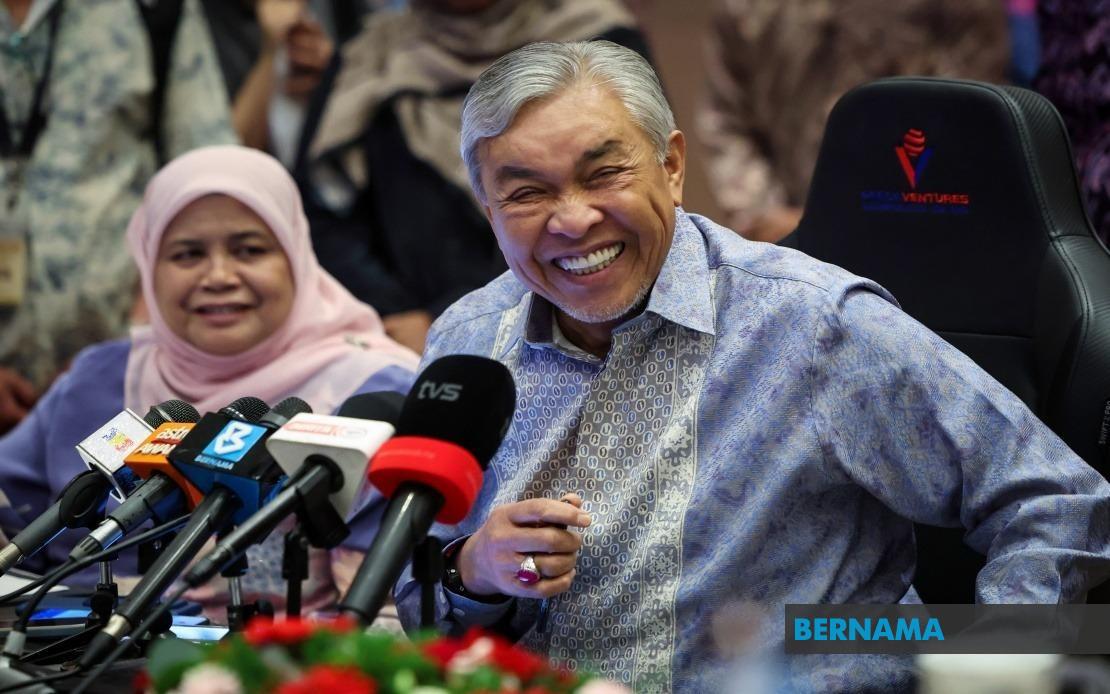
Barisan Nasional has moved to quell persistent speculation about political instability by reaffirming its unwavering commitment to the Unity Government framework established following the 2022 General Election. Deputy Prime Minister and BN chairman Datuk Seri Dr Ahmad Zahid Hamidi made the declaration while addressing party officials in Penang, emphasising that the coalition's participation in the broader administrative alliance remains non-negotiable until the current parliamentary term concludes. His remarks directly counter circulating rumours suggesting internal machinations designed to undermine Prime Minister Datuk Seri Anwar Ibrahim's leadership, a pattern of speculation that has periodically troubled Malaysian political circles since the government's formation.
Ahmad Zahid adopted deliberately emphatic language to underscore BN's position, explicitly disavowing any involvement in destabilisation schemes commonly associated with regional political crises. By invoking references to the "Bangkok Move" and "Dubai Move"—coded terminology for covert manoeuvres to engineer government collapse—the UMNO president signalled an attempt to permanently close this chapter of discourse. The remarks carry particular weight given BN's historical significance within Malaysian politics and its central positioning within the current coalition architecture. Observers note that such explicit denials typically emerge when leadership feels compelled to address growing party member discontent or external pressure questioning institutional stability.
The timing of Ahmad Zahid's statement reflects broader anxieties within Malaysian politics about the durability of consensus-based governance arrangements. The Unity Government itself represents an unprecedented departure from conventional political practice, requiring ideological adversaries to collaborate across traditional partisan divides. This arrangement has generated persistent friction, with various constituencies questioning whether such cooperation can sustain itself through the inevitable pressures of electoral cycles and competing regional interests. BN's formal reaffirmation thus serves both as internal reassurance to party members and external signalling to coalition partners regarding organisational discipline and reliability.
Ahmad Zahid grounded his commitment statement in explicit reference to the Yang di-Pertuan Agong's decree authorising the government's formation, invoking constitutional and institutional legitimacy to buttress BN's political positioning. This framing emphasises that the coalition's participation transcends ordinary partisan considerations, instead reflecting obligations to constitutional frameworks and monarchical directives. For Malaysian audiences, such appeals to institutional authority carry considerable cultural and political resonance, implicitly suggesting that departing from this commitment would constitute a breach of constitutional propriety rather than merely a shift in political alliances. This rhetorical strategy effectively elevates BN's commitment beyond negotiable political calculus into the realm of institutional obligation.
The deputy prime minister's remarks, delivered at the 61st Coordination Meeting between the Minister of Rural and Regional Development and state-level officials overseeing development portfolios, also extended to addressing practical governance challenges affecting party operations. Ahmad Zahid acknowledged difficulties surrounding a BN polling district centre in Klawang that had suspended operations in protest against the coalition's decision not to contest a state seat during Negeri Sembilan's concurrent electoral campaign. Such operational disruptions, though administratively modest in scale, carry symbolic significance as indicators of potential internal dissatisfaction with strategic decisions affecting constituency-level party activists. The deputy prime minister's response—assuring immediate resolution through engagement with state leadership—demonstrates attempts to manage these tensions constructively rather than dismissively.
The Klawang constituency dispute illuminates friction points within the broader Unity Government framework, particularly regarding how different coalition components accommodate divergent interests across contested electoral territories. The eventual three-way contest involving Pakatan Harapan, Perikatan Nasional, and Bersatu candidates reflected the complex arithmetic underlying contemporary Malaysian electoral competition, where coalition mathematics increasingly complicate traditional vote consolidation strategies. For BN activists accustomed to dominant positioning within their constituencies, accepting withdrawal from particular contests necessarily requires reframing such decisions as contributions to larger strategic objectives rather than localised defeats. Ahmad Zahid's acknowledgment of state-level resolution processes reflected sensitivity to these grassroots frustrations.
Meanwhile, Ahmad Zahid dismissed speculation regarding formal political cooperation between BN and Perikatan Nasional under a proposed "Perikatan Barisan Nasional" alliance framework. He characterised such discussions as purely rhetorical flourishes during campaign activities rather than substantive negotiations, explicitly rejecting the notion that either coalition had progressed beyond preliminary verbal exchanges. This dismissal carries particular importance given regional political dynamics, where opposition coalition consolidation could theoretically challenge Unity Government stability. By categorically denying any formal exploratory discussions, Ahmad Zahid simultaneously reassured coalition partners regarding BN's reliability while signalling that ideological and strategic differences between BN and PN remained substantive obstacles to closer coordination.
The deputy prime minister also addressed the broader question of maintaining functional political relationships across coalition boundaries, particularly during competitive electoral campaigns. Ahmad Zahid noted that despite BN and Pakatan Harapan supporting opposing candidates in Negeri Sembilan's state election, his personal relationship with Prime Minister Anwar remained cordial and properly maintained. This characterisation of separated-yet-collegial engagement reflects the delicate equilibrium required to sustain Malaysia's Unity Government framework. Coalition partners must simultaneously pursue distinct partisan interests at electoral levels while maintaining administrative cooperation at national governance levels, a balancing act that continuously tests institutional maturity and personal relationship management among senior political figures.
The interaction between Ahmad Zahid and Anwar Ibrahim, evidenced through the exchange of pantun verses emphasising unity and political discipline, illustrated the lighter interpersonal dimensions underlying the formal governmental architecture. Such cultural and personal engagement, operating below purely transactional political communication, reportedly contributes meaningfully to coalition durability by maintaining human connections between potential adversaries. For Malaysian political observers, the capacity of senior figures to interact through traditional literary forms while managing substantive policy disagreements represents an important stabilising mechanism within plural political environments characterised by significant ideological divergence.
Moving forward, Ahmad Zahid's comprehensive reaffirmation of BN's commitment signals the coalition's intention to maintain participation through the 15th Parliament's conclusion, despite ongoing pressures and internal constituencies questioning specific tactical decisions. The explicit invocation of constitutional frameworks, institutional obligations, and leadership continuity underscores BN's investment in presenting itself as politically responsible and constitutionally aligned. For Malaysian and regional audiences monitoring political stability, these pronouncements provide temporary reassurance regarding governmental durability, though enduring questions about the long-term sustainability of consensus arrangements between ideologically disparate partners remain unresolved by such declarations.

