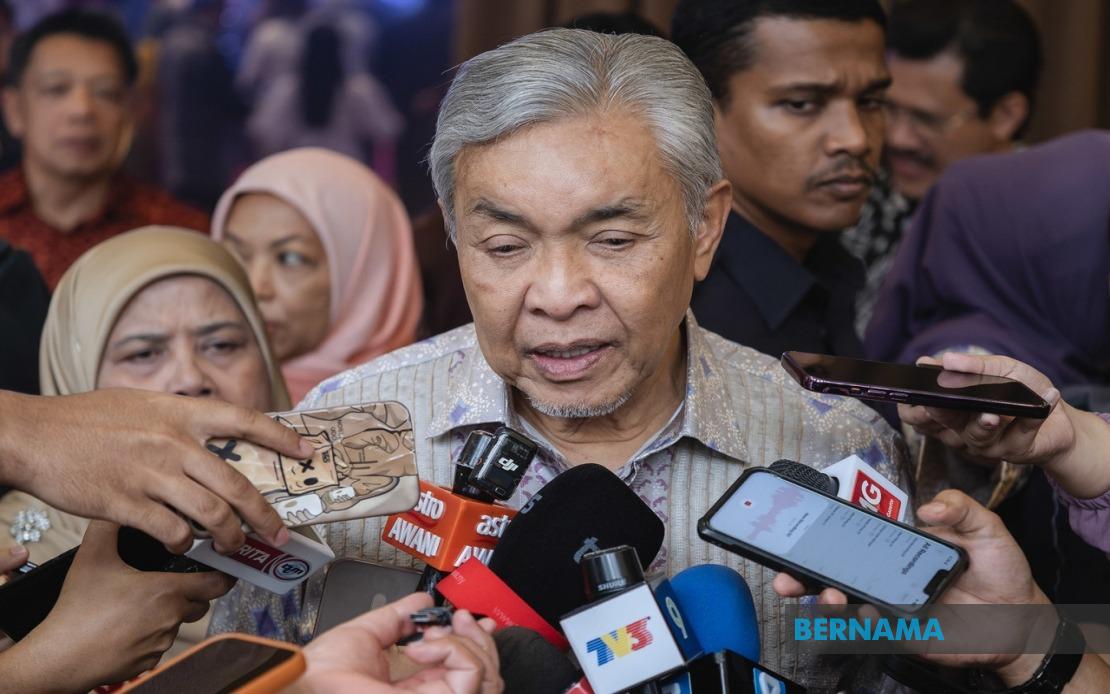
Barisan Nasional has committed to maintaining a hands-off approach regarding the Negeri Sembilan royal institution and the state's Council of Justice and Laws (DKU), signalling the coalition's determination to keep constitutional and legal matters separate from electoral politics. Deputy Prime Minister Datuk Seri Dr Ahmad Zahid Hamidi, speaking after attending a service excellence ceremony at the Ministry of Rural and Regional Development in Kuala Lumpur on June 29, stressed that this boundary represents a fundamental principle guiding the coalition's conduct as it prepares for the upcoming state election. The undertaking reflects a broader understanding that matters touching on the monarchy and judicial processes require protection from partisan interference, a concern that has occasionally complicated politics in Malaysian states where palace prerogatives intersect with electoral dynamics.
Ahmad Zahid, who doubles as UMNO president, outlined the commitment during feedback to journalists following a gathering with Negeri Sembilan's party brass. The coalition's pledge emerged from substantive discussions with state-level leadership centred on strategic preparation for the ballot. His remarks underscored an explicit recognition that the constitutional role of the palace and the independent functioning of legal institutions must remain insulated from coalition strategy and campaigning. This delineation carries particular weight in Negeri Sembilan, where historical episodes have occasionally seen palace matters intersect with party political manoeuvring, creating friction that the current leadership evidently wishes to avoid.
The coalition is recalibrating its approach to the Negeri Sembilan contest in several material respects. Most significantly, BN is abandoning the collaborative framework that defined the previous state election cycle. At the 15th state poll, the coalition fielded joint candidates with component parties from Pakatan Harapan, a power-sharing arrangement that reflected the broader Memorandum of Understanding negotiated at federal level. This time, Ahmad Zahid indicated, BN will contest independently, signalling a return to traditional adversarial positioning. The shift carries implications for seat distribution, candidate nomination, and likely coalition vote efficiency, as BN can no longer rely on PH component parties to absorb certain constituencies where they historically held stronger ground.
Instead of seeking PH cooperation, BN's stated priority has narrowed to cultivating cohesion within its own ranks across all organisational tiers. Ahmad Zahid emphasised that internal unity among leaders and members, from state leadership down to grassroots operatives, represents the coalition's indispensable asset as it readies itself for what the party acknowledges will be a qualitatively different electoral environment than in 2018. This recalibration reflects lessons learned: the previous arrangement, while expedient for securing federal stability, apparently diluted BN's capacity to mobilise its core support bases and project a coherent party narrative. The coalition evidently believes that consolidated BN messaging and organisation will prove more effective than collaborative but potentially fragmented campaigning.
The Negeri Sembilan election will determine control of the state assembly's 36 seats, making it a consequential contest for BN's standing in the peninsula's heartland. Negeri Sembilan has traditionally been a BN stronghold, though the coalition's dominance eroded during the 2018 cycle and subsequent state reconfiguration. The August 1 polling date provides a compressed timeline for the coalition to rebuild momentum and organisational capacity. Party leaders recognise that success will depend less on external arrangements than on disciplined internal execution, message discipline, and the capacity to convert residual support among traditional BN constituencies into actual votes on polling day.
For Malaysian observers, the episode illuminates how political leadership navigates the intersection of electoral ambition and constitutional propriety. Ahmad Zahid's public statement represents not merely tactical positioning but a substantive commitment to respecting institutional boundaries that, once compromised, prove difficult to restore. The palace and judiciary operate under distinct constitutional mandates that transcend electoral cycles, and maintaining their independence and perceived impartiality serves the broader health of Malaysia's political system. By explicitly forswearing interference in palace and DKU matters, BN's leadership telegraphs an understanding that constitutional institutions require protection from the pressures of campaign season.
This stance carries indirect implications for opposition parties and for the broader political culture in Negeri Sembilan. Should BN maintain this disciplined boundary, it establishes a benchmark against which other coalitions and candidates will be measured. Conversely, any perception that the coalition or its components are endeavouring to leverage palace sensitivities or legal processes for electoral advantage would immediately breach the credibility established by Ahmad Zahid's commitment. The statement thus represents not merely a leadership position but an implicit contract with the electorate regarding how politics will be conducted in the state during this particular cycle.
The coalition's inward focus on party unity also reflects recognition that Negeri Sembilan's political landscape has become more fragmented and unpredictable than in earlier decades. The emergence of more competitive multi-cornered contests, shifting voter preferences, and the residual effects of the 2018 realignment have made reliance on traditional support bases insufficient. Internal cohesion becomes critical when external arrangements cannot be relied upon to deliver votes. BN's emphasis on ensuring that party leaders and members operate from a unified platform thus amounts to a strategic pivot toward organisation and message consistency as primary competitive tools.
As Negeri Sembilan heads toward August's ballot, the state has become emblematic of BN's broader challenge of repositioning itself in a post-2018 electoral landscape where the coalition can no longer assume automatic dominance and must compete more intensively for voter favour. The commitment to institutional respect and internal party discipline, while seemingly abstract, translates into concrete implications for how the campaign unfolds. BN is essentially betting that tight organisation, clear messaging, and demonstrated respect for constitutional boundaries will prove more effective than the looser collaborative arrangements and institutionally fraught approaches that characterised earlier contests. The outcome will offer insight into whether this recalibrated strategy resonates with Negeri Sembilan voters when they cast ballots in August.

