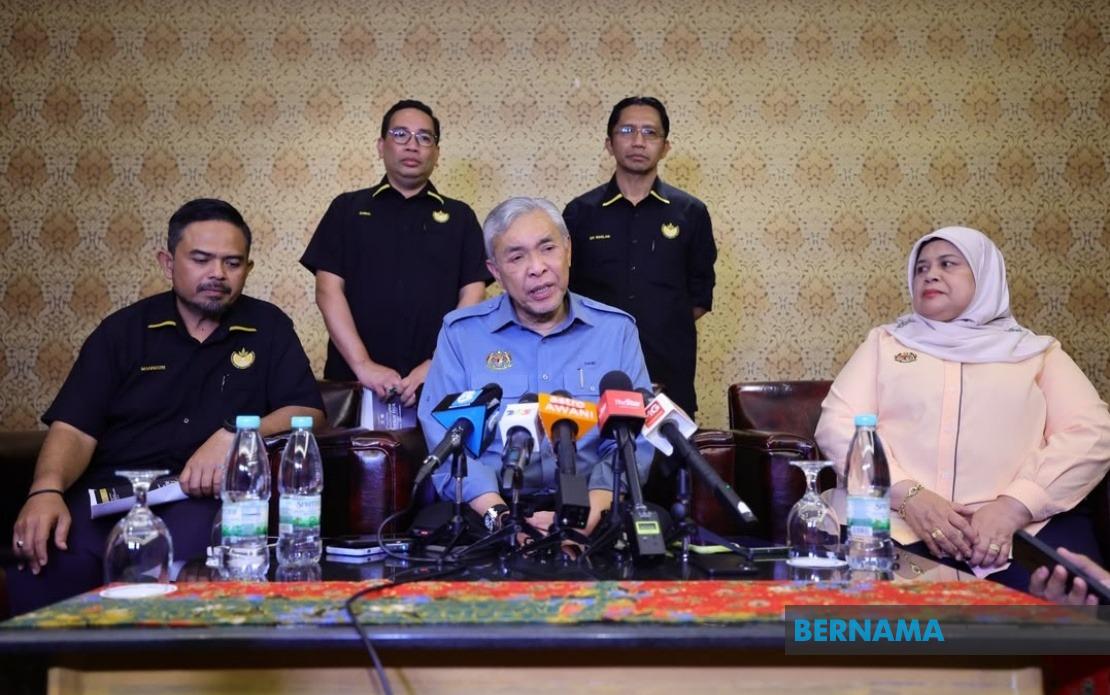
Barisan Nasional leadership is banking on sustained voter engagement following an exceptional early voting phase in the 16th Negeri Sembilan state election, with BN chairman Datuk Seri Dr Ahmad Zahid Hamidi publicly expressing optimism that Saturday's main polling day will see comparable levels of participation. The coalition's optimism stems from the Election Commission's announcement that 88.97 per cent of early voters had cast their ballots by 3 pm on the designated early voting date, a figure that significantly exceeds typical benchmarks and signals what party officials interpret as healthy democratic engagement across the state.
Ahmad Zahid characterised the elevated turnout as a reflection of voters' commitment to the democratic process, emphasising that such enthusiasm should serve as a foundation for Saturday's election day. Speaking after officiating at the RISDA Central Zone Smallholders Convention in Seremban, he called upon BN's ground machinery to capitalise on this apparent momentum by intensifying their voter outreach efforts during the final three days of the campaign period. His remarks suggest that the coalition views the strong early voting participation not merely as a statistical achievement but as evidence of underlying voter interest that, if properly leveraged, could translate into broader support on polling day.
The early voting process itself involved a substantial cohort drawn from specific demographics. A total of 22,339 voters participated in early voting, with 16,467 individuals casting ballots in person. This in-person contingent comprised 11,293 military personnel and their spouses alongside 5,174 police officers and their families. The remaining early voters exercised their right through postal ballots, a mechanism that typically accommodates those unable to vote on the main election day. This structure reveals how Malaysia's electoral system attempts to balance accessibility with the operational realities of maintaining security and military readiness during election periods.
The broader electoral landscape in Negeri Sembilan encompasses 867,151 registered voters eligible to participate on Saturday. Against this substantial voter base, the early voting figure of 22,339 represents roughly 2.6 per cent of the total electorate, though it encompasses virtually all available early voting opportunities. The Election Commission, led by chairman Datuk Seri Ramlan Harun, has set a target range of 72 to 75 per cent overall voter turnout for Saturday's main polling event. Such targets are informed by historical patterns and logistical capacity considerations, serving as benchmarks against which election observers and analysts typically assess whether voter participation meets, exceeds, or falls short of democratic engagement expectations.
Ahmad Zahid's characterisation of BN as an underdog in the Negeri Sembilan contest provides intriguing context for understanding the coalition's strategic positioning. Rather than projecting confidence, the party chairman's framing acknowledges perceived electoral headwinds, a rhetorical stance that serves multiple purposes within campaign dynamics. It can motivate party activists to work harder, manage expectations among supporters, and position any positive result as exceeding initial assessments. For Malaysian observers, this language reflects broader competitive dynamics in state-level politics, where coalition viability is increasingly contested across multiple states following electoral shifts over recent election cycles.
The emphasis on the campaign's final three days underscores the intensive nature of state election campaigns in Malaysia, where messaging cycles compress dramatically in the run-up to polling day. Ground-level engagement through door-to-door canvassing, community events, and localised messaging intensifies during this window, with parties attempting to crystallise voter support and address any remaining undecided segments. BN's renewed focus on voter contact during this phase suggests the coalition recognises that early voting momentum, while encouraging, requires reinforcement through continued direct engagement.
For Malaysian voters and regional observers, the Negeri Sembilan state election holds significance beyond the state's borders. State-level contests frequently serve as testing grounds for national political trends, allowing analysts to discern whether broader patterns affecting Malaysian politics are gaining or losing traction. The state's electoral dynamics, informed by its specific demographic composition, urban-rural distribution, and historical voting patterns, provide meaningful data points for understanding the national political landscape. Strong voter participation in early phases, therefore, may signal genuine engagement rather than apathy, which carries implications for how subsequent electoral competitions—both state and federal—might unfold.
The Election Commission's operational management of the early voting phase, reflected in both the logistical execution and the transparent announcement of turnout figures, demonstrates institutional commitment to facilitating broad participation. By enabling early voting for defined demographics including security personnel, the system recognises that governance and electoral participation must accommodate those in positions requiring continuous duty. The detailed breakdown of voter categories provides specificity that allows for meaningful analysis of participation patterns across different population segments, contributing to evidence-based understanding of how Malaysia's electoral system functions in practice.
Ahmad Zahid's public remarks also reflect broader strategic messaging considerations for BN as it navigates the contemporary Malaysian political environment. The coalition's fortunes have fluctuated across recent election cycles, and state contests provide opportunities to demonstrate renewed viability or alternatively to reassess direction. Framing the party as an underdog while simultaneously emphasising democratic participation and voter responsibility creates a narrative that positions BN within larger civic processes rather than purely as a partisan competitor. This rhetorical approach allows the coalition to connect with voters on the basis of shared commitment to democratic health, transcending purely partisan dividing lines.
The targeting of 72 to 75 per cent overall voter turnout by the Election Commission reflects international and regional norms for democratic health, positioning Malaysia within comparative context. Turnout at these levels is generally interpreted as indicating robust citizen engagement with electoral processes, particularly in comparison with numerous established democracies where turnout frequently hovers in the 50 to 60 per cent range. Achieving these targets in Negeri Sembilan would reinforce narratives of Malaysian electoral vitality, though the sample derived from this particular state election would require careful interpretation given Negeri Sembilan's specific characteristics and prior voting patterns.
Looking forward to Saturday's polling day, the dynamics established through early voting will provide useful comparative data. Should the 88.97 per cent early voting rate prove to be a genuine indicator of broader voter enthusiasm rather than an artefact of the early voting mechanism, Saturday's turnout could potentially exceed the Election Commission's target range. Conversely, if Saturday's actual turnout settles within or below the projected 72 to 75 per cent range, it would suggest that early voting, while operationally successful, represented a concentrated participation moment rather than a harbinger of exceptional overall engagement. Either outcome will generate analytical insights into voter behaviour patterns in contemporary Malaysia.

