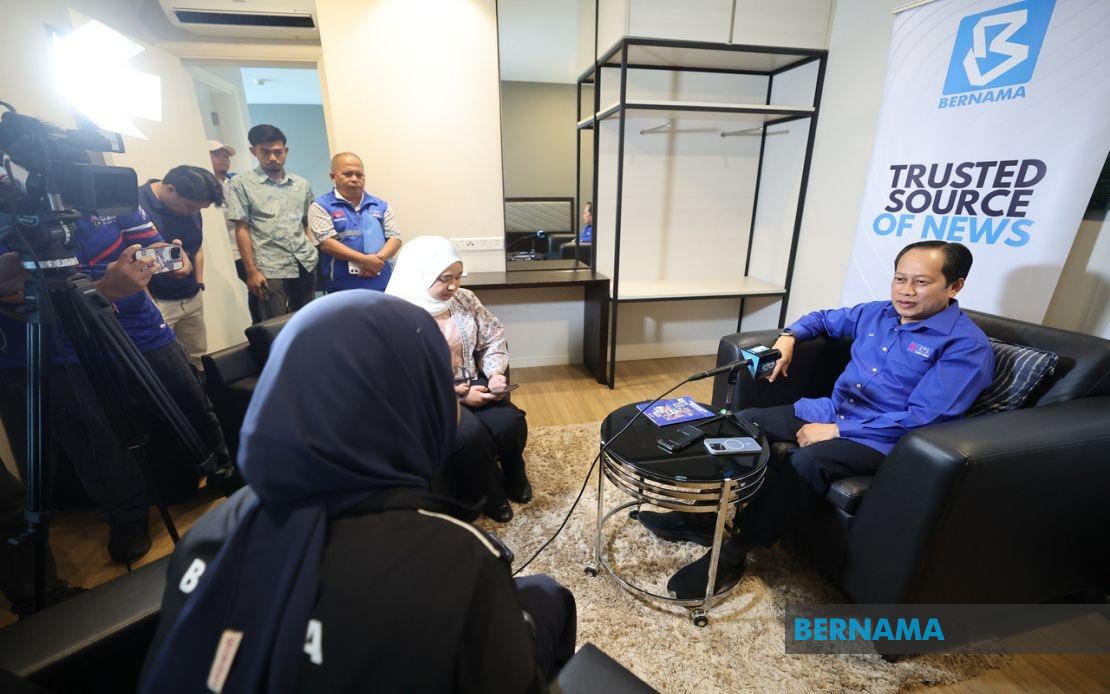
Barisan Nasional's top strategists in Johor are projecting a decisive victory in the state election scheduled for July 11, with party officials publicly targeting a haul of more than 40 seats from the 56-seat State Legislative Assembly. The confidence displayed by coalition leadership reflects months of intensive preparation and what they characterise as strong grassroots momentum across the crucial peninsular state, which has remained a BN stronghold despite electoral shifts elsewhere in Malaysia.
Datuk Seri Dr Ahmad Maslan, the Johor UMNO deputy liaison committee chairman, grounded his optimism in firsthand observations accumulated during extensive campaign work across nearly all of Johor's parliamentary divisions. Having personally assisted in mobilising efforts across 25 of the state's 26 parliamentary constituencies, Ahmad offered a detailed assessment of party positioning that goes beyond typical pre-election rhetoric, citing specific measurements of campaign effectiveness and organisational capacity. His analysis represents an informed perspective from someone deeply embedded in the state's political machinery at both federal and state levels, while also serving as chief of the Pontian UMNO division, one of Johor's significant political bases.
The projected 40-seat threshold carries particular significance for BN's governance agenda in Johor. Securing such a majority would enable the coalition to form government comfortably while maintaining legislative flexibility for its policy agenda and reducing vulnerability to defections or internal dissent. The target reflects what party analysts view as realistic rather than purely aspirational, grounded in voter reception patterns and candidate performance metrics gathered during the campaign trail.
Ahmad's confidence rested significantly on the operational tempo and quality of BN's ground machinery, particularly at the District Polling Centre level, which function as command hubs during elections. Throughout the pre-election period, these centres maintained intensive daily operations spanning from early morning through late evening, encompassing traditional door-to-door canvassing, sophisticated voter data analysis systems, campaign simulations designed to test messaging effectiveness, and coordination of multiple simultaneous activities. This continuous operational rhythm, according to Ahmad, demonstrated the organisational depth that distinguishes a well-resourced campaign from more ad-hoc efforts.
A particularly noteworthy element of BN's campaign strategy involved deploying reinforcement teams from other states, particularly Pahang, to supplement the existing Johor campaign apparatus. These external teams brought election-winning experience and fresh perspectives honed through successful campaigns elsewhere, complementing local knowledge with broader strategic insights. In constituencies such as Pontian, Pulai Sebatang, Benut, Kukup, and Pekan Nanas, Pahang's Menteri Besar himself led reinforcement efforts, bringing high-level political experience and morale-boosting senior party presence to critical battlegrounds.
The deployment of interstate reinforcement reflects a broader coalition strategy of mobilising resources nationally to ensure decisive outcomes in key state contests. For Johor, this represented recognition of the state's political importance within the larger BN framework, justifying the commitment of senior figures and organisational resources from other states. The presence of Pahang's Menteri Besar demonstrated BN's willingness to deploy its highest-ranking figures to contested areas, simultaneously boosting campaign morale and signalling the coalition's determination to retain this strategically vital state.
The campaign's emphasis on data analytics and voter targeting represented evolution in Malaysian electoral methodology, moving beyond purely traditional approaches. By integrating systematic voter data analysis, campaign teams aimed to identify persuadable voters and tailor messaging to specific demographic and geographic segments rather than relying on uniform broadcast-style communication. This more sophisticated approach reflected investment in campaign technology and analytical capacity, suggesting BN's determination to employ modern electoral practices alongside traditional grassroots activity.
For Southeast Asian political observers, Johor's election held broader significance as a test case for coalition politics in Malaysia's post-2018 electoral environment. The state had maintained BN control despite the 2018 federal upset, but subsequent elections had seen varying results across different states, creating uncertainty about the coalition's continued dominance. A strong Johor showing would provide psychological momentum for BN's national positioning and demonstrate sustained voter support among one of the peninsula's most significant state electorates.
The timing of the campaign, with polling day set for July 11, meant that final weeks would prove decisive in converting the organisational preparations and candidate positioning into actual electoral victory. Ahmad's commitment to maintaining intensive focus through to polling day underscored the understanding that campaigns in their final phase demanded sustained engagement rather than complacency. The close coordination between state-level organisers, federal party figures, and interstate reinforcement teams suggested a campaign operating at multiple levels simultaneously, from hyperlocal constituency contests to broader state-wide messaging frameworks.
BN's targeting of over 40 seats implicitly acknowledged that the opposition retained meaningful support in certain constituencies but that the coalition's organisational advantages and voter base remained sufficiently broad to deliver comfortable control. The specific threshold of 40 seats, representing roughly 71 percent of the assembly, would constitute a supermajority enabling unilateral action on most legislative matters while demonstrating convincing popular mandate for continued governance. Whether Ahmad's assessment and the coalition's internal polling accurately reflected voter intentions would become clear when Johor went to the polls on July 11.

