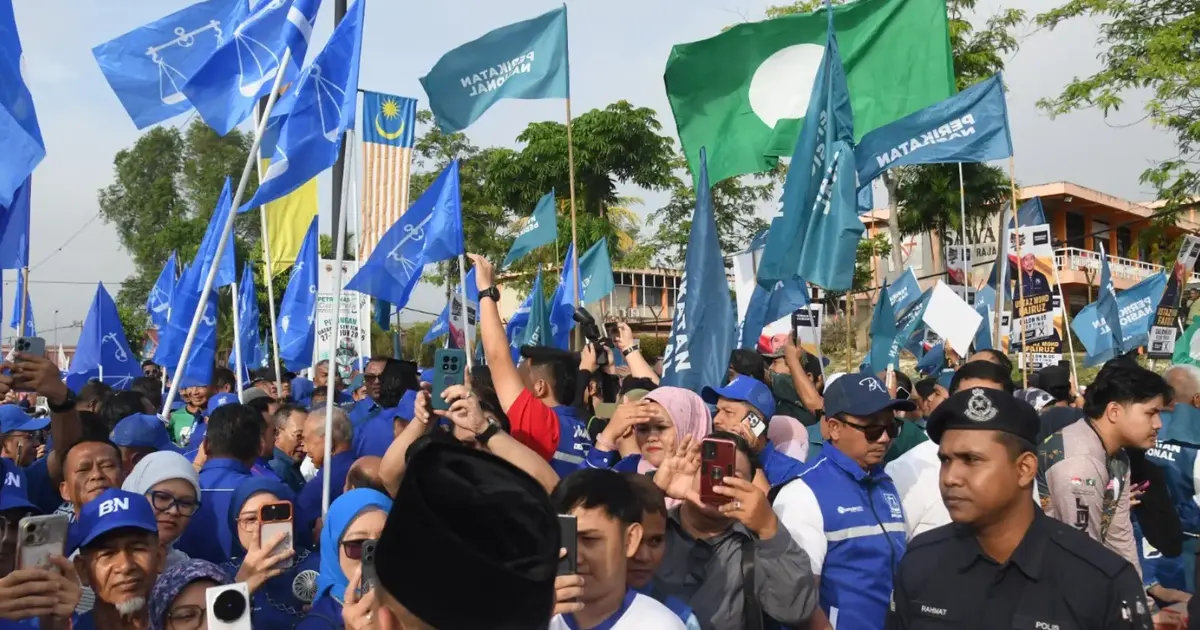
The coalition between Perikatan Nasional and Barisan Nasional appears unlikely to deliver the electoral breakthrough that PAS and its allies seek in Selangor, according to political analyst Azmi Hassan, who contends that BN simply cannot compensate for the departure of Bersatu from the opposition alliance. His assessment challenges assumptions that BN's organisational machinery and political experience could provide the necessary electoral muscle to dent Pakatan Harapan's stronghold in the country's economic powerhouse.
In the previous state election, Bersatu functioned as a critical intermediary between PAS's conservative Islamist base and urban, educated voters who might otherwise have rejected a purely religious platform. The party's positioning—ostensibly Malay-Muslim but claiming modernist credentials—allowed Perikatan Nasional to broaden its appeal across demographic divides, particularly attracting younger professionals and business-oriented electors in Selangor's sprawling metropolitan zones. This bridging capacity proved instrumental in PN's incremental advances, enabling the coalition to make inroads in constituencies where PAS alone would have struggled to gain traction.
Barisan Nasional, by contrast, operates from a fundamentally different ideological and organisational foundation. The coalition's component parties, particularly UMNO, bring decades of establishment credentials and entrenched electoral machinery. However, this very history complicates rather than simplifies PN's strategy in Selangor. Many voters in the state harbour lingering grievances against BN governments of the past, and UMNO's brand carries associations with governance practices that progressive and urban-oriented electors have actively rejected through successive election cycles. Where Bersatu offered freshness and an alternative identity within the Malay-Muslim sphere, BN's presence could intensify rather than ameliorate these reservations.
The analyst's perspective underscores a structural weakness in PN's broader coalition architecture. The alliance was constructed around shared interests and electoral calculations rather than complementary political identities. When component parties shift or withdraw, as Bersatu has done by merging with UMNO and stepping back from an independent opposition role, the entire strategic foundation can crumble. PAS's dominance within PN means that without mediating forces, the coalition risks being perceived as a vehicle for Islamist politics rather than as a genuine alternative government offering diverse appeal. This perception particularly undermines performance in Selangor, where religious conservatism competes against cosmopolitan values in electoral consciousness.
Selangor's electoral significance extends beyond its state boundaries. As Malaysia's richest and most populous state, it drives national political momentum and generates revenue that substantially funds federal operations. Control of Selangor would represent a transformative achievement for PN, potentially reshaping the country's political trajectory. Conversely, another PH victory would consolidate Anwar Ibrahim's federal government while demonstrating that PN cannot penetrate even economically peripheral urban and suburban constituencies where Islamic identity-politics holds diminished purchase. The stakes therefore demand that PN field its most compelling political instruments, and by Hassan's analysis, a BN-PN alliance represents precisely the opposite.
Historical precedent reinforces these analytical concerns. UMNO's repeated electoral losses in Selangor reflect something deeper than mere administrative shortcomings—they signal a fundamental realignment of voter preferences against traditional establishment parties across generations. Younger voters, who now constitute substantial Selangor electorates, formed their political consciousness during periods of civil society activism, federal-level democratic contestation, and expectations of transparent governance that UMNO's historical record does not comfortably accommodate. BN's return to state electoral competition might therefore prove counterproductive, activating latent anti-establishment sentiment that could paradoxically strengthen PH's hold on power.
The role of Bersatu had proven especially valuable in bridging this generational and ideological chasm. Founded relatively recently and lacking BN's historical baggage, Bersatu attracted politicians and cadres who positioned themselves as reformers within conservative religious frameworks. This identity allowed PN to campaign simultaneously as an Islamic alternative and a modernising force—a delicate balance that proved electorally potent in 2022. Without this mediating layer, PN's coalition increasingly collapses into its constituent ideological elements, with PAS's religious conservatism exposed as the dominant characteristic rather than one component of a broader national vision.
Analyst Hassan's conclusion carries implications for how PN constructs its electoral narrative for upcoming contests. Rather than seeking additional institutional partners like BN, PN might require ideological repositioning or internal diversification to broaden its appeal. This could involve more prominent roles for younger, urban-educated figures within PAS itself, or the cultivation of technocratic credentials that distance the coalition from purely religious identity politics. Such internal recalibration would prove far more demanding than simply adding another coalition partner, but it addresses the underlying structural constraint that BN cannot remedy through its organisational resources alone.
For Malaysian politics more broadly, this assessment suggests that the 2022 alignment that produced Perikatan Nasional's rise may have represented a temporary configuration unlikely to sustain itself beyond specific historical circumstances. Bersatu's utility derived largely from its novelty and positioning as a bridge between traditional Islamic politics and modernisation imperatives. Once that party merged back into UMNO or transitioned into a support vehicle for federal government, the coalition lost a critical valve for managing internal tensions and broadening external appeal. As Malaysia continues rotating through electoral cycles, such lessons about coalition durability and the distinct value of specific parties will shape how opposition forces calculate their future strategies.

