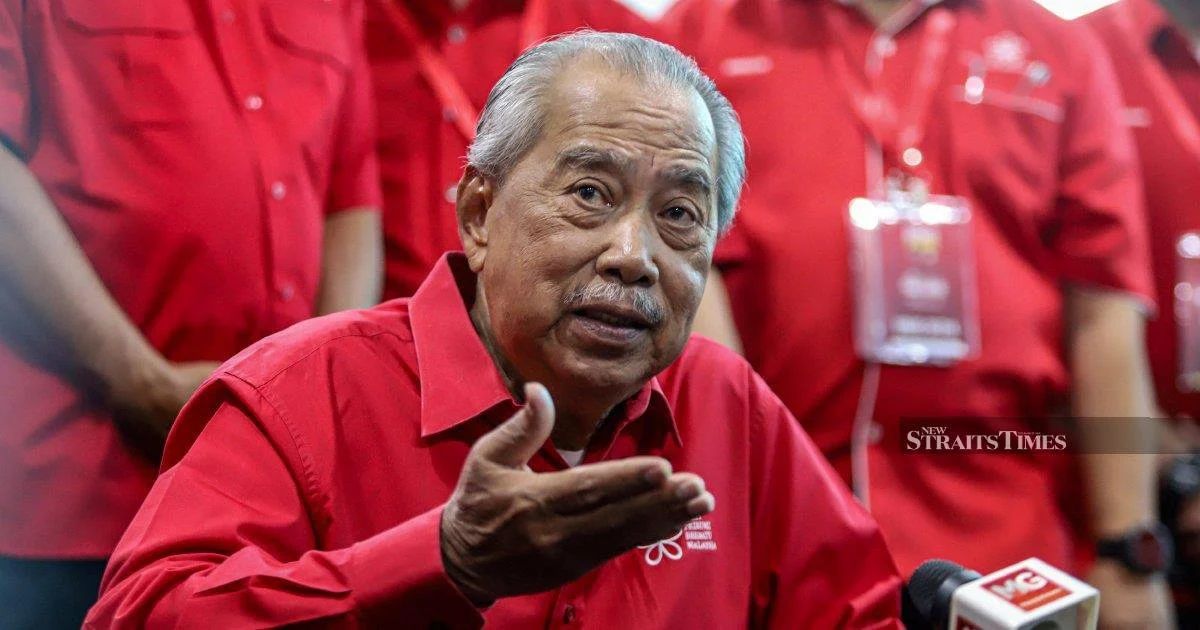
Tan Sri Muhyiddin Yassin, president of Bersatu, has moved to quell persistent doubts about the stability of Perikatan Nasional by declaring that his party views its membership in the coalition as a permanent arrangement rather than a temporary political convenience. The statement comes as Malaysia's opposition bloc continues to navigate questions about its durability and cohesion following recent developments in the nation's fractious political landscape.
The assertion carries significance given the volatile history of Malaysian political coalitions, where partnerships between parties frequently dissolve amid disputes over ministerial posts, policy direction, or electoral strategy. Bersatu's explicit reaffirmation reflects an attempt to project stability to party members, coalition partners, and the broader electorate amid what Muhyiddin characterised as ongoing speculation regarding Perikatan Nasional's trajectory. Such speculation frequently emerges in Malaysian politics whenever coalition members engage in public disagreements or when individual leaders make statements that could be interpreted as exploring alternative political alignments.
Perikatan Nasional itself represents a relatively recent configuration in Malaysian coalition politics. The bloc emerged as a reorganisation of political forces, bringing together parties with shared ideological commitments, particularly regarding Islam's role in governance and the constitutional position of the Malay-Muslim majority. Bersatu's role within this structure remains central to the coalition's electoral viability, particularly in Peninsular Malaysia where the party maintains significant grassroots organisation and holds seats in several state legislatures.
Muhyiddin's use of the word "forever" suggests an intention to provide clarity and reassurance amid what coalition strategists view as destabilising outside commentary. In Malaysian political discourse, such categorical language frequently serves a rhetorical function beyond its literal interpretation, offering party faithful and coalition partners a sense of committed direction. The declaration also implicitly rejects any notion that Bersatu might be contemplating a return to previous political arrangements, including potential reconciliation with the United Malays National Organisation despite the latter's dominance within the Barisan Nasional government.
The timing of Muhyiddin's statement reflects the ongoing dynamics of Malaysian opposition politics. Perikatan Nasional has positioned itself as an alternative governing force to the Barisan Nasional-led administration, yet questions about coalition unity persistently surface whenever member parties register disagreements on strategy or when political developments suggest tactical opportunities for realignment. Bersatu's founding in 2016 by former UMNO figures, including Muhyiddin himself, created a party structure that has always needed to assert its distinctive identity separate from its Barisan competitor while simultaneously projecting stability to attract potential coalition partners and swing voters.
From a Malaysian perspective, the health of opposition coalitions directly affects the broader political balance. A fragmented opposition potentially benefits the governing Barisan alliance by reducing coherent alternative political offerings. Conversely, a stable opposition coalition strengthens parliamentary checks and forces the government to maintain accountability and policy responsiveness. Perikatan Nasional's performance in recent state elections and by-elections has consequently received close scrutiny as an indicator of the coalition's actual resonance among voters rather than merely its organisational stability.
Muhyiddin's leadership of Bersatu since the party's establishment has been marked by efforts to position the organisation as bridging various Islamic political orientations while maintaining credible claims to represent Malay interests. This balancing act becomes more complex within a broader coalition framework, where Bersatu must maintain internal coherence while accommodating partner parties with sometimes distinct priorities. The president's reassurance about Bersatu's permanent commitment therefore serves multiple audiences simultaneously: internal party members requiring proof of strategic direction, coalition partners needing confidence in mutual commitments, and potential opposition supporters considering whether a Perikatan Nasional government represents a viable alternative.
Geopolitical and regional factors also inform Malaysian coalition politics, though less directly. The rise of Islamic-oriented political movements across Southeast Asia has created an international context where parties like Bersatu view themselves as part of broader ideological currents. This perspective potentially reinforces commitment to coalition partners who share similar worldviews, making temporary arrangements strategically less advantageous than long-term partnerships built on shared principles rather than mere electoral convenience.
The statement also carries implications for potential coalition recruitment. Opposition parties or independent politicians considering joining Perikatan Nasional would likely interpret Muhyiddin's declaration as providing assurance that the coalition represents a durable home rather than a transitional arrangement pending shifts in political circumstances. Such assurances matter significantly when calculating the political risks of leaving established structures like Barisan Nasional for an alternative coalition.
Moving forward, the credibility of Muhyiddin's assertion will ultimately depend on Perikatan Nasional's electoral performance and the coalition's capacity to manage internal disagreements without allowing them to escalate into alliance-threatening crises. Malaysian voters will assess not merely what coalition leaders declare but whether their actions demonstrate genuine commitment to collaborative governance across party lines. The coming election cycle will provide crucial evidence regarding whether such pledges reflect authentic strategic positioning or merely tactical positioning in Malaysia's perpetually shifting political arena.

