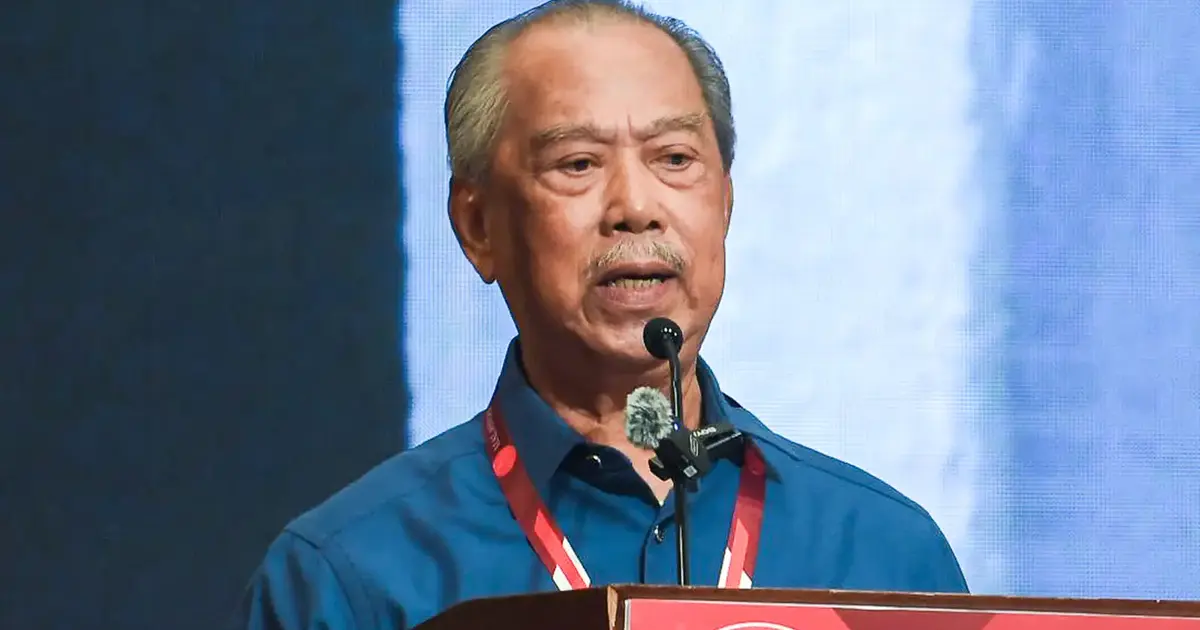
Political commentators have flagged a potential structural challenge for Bersatu as it navigates coalition politics ahead of the next general election, with particular focus on whether party president Muhyiddin Yassin can successfully defend his Pagoh parliamentary seat without broadened partnership arrangements. Analyst Mazlan Ali has highlighted that the former prime minister's previous parliamentary victories depended on coordinated electoral support from multiple coalition partners, suggesting that standalone party machinery may prove insufficient for retaining the seat in future contests.
Muhyiddin's political career has been characterised by strategic coalition-building across ideological and organisational divides. His ability to maintain Pagoh—a constituency he has represented for decades—has historically relied on the organisational reach and voter mobilisation capabilities of larger political entities. During the period when Bersatu was aligned with Pakatan Harapan and later when working alongside PAS, the combined resources and ground networks of these formations provided electoral advantages that extended beyond Bersatu's standalone capacity.
The current political landscape presents distinct challenges compared to previous electoral cycles. Bersatu's position within Malaysia's coalition architecture remains fluid, and the party's individual grassroots organisational strength differs markedly from larger formations like UMNO or DAP. For a figure of Muhyiddin's profile and a seat like Pagoh, where electoral margins have historically been competitive rather than commanding, such organisational constraints carry material consequences.
Analysts point to Pagoh's demographic and electoral characteristics as crucial context. The constituency encompasses both urban and rural voting blocs with varying political preferences and responsiveness to different messaging strategies. Mobilising such a diverse voter base requires either substantial party resources or effective coalition coordination that can deploy complementary campaign approaches across different community segments. Bersatu alone may lack the bandwidth for comprehensive coverage during an intensive general election campaign.
The coalition question also intersects with Muhyiddin's broader political standing. His tenure as prime minister from 2020 to 2021 and his subsequent leadership of Bersatu have generated both substantial support and determined opposition among Malaysian voters. Some constituencies reward this profile with loyalty, while others penalise it with tactical voting against him. In potentially hostile electoral territory, coalition partners' contributions become especially valuable in offsetting negative sentiment and mobilising swing voters.
Bersatu's partnership history offers instructive lessons. The party's time within Pakatan Harapan demonstrated how alignment with DAP and PKR could substantially enhance electoral performance in specific seats through shared campaign resources and strategic vote management. Similarly, the subsequent partnership with PAS—while more limited in scope—provided access to PAS's established ground networks and supporter loyalty in certain regions. Each partnership brought distinct electoral assets that proved complementary to Bersatu's own organising capacity.
The timing of this analysis carries significance as Malaysian politics enters a period of coalition repositioning. With the current Madani administration in office and the next general election timeline gradually clarifying, political parties face decisions about partnership configurations. For Bersatu specifically, these choices will directly influence not only Muhyiddin's personal electoral prospects but also the party's competitive positioning nationwide. Smaller coalition arrangements might suffice for peripheral seats, but defending high-profile constituencies where opposition research and competing campaigns receive intense focus demands broader coalition architecture.
Regional political developments also create contextual pressure. Competition within the Malay-Muslim political sphere remains intense, with UMNO, PAS, and other formations actively contesting for voter support in overlapping constituencies. In this environment, Bersatu cannot assume automatic consolidation of Malay-majority voter blocs. Coalition arrangements that bring additional organisational capacity and voter mobilisation networks become strategically important for defending seats against multiple rival candidates competing for similar voter demographics.
Mazlan Ali's analysis reflects broader scholarly and practitioner consensus that Malaysian electoral outcomes increasingly depend on coalition-level variables rather than individual party performance metrics alone. The transition from multi-party competition to structured coalition politics has fundamentally altered the mechanics of parliamentary representation. Voters increasingly decide based on coalition platforms and leadership rather than single-party positioning, while campaign resources and voter contact become organised through coalition mechanisms rather than purely party channels.
For Muhyiddin specifically, the coalition question links to his personal political legacy and future influence within Malaysian politics. Retaining Pagoh carries symbolic importance beyond the single parliamentary seat—it anchors his party leadership credibility and maintains his presence in parliament as a potential voice in government formation discussions. Loss of the seat would significantly diminish his political weight and constrain Bersatu's negotiating position in any future coalition arrangements.
The practical mechanics of coalition negotiation for seat defence create additional complexity. Potential partners must weigh the electoral benefits of supporting Muhyiddin's candidacy against their own strategic objectives and local political calculations. A partner agreeing to stand aside or provide subordinate support for Pagoh will seek reciprocal arrangements in other constituencies where they field candidates, creating cascading implications for coalition seat allocation nationwide.
Moving forward, Bersatu's leadership faces a strategic inflection point. The party must decide whether to pursue coalition arrangements primarily to defend high-profile incumbents like Muhyiddin or to develop standalone organisational capacity sufficient for broader electoral viability. This choice will shape the party's trajectory within Malaysian politics and influence both the breadth and sustainability of any coalition arrangements it subsequently pursues.

