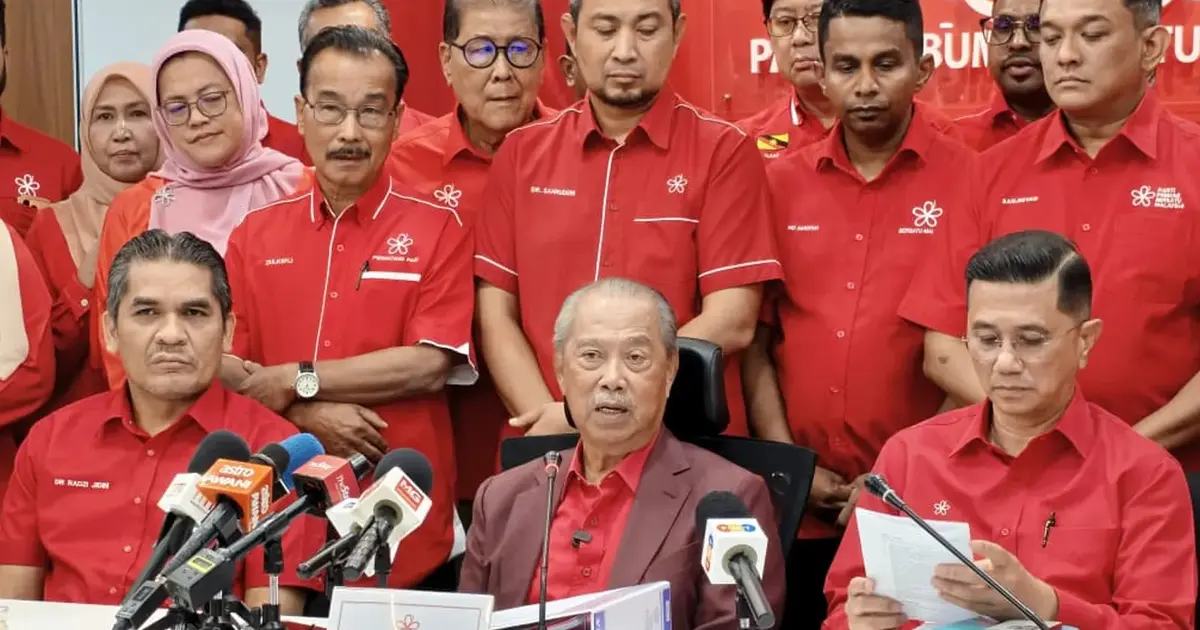
Bersatu will maintain its position within the Perikatan Nasional coalition, party president Muhyiddin Yassin has declared, anchoring the decision in what he characterises as widespread public approval of the alliance. The statement comes as Malaysia's political landscape continues to evolve following the 2023 general election, with various coalitions jockeying for influence and voter confidence ahead of future electoral contests.
Muhyiddin's assertion that public acceptance underpins Bersatu's coalition choice reflects a strategic calculation by the party leadership. Rather than framing the decision purely in terms of internal political arrangements or power-sharing agreements, the Bersatu president has sought to legitimise the partnership by invoking popular sentiment. This rhetorical approach suggests the party views its Perikatan Nasional alignment as responsive to voter preferences rather than merely a transaction among political elites.
For Malaysian observers, Bersatu's continued commitment to Perikatan Nasional carries significant implications for the broader political configuration. The coalition has positioned itself as an alternative to the federal government, particularly under Prime Minister Anwar Ibrahim's leadership and the Pakatan Harapan-led administration. By remaining within this grouping, Bersatu signals its intention to function as part of a sustained opposition force capable of challenging the ruling coalition.
The party's trajectory has been notable in recent Malaysian politics. Bersatu emerged from a split within UMNO in 2016 and has subsequently undergone various political realignments. Its participation in Perikatan Nasional represents a consolidation of anti-Pakatan forces, bringing together parties including PAS and other components seeking to contest the legitimacy of the current federal government.
Muhyiddin's framing of the decision around public acceptance rather than elite bargaining merit deeper examination. If Bersatu genuinely believes its coalition choice aligns with voter preferences, this suggests the party conducts polling or undertakes grassroots assessments to gauge public opinion. However, critics might argue that such claims require scrutiny, as political parties frequently invoke "public will" to justify decisions made primarily for organisational interests. The burden falls on Bersatu to demonstrate how this purported public acceptance translates into concrete electoral support.
The emphasis on public acceptance also speaks to contemporary Malaysian political culture, where legitimacy through electoral validation matters increasingly. Following the institutional turmoil of recent years—including the fallout from the 2020 political crisis and subsequent government formations—Malaysian voters have become more discerning consumers of political messaging. Parties that can convincingly argue they represent genuine public choice gain organisational credibility.
For Southeast Asian geopolitics, Bersatu's commitment to Perikatan Nasional carries indirect relevance. Malaysia's domestic political stability influences regional diplomacy, investor confidence, and the country's foreign policy orientation. A fragmented opposition that splinters into multiple competing blocs differs fundamentally from a cohesive alternative coalition. Perikatan Nasional's coherence, therefore, shapes not merely domestic competition but Malaysia's broader regional engagement.
The party's decision also reflects calculations regarding the 2027 general election, now a realistic political horizon. By consolidating its position within Perikatan Nasional rather than attempting independent parliamentary operations or pursuing realignment toward the government, Bersatu is signalling long-term strategic commitment. This approach allows for coordinated opposition campaign planning and resource allocation across coalition members.
Bersatu's base comprises various constituencies with distinct interests. The party draws support from Malay-Muslim voters, former UMNO members, and regions where its leadership maintains particular influence. Maintaining Perikatan Nasional membership allows these constituencies to remain mobilised within a broader anti-government framework while preserving Bersatu's distinct identity and leadership structure.
The question of how public acceptance manifests remains pertinent. Perikatan Nasional's polling performance, its electoral viability in specific constituencies, and its capacity to articulate policy alternatives distinct from Pakatan Harapan all affect how credible Muhyiddin's claims about public backing prove. Regional variations in coalition support—with Perikatan Nasional performing differently across Peninsular Malaysia, Sabah, and Sarawak—add further complexity.
Looking forward, Bersatu's confirmed participation in Perikatan Nasional establishes parameters for opposition political activity over coming months. Rather than pursuing unpredictable coalition shifts that might destabilise parliamentary calculations, the party has opted for institutional clarity. This decision facilitates intra-coalition coordination on legislative matters and provides opposition supporters a more stable platform for engagement.
Ultimately, Muhyiddin's statement represents both an affirmation of existing arrangements and an implicit claim about political legitimacy grounded in public sentiment. Whether Malaysian voters genuinely endorse this assessment will become clear through electoral processes and the coalition's ability to effectively challenge government policy and parliamentary dominance. For now, Bersatu's commitment to Perikatan Nasional sets an anchor point in Malaysia's evolving political geography.