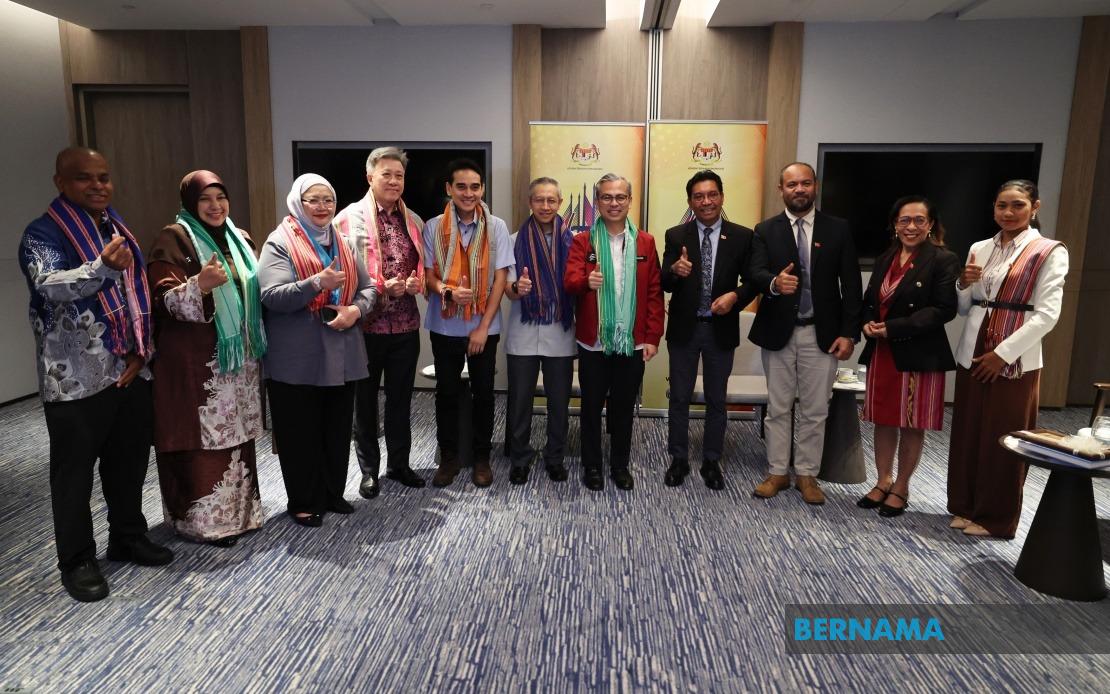
The Malaysian National News Agency (Bernama) and Timor-Leste's state news organization Agência Noticiosa de Timor-Leste (TATOLI) have formalised a strategic partnership through a memorandum of understanding, marking a significant step in strengthening media ties between two ASEAN member states. The agreement was officially executed in Butterworth during the National Journalists' Day (HAWANA) 2026 celebration, with the exchange witnessed by Prime Minister Datuk Seri Anwar Ibrahim and other senior government officials including Communication Minister Datuk Fahmi Fadzil and Timor-Leste's Secretary of State for Social Communication, Expedito Loro Dias Ximenes.
According to Bernama Chief Executive Officer Datin Paduka Nur-ul Afida Kamaludin, the partnership encompasses far more than a simple news exchange arrangement. The collaboration will enable both agencies to share photographs, multimedia content, and editorial resources while jointly developing training programmes and journalism courses tailored to building professional capacity across Southeast Asia. This multifaceted approach reflects an understanding that regional media strengthening requires investment in both immediate content distribution and longer-term institutional development.
The timing of this agreement holds particular significance, as Timor-Leste officially joined ASEAN just months earlier in October 2025. According to Nur-ul Afida, the Timorese agency had begun exploring partnership opportunities well before formal membership was secured, demonstrating serious commitment to integrating its news operations with the broader regional media ecosystem. Bernama's detailed evaluation of the proposal ensured that both organizations would benefit equitably, with consideration given to professional development opportunities for staff members at both agencies.
A distinctive feature of the partnership involves linguistic reach and cultural accessibility. TATOLI plans to distribute Bernama content through its platform in four languages—Tetum, Portuguese, Bahasa Indonesia, and English—thereby ensuring that Timor-Leste's citizens gain nuanced insight into Malaysian affairs and broader Southeast Asian developments. Recognising this opportunity, Bernama has committed to exploring Portuguese language translation of its own reporting, adding to its existing output in Bahasa Melayu, English, Tamil, Mandarin, Arabic, and Spanish. This expansion would allow the Malaysian agency to connect with Portuguese-speaking audiences globally, particularly in African nations and other territories where the language remains influential.
The immediate focus will centre on professional development. A cohort of TATOLI reporters is scheduled to undergo comprehensive training at Bernama facilities before year-end, gaining exposure to contemporary journalistic practices across multiple platforms. Bernama's training infrastructure is substantial, encompassing the Bernama School of Journalism and the Bernama Excellence Centre, which collectively represent more than two decades of accumulated pedagogical experience. The agency maintains specialist educators and editors versed in online journalism, television reporting, digital media production, radio broadcasting, and photojournalism—domains that reflect the technical diversity modern news organizations must master.
TATOLI President Noémio Mateus Soares Falcão positioned the agreement within a broader framework of institutional commitment to journalistic excellence and press freedom. He articulated the partnership not merely as a transactional arrangement but as part of TATOLI's mission to elevate professional standards across the Timorese media sector. Falcão emphasised that meaningful cooperation and sustained dialogue between news agencies strengthens the capacity of individual journalists, catalyses innovation in reporting methodologies and distribution channels, and contributes to creating an information environment characterised by accuracy, responsibility, and public benefit.
In a media landscape increasingly dominated by unverified content spreading rapidly across social platforms, Falcão identified the partnership as a counterweight to misinformation. He noted that the speed with which information now circulates digitally creates commensurate responsibility for professional news organizations to verify sources, maintain editorial standards, and ensure that audiences receive factually grounded reporting guided by established journalistic principles. This emphasis reflects growing recognition across ASEAN that national news agencies bear particular responsibility for protecting information integrity in their respective societies.
Bernama itself represents an established institutional player with deep historical roots in Malaysian media. Established under parliamentary legislation on April 6, 1967, and formally launched on August 30, 1967—coinciding with Malaysia's tenth independence anniversary—the agency has evolved into a regional news powerhouse. Its extensive archive, established reporting relationships with global news organizations, and sophisticated multimedia distribution infrastructure position it as a valuable partner for emerging or smaller news agencies seeking to upgrade their operations.
TATOLI, by contrast, is a younger institution, established in 2016 as Timor-Leste's official government news dissemination channel. Despite its recent founding, the organization carries the responsibility of representing the nation's voice internationally and managing domestic communications for the government. The partnership with Bernama provides TATOLI with access to proven systems and experienced professionals capable of enhancing the Timorese agency's operational sophistication.
The broader implication of this agreement extends beyond bilateral relations between Malaysia and Timor-Leste. The partnership exemplifies ASEAN's commitment to strengthening institutional cooperation in journalism and media development. As the bloc navigates complex geopolitical environments and faces coordinated disinformation campaigns, investing in regional news agency capacity becomes strategically important. When national news organizations collaborate and maintain editorial independence while sharing resources and expertise, they collectively strengthen the region's ability to generate and disseminate credible information.
The presence of representatives from other ASEAN members—including Cambodia's Undersecretary of State at the Ministry of Information Prak Thaveak Amida and Laos' Permanent Secretary of Cabinet Office at the Ministry of Technology and Communications Phuangpasert Keosouvanh—at the HAWANA 2026 ceremony suggests that media cooperation is becoming an increasingly recognized priority across Southeast Asia. These officials' attendance signals tacit endorsement of the Bernama-TATOLI model and possibly presages similar partnerships involving other ASEAN member states.
For Malaysian readers, this partnership represents an opportunity to understand how Bernama's expertise and institutional maturity can project Malaysian perspectives and values into new markets, particularly in Timor-Leste where demographic and linguistic factors create receptive audiences for Malaysian content. For regional observers, the agreement illustrates how ASEAN's newest member state is rapidly integrating into the bloc's institutional frameworks, positioning itself as an active participant rather than a peripheral observer in regional development initiatives.

