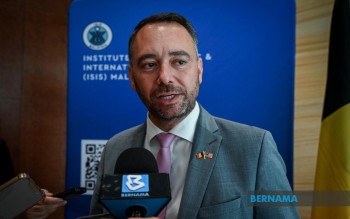
Belgium is positioning itself as a strategic partner for Malaysia's renewable energy ambitions, with the country's Deputy Prime Minister Maxime Prévot advocating for expanded bilateral cooperation in offshore wind during a state visit to Kuala Lumpur. Speaking at the 39th Asia-Pacific Roundtable forum, Prévot articulated Belgium's vision for joint ventures in clean energy technology, framing offshore wind capacity as a cornerstone of both nations' decarbonisation roadmaps and long-term energy security. The overture reflects growing European recognition that Southeast Asian markets, particularly Malaysia, represent critical frontiers for scaling renewable infrastructure in a region facing mounting energy demand coupled with climate commitments.
The Belgian minister's confidence in proposing this partnership stems from his country's proven track record in offshore wind development. Despite possessing only 60 kilometres of coastline—a constraint that makes Belgium's achievement all the more instructive—the nation has constructed offshore wind farms currently capable of generating two gigawatts of electricity. More significantly, Belgium has announced plans to expand this capacity to between six and seven gigawatts over the coming years, a leap equivalent to the output of five to seven conventional nuclear power plants. This expansion trajectory demonstrates that even geographically limited nations can achieve substantial renewable energy generation through technical sophistication and strategic investment, a lesson directly applicable to Malaysia's own offshore wind potential in the Straits of Malacca and other suitable coastal areas.
Prévot framed offshore wind as one of several complementary sectors ripe for bilateral advancement. Beyond energy, he identified semiconductors, logistics, clinical trials, biotechnology research and development, and pharmaceuticals as domains where Belgian expertise and Malaysian capabilities could create mutual value. This diversified approach suggests Belgium views the relationship as a comprehensive economic partnership rather than a transactional energy deal. For Malaysia, the proposition arrives at a moment when the nation is actively rebalancing its energy mix away from fossil fuels while managing rapid industrial expansion and rising electricity consumption across manufacturing hubs and urban centres.
The European Union has moved to cement this strategic orientation through substantial financial commitments. Under the EU's Global Gateway Strategy, the bloc and its member states have allocated €10 billion—equivalent to approximately RM46.5 billion—specifically to support the ASEAN Power Grid initiative and accelerate the region's energy transition. This initiative represents a significant geopolitical dimension to the energy discussion, effectively positioning European capital and technology as alternative sources of infrastructure investment and expertise compared to traditional development partners. The Global Gateway framework explicitly aims to foster sustainable, locally-beneficial development while strengthening regional connectivity and resilience, language that underscores how energy cooperation intersects with broader strategic positioning in Southeast Asia.
Malaysia's energy landscape stands to benefit substantially from such partnerships. The nation currently grapples with balancing renewable energy targets—Malaysia has set a goal of 40% renewable energy by 2035—against the realities of industrial competitiveness and power system reliability. Offshore wind, with its superior capacity factors compared to onshore installations and minimal land use conflicts, addresses these dual imperatives. Belgian expertise in integrating large-scale offshore wind into existing grids could prove invaluable as Malaysia develops the technical and regulatory infrastructure necessary to support such projects at commercial scale. The technology transfer and knowledge sharing implicit in partnerships with mature offshore wind operators would strengthen Malaysia's long-term technological autonomy and competitiveness in renewable energy sectors.
The economic dimensions of Malaysia-Belgium relations already reflect a growing engagement trajectory. Total bilateral trade reached RM9.74 billion in 2025, with Malaysian exports comprising RM6.85 billion and imports at RM2.89 billion. More telling is the investment footprint: as of 2025, Belgian firms had secured approval for 67 projects in Malaysia involving RM5.1 billion in committed capital and generating over 4,600 jobs. These figures indicate that Belgian business interests are deepening their Malaysian presence, suggesting that Prévot's renewable energy proposal aligns with broader corporate strategy in the region. Any expansion of energy sector cooperation would likely stimulate additional foreign direct investment flows and create downstream opportunities in associated industries such as manufacturing, engineering services, and technical education.
Prévot's visit represents his first trip to Malaysia since assuming the position of Deputy Prime Minister and Minister of Foreign Affairs in February 2025, itself a signal of priority accorded to Southeast Asian relations within the Belgian government. The timing of the pitch—delivered during a prominent regional forum—indicates Brussels views energy transition cooperation as central to European-ASEAN relations during this critical decade. European capitals are acutely conscious that energy infrastructure decisions made now will determine regional geopolitical alignments for decades, making strategic investments in renewable capacity not merely technical exercises but exercises in relationship-building and influence.
The convergence of Malaysian energy needs, European technological prowess, and EU financing mechanisms creates a compelling framework for collaboration. Malaysia possesses substantial offshore wind resources, particularly in the waters surrounding Peninsular Malaysia and East Malaysia, yet lacks the accumulated experience that Belgium and other European nations have developed. Establishing formal mechanisms for technology transfer, joint ventures, and knowledge exchange could accelerate Malaysia's offshore wind capacity while simultaneously securing European stakeholders a foothold in Southeast Asian energy markets. Such arrangements frequently include provisions for local workforce development, supply chain integration, and graduated technology transfer, ensuring benefits extend beyond bilateral corporate relationships to strengthen Malaysian industrial capabilities.
The broader ASEAN context amplifies the significance of Malaysia-Belgium energy cooperation. The ASEAN Power Grid initiative, to which the EU is allocating €10 billion, envisages integrated energy networks across member states, enabling resource-rich nations to supply renewable power to demand centres across borders. If Malaysia develops substantial offshore wind capacity through partnership with European operators, the nation could potentially emerge as a regional energy exporter, complementing hydroelectric resources from Laos and other renewable sources across the bloc. This transformation would simultaneously advance Malaysia's green economy credentials, attract further clean energy investment, and position the country as an energy security anchor within ASEAN during a period of regional geopolitical flux.
The proposal also reflects evolving geopolitical calculations within the global energy transition. Competition for influence in Southeast Asia's energy sector encompasses not only European and American actors but also Chinese firms specialising in solar and battery manufacturing, Indian renewable developers, and Middle Eastern sovereign wealth funds diversifying into clean energy. European engagement through technology partnerships and infrastructure investment represents a distinct development model emphasising transparency, regulatory alignment, and locally-beneficial ownership structures. Malaysian policymakers evaluating offshore wind development partnerships will effectively be choosing between competing models of energy infrastructure governance, each carrying different implications for technological sovereignty, employment structures, and long-term economic resilience.

