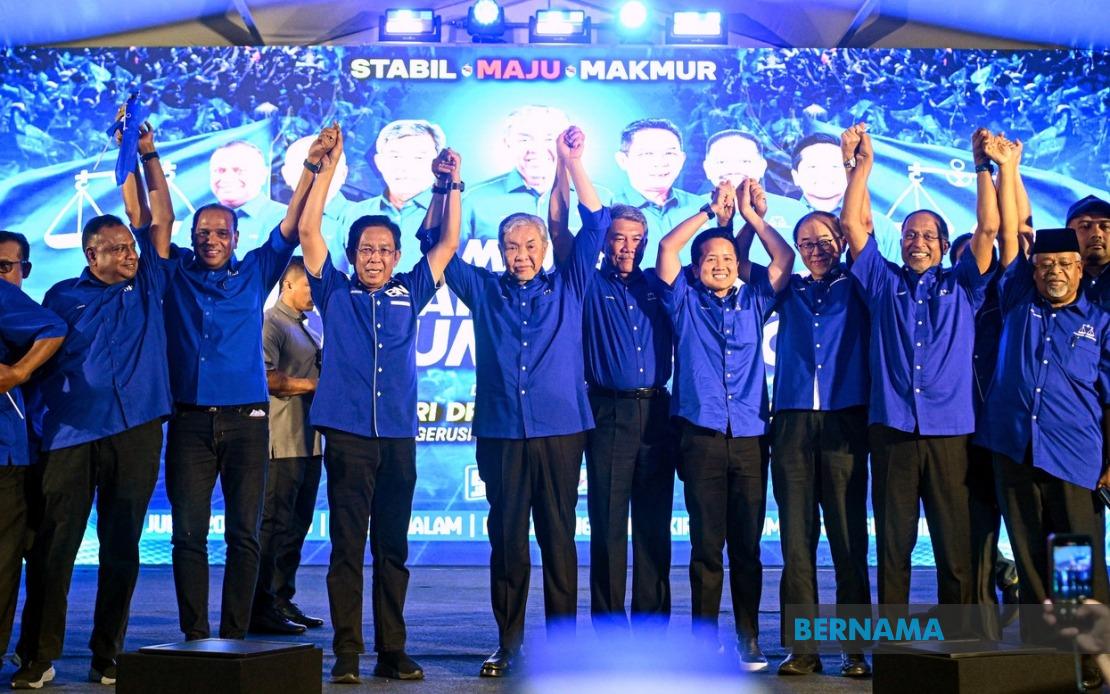
Barisan Nasional has formally announced 25 candidates for the 16th Negeri Sembilan state election, striking a balance between experienced legislators and fresh political talent. The coalition unveiled its comprehensive election machinery at a gathering in Paroi, signalling its preparations for what is expected to be a closely contested race in the traditionally competitive central state.
Negeri Sembilan BN chairman Datuk Seri Mohamad Hasan will retain his seat in Rantau, extending a tenure that dates back two decades. His continuing candidacy represents continuity for a state that has seen significant political shifts in recent years, and reflects confidence from UMNO president Datuk Seri Dr Ahmad Zahid Hamidi in the leadership of BN's Negeri Sembilan chapter. Mohamad's position as deputy chairman of the national coalition further underscores his strategic importance to party calculations.
Alongside Mohamad's reconfirmation, Datuk Seri Jalaluddin Alias will defend the Pertang state seat, a position he has occupied since the 2013 election. Jalaluddin, who serves simultaneously as chairman of Negeri Sembilan UMNO's Liaison Committee and as the Member of Parliament for Jelebu, represents the overlapping leadership structures that characterise Malaysian federal and state politics. His dual responsibilities highlight the interconnected nature of governance at both levels and the strategic value of retaining MPs with simultaneous state assembly influence.
The decision to retain Mohamad and Jalaluddin reflects a conservative approach to candidate selection, prioritising experienced figures in seats that BN considers essential to its electoral prospects. Both men have established networks in their respective constituencies and carry the advantage of institutional knowledge accumulated over multiple election cycles. This strategy acknowledges the reality that state elections are often decided at the margins, particularly in marginal constituencies where incumbent recognition and ground presence prove decisive.
Other incumbents confirmed for recontention include Datuk Mohd Faizal Ramli in Linggi and Datuk Mustapha Nagoor in Palong, further emphasising BN's inclination towards retaining proven performers. These selections suggest the coalition views these seats as defensible against potential challenges from both Pakatan Harapan and any other opposition coalitions that may emerge. The retention of multiple experienced candidates simultaneously sends a message of stability to the electorate whilst maintaining continuity in legislative oversight.
However, the announcement reveals significant incompleteness in BN's preparations for the election. Eleven state seats remain without finalised candidates, representing nearly forty percent of the state assembly. This gap encompasses constituencies across the geographic and socioeconomic spectrum of Negeri Sembilan, including Klawang, Serting, Lobak, Sikamat, Ampangan, Bukit Kepayang, Mambau, Paroi, Lukut, Bagan Pinang, and Gemas. The postponement of these selections suggests internal negotiations remain underway, possibly involving debates about whether to retain sitting assemblymen or introduce new candidates in more vulnerable seats.
For Malaysian political observers, the incomplete candidate roster raises questions about BN's internal coordination and readiness for an election that could be called at relatively short notice. Unlike federal elections, state contests in Malaysia can materialise with compressed campaign timelines, placing a premium on advance preparation. The fact that substantial portions of the slate remain undecided hints at either deliberate strategic timing or potential difficulties in reaching consensus among coalition partners, particularly concerning seat allocations between UMNO and its partners MCA and MIC.
Negeri Sembilan's political landscape has undergone considerable transformation over the past decade, with the state experiencing shifts in federal-level representation and evolving voter preferences. The state's relatively small size and comparatively modest electorate make it sensitive to statewide campaigns, where individual leader popularity and state-specific issues acquire outsized importance. Voters in Negeri Sembilan have demonstrated willingness to split support between federal and state governments, complicating predictions about electoral outcomes based on national political trends alone.
The incomplete candidate announcements also create a window for speculation and counter-positioning by opposition parties. Pakatan Harapan and other potential contenders gain additional time to shore up their own preparations, whilst the vacuum in BN's lineup might encourage defections or candidacy negotiations in constituencies where the coalition's intentions remain unclear. This tactical disadvantage could prove consequential if election timing is accelerated.
As BN moves toward finalising its remaining candidates, the coalition faces the broader challenge of articulating a coherent state-level platform that resonates beyond traditional support bases. Negeri Sembilan's economy, education infrastructure, and development priorities differ materially from national concerns, demanding that candidates present substantive local agendas rather than merely echoing national messaging. The quality and relevance of the eventual 25-strong slate may ultimately matter more than the speed with which it was assembled.
The coming weeks will reveal whether BN's phased announcement strategy reflects confident deliberation or organisational strain. For Negeri Sembilan voters and observers across Southeast Asia monitoring Malaysian state-level politics, the completeness and coherence of the final candidate list will provide meaningful indicators about the coalition's preparation levels and internal stability heading into what could prove a pivotal electoral contest.

