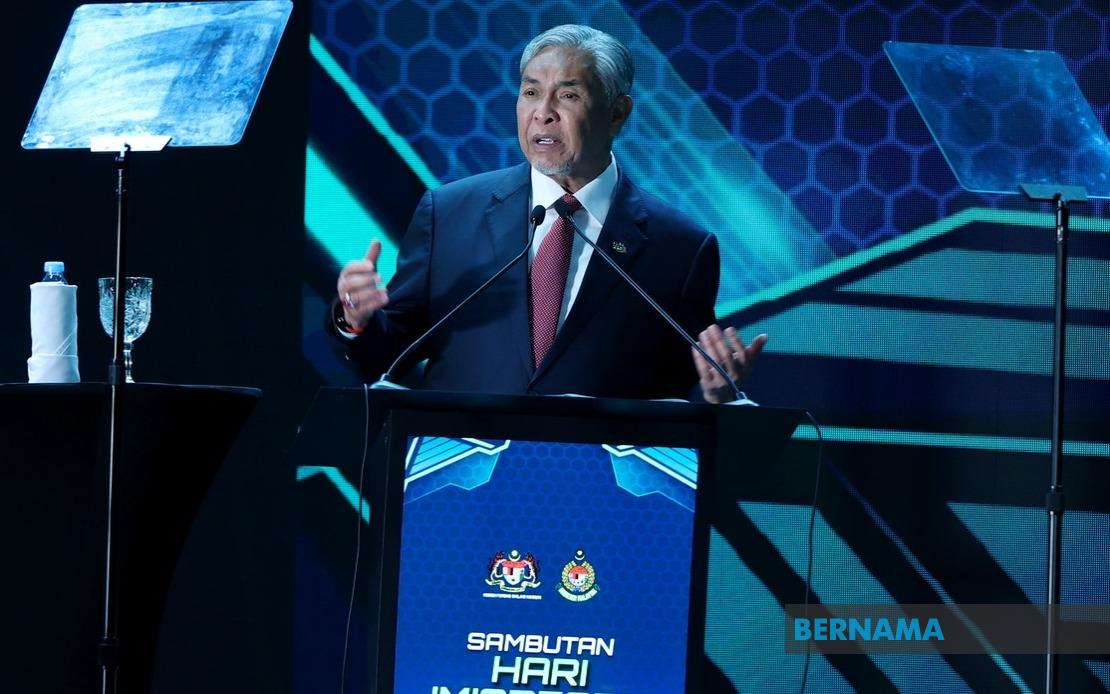
Barisan Nasional has reaffirmed its unwavering commitment to the ongoing Unity Government arrangement, with party chairman Datuk Seri Dr Ahmad Zahid Hamidi declaring that the coalition will honour the mandate delivered at the last UMNO General Assembly (PAU). Speaking at a press conference following the 2026 Immigration Day celebration in Cyberjaya on July 21, Ahmad Zahid, who holds the dual positions of UMNO president and Deputy Prime Minister, emphasised that the party's stance reflects the wishes of its highest decision-making body and must be respected by all concerned parties.
The assurance comes at a time when Malaysia's political landscape remains fluid, with various interests competing for influence within the ruling coalition that was formed following the 2022 general election. Ahmad Zahid's declaration carries particular weight given his proximity to Prime Minister Datuk Seri Anwar Ibrahim and his standing as one of UMNO's most senior figures. His insistence that no body supersedes the authority of the General Assembly underscores the significance of the collective decision and suggests that internal party consensus on this matter is solid, at least at the leadership level.
The emphasis on honouring the General Assembly resolution reflects a broader institutional concern within UMNO and BN to project stability and predictability to both domestic stakeholders and the international business community. Political uncertainty has historically rattled investor confidence in Malaysia, and maintaining a coherent coalition government narrative serves to mitigate such concerns. By anchoring BN's participation in language of democratic process and institutional decision-making, Ahmad Zahid frames the arrangement not as a tactical accommodation but as a principled commitment grounded in party governance structures.
Separately, Ahmad Zahid addressed the delicate question of ministerial accountability within the government, acknowledging the Prime Minister's constitutional authority to manage Cabinet appointments and removals. This response came in the context of recent reports that Anwar Ibrahim had issued warnings to ministers and deputy ministers against leveraging their positions to attack coalition partners during state-level election campaigns. The distinction matters significantly in Malaysia's coalition context, where resource-sharing and turf management between partners generate frequent friction.
Ahmad Zahid's statement effectively delegates the authority for enforcing discipline to the Prime Minister, which itself represents a calculated position. By publicly affirming Anwar's prerogative, Ahmad Zahid demonstrates UMNO's willingness to subordinate internal grievances to cabinet-level decision-making processes. This approach helps prevent individual disputes from escalating into inter-party conflicts that could destabilize the Unity Government as a whole. For coalition members, it signals that concerns about potential misconduct should be channelled through formal mechanisms rather than public disputes.
The warnings reportedly issued by Anwar Ibrahim target a specific problem common to multi-party coalitions: the temptation for government members to score political points at the expense of alliance partners, particularly during electoral campaigns when stakes are raised. Such behaviour undermines coalition discipline and can create corrosive resentment between parties that must otherwise cooperate on legislative and policy matters. By establishing clear consequences, the Prime Minister seeks to prevent the kind of internal undermining that has historically weakened coalition governments in Malaysia.
For Barisan Nasional specifically, the commitment to the Unity Government represents a strategic calculation that participation in federal power outweighs the potential benefits of opposition status. This holds particular significance given BN's historical dominance before 2018, and the party's journey through the opposition ranks between 2018 and 2022. Returning to government required accepting a subordinate role relative to PKR and other coalition partners, a position that would inevitably generate internal criticism from those favouring a more aggressive stance.
The Malaysian political environment has seen increased volatility in recent years, with state and federal elections producing unpredictable results and coalition arrangements shifting accordingly. Against this backdrop, Ahmad Zahid's reiteration of commitment serves to anchor one element of the equation, signalling to potential allies and observers that BN will not be easily dislodged from its current positioning. Such stability in at least one major coalition component may be necessary to prevent cascading realignments that could trigger broader governmental instability.
Looking forward, the binding nature of the General Assembly resolution creates both opportunities and constraints for BN leadership. It provides political cover against internal faction challenges, as Ahmad Zahid can point to democratic party procedures as justification for the coalition arrangement. However, it also constrains flexibility should circumstances change dramatically or should electoral performance in upcoming state contests fundamentally alter calculations about the coalition's viability. The resolution thus represents a two-edged sword: reassuring to current allies but potentially problematic if party members conclude that the original mandate no longer serves UMNO's interests.
The broader context of Ahmad Zahid's remarks suggests that despite periodic tensions, Malaysia's ruling coalition has achieved sufficient stability to address operational matters like ministerial conduct through established channels. The delegation of disciplinary authority to the Prime Minister, combined with BN's formal commitment to coalition participation, creates a framework within which disputes can theoretically be managed without threatening the entire structure. Whether this framework will prove robust enough to withstand the inevitable stresses of coalition governance through the next general election remains an open question for Malaysian politics.

