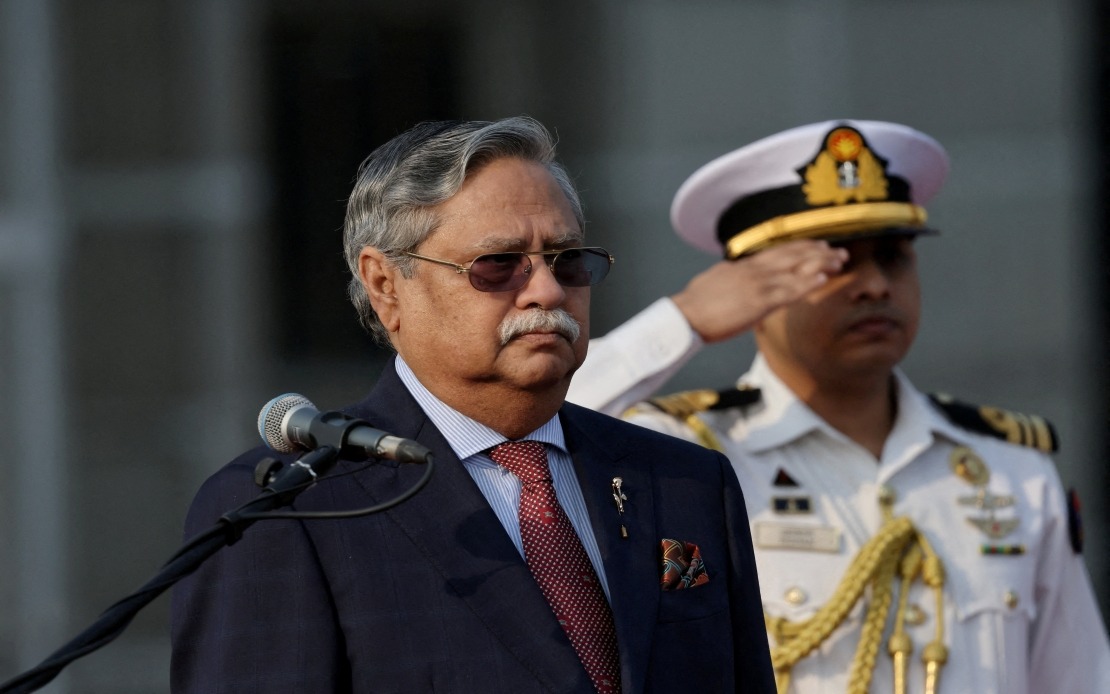
Bangladesh witnessed another significant constitutional moment on Friday when President Mohammed Shahabuddin tendered his resignation to Parliament Speaker Hafiz Uddin Ahmed, citing serious health concerns that have rendered him unable to discharge the responsibilities of his office. The 76-year-old leader's departure marks a dramatic interruption to what should have been a five-year presidential term extending to April 2028, underscoring the volatile nature of political life in the South Asian nation and the cascading consequences of last year's upheaval that fundamentally reshaped the country's leadership landscape.
Shahabuddin's health declaration in his resignation letter arrives at a particularly sensitive juncture for Bangladesh's transitional administration. The Bangladesh Nationalist Party, which currently commands a parliamentary majority following the dramatic ouster of Prime Minister Sheikh Hasina last summer, now faces the task of selecting and installing a new head of state within a constitutionally mandated 90-day window. This timeline, while providing adequate space for deliberation, nonetheless injects urgency into a political environment already strained by questions concerning the legitimacy and direction of the post-Hasina order.
The circumstances surrounding Shahabuddin's exit carry significant symbolic weight beyond the health justifications offered in his formal letter. Reports surfaced in recent months suggesting that the president had engaged in telephone conversations with Hasina during a medical visit to the United Kingdom in May, a revelation that triggered considerable discomfort within ruling circles already wary of any perceived connections between the current administration and the ousted leader. Such contact, however innocuous in nature, has become politically radioactive given Hasina's flight to India following the student-led demonstrations that convulsed Bangladesh in the summer of 2024.
Hashina's trajectory illuminates the extraordinary reversals that have defined contemporary Bangladeshi politics. Once commanding absolute authority through her Awami League party, she now exists in Indian exile facing capital punishment for civilian deaths connected to her government's tenure. Her intended return to Bangladesh later this year, as she has publicly indicated, will test the stability of the current administration and potentially reignite dormant tensions. The mere suggestion of her communication with a sitting president was sufficient to generate momentum for Shahabuddin's departure, revealing how thoroughly her legacy has become toxic within establishment circles.
Shahabuddin's appointment to the presidency in April 2023 occurred during the twilight of Hasina's administration, before the dramatic popular uprising that would ultimately dislodge her from power. He thus occupied an unusual position: elevated to office during one political dispensation, only to find himself serving under an entirely different regime following the seismic events of mid-2024. This dissonance appears to have become increasingly untenable, both for the individual and for the administration that inherited him.
Under Bangladesh's constitutional framework, the role of interim president will automatically transfer to Parliament Speaker Hafiz Uddin Ahmed upon Shahabuddin's departure. This arrangement ensures continuity of state functions while the legislative body determines who will fill the presidency permanently. The BNP's substantial parliamentary majority positions it to engineer the selection of a president aligned with its political preferences, a dynamic that carries obvious implications for the character of the post-Hasina settlement.
The resignation represents the culmination of mounting pressure from opposition quarters demanding that Shahabuddin relinquish office. These calls had intensified in recent weeks, transforming the question from whether he would depart into when such departure would occur. The apparent deterioration of his health provided both a convenient exit vehicle and a face-saving mechanism that allowed all parties to characterise the departure as inevitable rather than forced.
For Malaysian observers and regional analysts monitoring Bangladesh's post-July 2024 transition, this development reinforces patterns visible across much of South Asia wherein political offices have become increasingly precarious and tenures subject to unexpected interruption. The durability of constitutional positions appears secondary to shifting factional alignments and popular sentiment. Shahabuddin's truncated presidency exemplifies how individuals elevated through one political configuration can find themselves ensnared by subsequent transformations beyond their capacity to control or navigate successfully.
The 90-day period for selecting a replacement president will provide critical opportunities for assessing the Bangladesh Nationalist Party's vision for state leadership and its intended relationship with institutional structures inherited from the Hasina era. These decisions will shape not merely the ceremonial functions of the presidency but potentially influence how Bangladesh manages reconciliation with its recent past and positions itself regionally amid broader Indo-Pacific geopolitical currents that hold implications for Southeast Asian states navigating similar competitive dynamics.
Shahabuddin's departure, though ostensibly grounded in medical considerations, thus represents far more than the retirement of an aging official. It crystallises the ongoing reconstruction of Bangladesh's political order, the precarious status of inherited institutional positions, and the persistent gravitational pull that Hasina's absence continues to exert upon the nation's ruling structures. The selection of her successor will constitute a meaningful statement regarding the durability of the post-2024 settlement and the administration's confidence in its capacity to govern without perpetually accounting for the spectre of the ousted premier now residing in neighbouring India.

