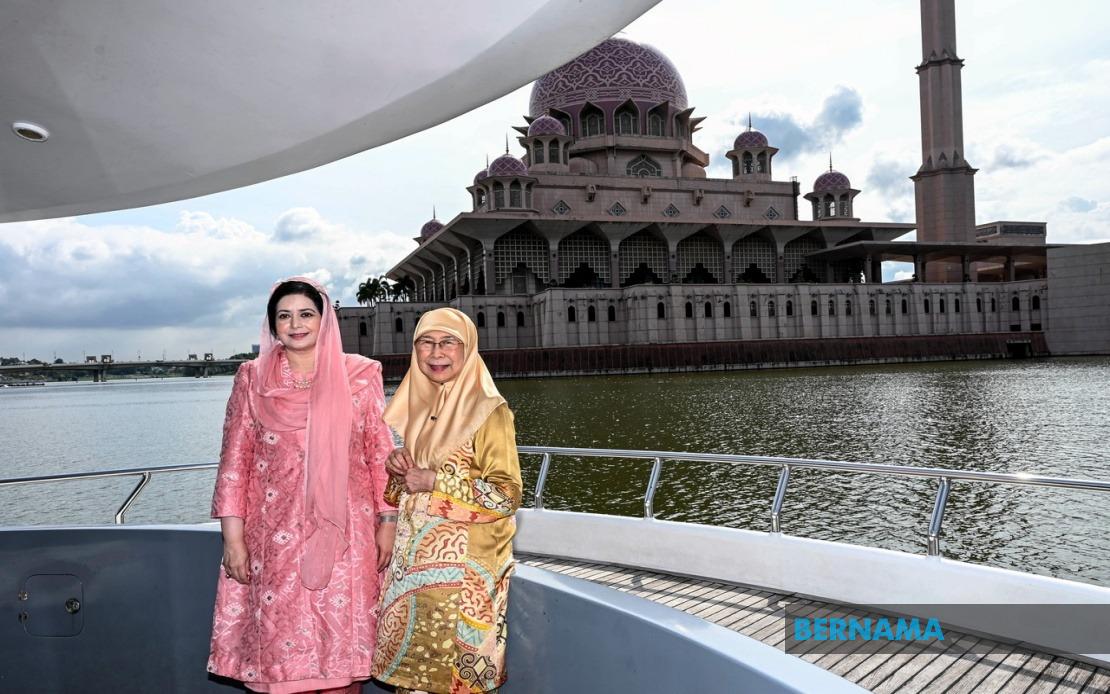
Dr Zubaida Rahman, spouse of newly-minted Bangladesh Prime Minister Tarique Rahman, spent Saturday morning experiencing Putrajaya's waterfront attractions from the vantage point of a lake cruise, soaking in panoramic views of the federal territory's distinctive architectural ensemble. The excursion, which commenced at 9:30 am, formed part of the high-level diplomatic schedule accompanying her husband's presence in Malaysia for an official state visit intended to deepen partnership between the two South Asian nations.
The Bangladeshi first lady received a warm reception from Dr Wan Azizah Wan Ismail, wife of Prime Minister Datuk Seri Anwar Ibrahim, as well as Hannah Yeoh, who holds the portfolio of Minister in the Prime Minister's Department overseeing the Federal Territories portfolio. The welcoming delegation reflected the significance Malaysia places on strengthening ties with Dhaka, positioning the encounter as more than a perfunctory courtesy but rather a substantive engagement between the leadership families of both countries.
During approximately sixty minutes spent aboard the vessel, Dr Zubaida engaged in substantive dialogue with her Malaysian counterparts whilst observing Putrajaya's skyline—a carefully planned cityscape featuring government buildings, mosques, and public spaces designed to project Malaysia's administrative modernity. The cruise provided an informal diplomatic setting, allowing the principals to discuss mutual concerns and shared aspirations in a relaxed environment that facilitated candid conversation beyond formal protocol.
The broader context for this personal engagement stems from the arrival of Prime Minister Tarique Rahman and Dr Zubaida in Malaysia on Sunday evening to undertake a two-day official visit. This mission carries particular significance as it represents Tarique's inaugural bilateral journey abroad since assuming Bangladesh's highest executive office in February 2026, signalling his government's prioritisation of regional relationships at this formative juncture of his administration.
Prime Minister Anwar extended the invitation personally, underscoring Malaysia's interest in fortifying institutional and people-to-people connections with its South Asian neighbour. The visit's stated objectives encompass both consolidating existing collaborative frameworks and identifying novel avenues for cooperation spanning sectors of mutual economic, strategic, and cultural benefit. For Malaysia, such engagements affirm its positioning as a central node within South Asian regional diplomacy, a role increasingly important as the broader Indo-Pacific geopolitical landscape experiences realignment.
The bilateral relationship possesses substantial economic foundations. Bangladesh currently ranks as Malaysia's 28th-largest trading partner globally, a position that understates the relationship's importance within South Asian contexts. The two-way merchandise trade reached RM12.18 billion in recent accounting periods, establishing Bangladesh as Malaysia's second-most valuable trading partner throughout the South Asian subcontinent, trailing only India's significantly larger commercial footprint. This trading relationship encompasses diverse sectors including textiles, agriculture, pharmaceuticals, and increasingly technology-enabled services.
From a Malaysian perspective, deepening engagement with Bangladesh carries strategic implications beyond immediate commercial considerations. The South Asian nation, as the world's eighth-most populous country and a crucial participant in Indo-Pacific maritime dynamics, represents an important counterpart for Malaysia as it recalibrates regional partnerships. Bangladesh's position along critical shipping lanes and its growing economic dynamism make it an attractive destination for Malaysian investment and technology transfer, while Bangladeshi workers contribute meaningfully to Malaysia's labour-dependent sectors.
The symbolic weight of the Putrajaya Lake Cruise itself merits consideration. The federal territory represents Malaysia's aspirational vision as a modern, well-planned administrative centre—a showcase intended to demonstrate governmental competence and nation-building achievement. Exposing visiting dignitaries to this curated landscape serves communicative purposes beyond mere sightseeing, implicitly suggesting Malaysia's development trajectory and the standards it has achieved. Such choreographed moments of statecraft, though seemingly informal, contribute to broader diplomatic narratives about capability, stability, and partnership readiness.
The participation of both Dr Wan Azizah and Hannah Yeoh in welcoming Dr Zubaida underscores Malaysia's commitment to advancing women's representation within diplomatic spheres. Both Malaysian officials occupy significant governmental positions, with Dr Wan Azizah serving as an influential political figure in her own right and Hannah Yeoh representing a younger generation of Malaysian political leadership. This composition sends subtle messaging about Malaysia's institutional evolution and values regarding women's participation in governance—messaging that resonates across South Asia where gender representation in leadership continues evolving.
Tarique Rahman's assumption of office in February 2026 followed particular political circumstances within Bangladesh. His decision to prioritise an official bilateral visit to Malaysia relatively early in his tenure indicates several considerations: recognition of Malaysia's economic significance, appreciation for Malaysia's non-aligned diplomatic posture, and possibly efforts to demonstrate Bangladesh's connectivity with major Southeast Asian players to domestic and international audiences. The choice of Malaysia as the venue for his first official bilateral journey abroad carries diplomatic significance, effectively elevating Malaysia's relationship profile within Bangladeshi foreign policy calculations.
The two-day timeframe for the visit allows for substantive engagement beyond ceremonial encounters. Typically, such schedules encompass bilateral meetings between prime ministers, discussions involving trade delegations and business communities, cultural exchanges, and possibly military or security dialogue. The inclusion of leisurely yet diplomatically purposeful activities like the lake cruise serves to humanise official relations, creating informal moments where personal rapport between leaders can develop—a dimension of statecraft that international relations scholarship increasingly recognises as consequential for long-term partnership durability.
Looking forward, this visit potentially catalyses expanded Malaysian-Bangladeshi cooperation in domains ranging from infrastructure development, where Malaysian expertise and capital could support Bangladesh's urbanisation, to tertiary education partnerships, where Malaysian universities increasingly attract South Asian talent. Energy security discussions may also feature, as Bangladesh explores diversified sources to support its expanding economy. For Malaysian businesses, the visit signals receptiveness from Bangladesh's highest levels toward increased commercial engagement and investment proposals.

