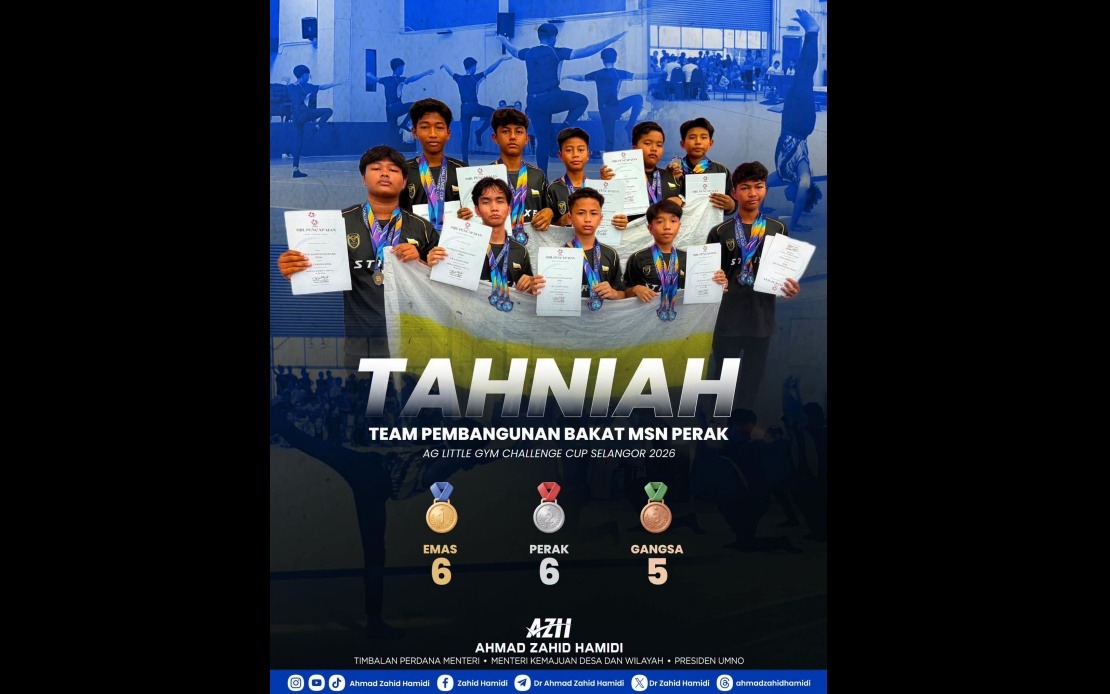
Young athletes from Bagan Datuk have etched their names into local sporting history by delivering an exceptional performance at the AG Little Gym Challenge Cup Selangor 2026, held in Kajang on August 1. The team's haul of six gold medals, complemented by six silver and five bronze medals, represents a significant achievement that has drawn widespread recognition from both state and federal leadership. The success signals the growing prominence of gymnastics in Perak and demonstrates the competitive calibre that young Malaysian athletes are capable of attaining on the regional stage.
Deputy Prime Minister Datuk Seri Dr Ahmad Zahid Hamidi, who represents Bagan Datuk as its Member of Parliament, publicly celebrated the accomplishment through a Facebook post that underscored the broader significance of the medals beyond sport. His response reflects a political interest in highlighting how communities within his constituency are excelling across multiple disciplines. The attention from Malaysia's second-highest elected official to a local gymnastics competition emphasises the symbolic value placed on youth achievement in bridging academic excellence with athletic prowess.
In his statement, Ahmad Zahid positioned the gymnasts' success as evidence that Bagan Datuk's younger generation possesses capabilities extending well beyond the classroom. He emphasised that the medals represent not merely athletic talent but the fruits of proper guidance, institutional support, and opportunities—factors that underline why some communities consistently produce sporting champions while others struggle to develop athletic infrastructure. This framing connects youth sports development to broader questions of resource allocation and community investment across Malaysian districts.
The Deputy Prime Minister's commendation extended to the entire ecosystem surrounding the athletes, acknowledging the critical roles played by coaches, parents, and support teams whose unseen labour undergirds visible medal success. This recognition is particularly pertinent in Malaysian sports culture, where grassroots development often depends on volunteer coaching and parental sacrifice rather than state funding. By publicly naming these contributors, Ahmad Zahid highlighted the communal nature of sporting achievement and implicitly validated the efforts of amateur sports clubs operating with limited resources.
The Bagan Datuk Generasi Muda Gymnastics Club, the organisation responsible for developing and training these athletes, released its own statement that struck a notably forward-looking tone. Rather than treating the medals as a culmination, the club framed them as a waypoint in a longer journey of athletic development. This perspective aligns with contemporary sports science understanding that single competitions, however successful, represent only moments within an athlete's trajectory, and that sustained improvement requires continuous refinement of technique and physical conditioning.
The club's emphasis on discipline, training hours, and the psychological resilience demanded by gymnastics training speaks to the sport's unique demands compared to team-based athletics. Gymnastics requires individual mastery of complex motor skills, absolute focus during competition, and the capacity to perform precisely under pressure—qualities that take months and years to cultivate. The medals won in Kajang therefore represent not sudden achievement but the materialisation of extended preparation that likely involved daily training sessions, nutritional discipline, and mental conditioning.
For Malaysian sports policy discussions, the Bagan Datuk performance offers a case study in how localised success can emerge from determined club-level operations. Unlike football or badminton, which benefit from established developmental pathways and corporate sponsorships, gymnastics in Malaysia remains predominantly club-driven. The fact that a district-level club in Perak could produce medal-winning performers at a state-level championship suggests that systematic gymnastics development, even with modest resources, can yield competitive results.
The championship victory also carries implications for gender dynamics in Malaysian sports. Gymnastics, particularly at youth levels, attracts substantial female participation, and any competitive success in the sport inherently provides visibility and recognition to young female athletes. This exposure matters in a context where sporting opportunities and media coverage remain unevenly distributed between male and female athletes across most Malaysian sports disciplines.
Looking forward, the Bagan Datuk team's statement that "this is not the finish line" carries practical implications for how these young athletes and their club will invest their newfound profile. Success at district or state level often opens pathways to coaching from more experienced mentors, access to better training facilities, and potential sponsorship opportunities. Whether the Kajang medals translate into sustained competitive advancement will depend on the club's capacity to maintain momentum and athletes' willingness to intensify training commitments as they face stronger regional and national competition.
The Bagan Datuk achievement also underscores the heterogeneous nature of Malaysian sporting talent, which extends far beyond the dominant sports of badminton, football, and chess that typically dominate national headlines. Gymnastics medals from a Perak district team represent untapped reservoirs of athletic potential distributed across Malaysia's communities. Developing these talents systematically would require greater awareness of where emerging athletes are competing and intentional policies to identify and support promising young performers before they age out of competitive windows.
For readers across Southeast Asia, the story illustrates how sports development at the community level can function within emerging economies. The Bagan Datuk model—modest infrastructure, volunteer coaching, parental investment—mirrors patterns visible across the region where clubs rather than state academies often nurture young athletes. Understanding these pathways provides insight into how the region's sporting talent emerges and where future Olympic or Asian Games medalists are being developed.

