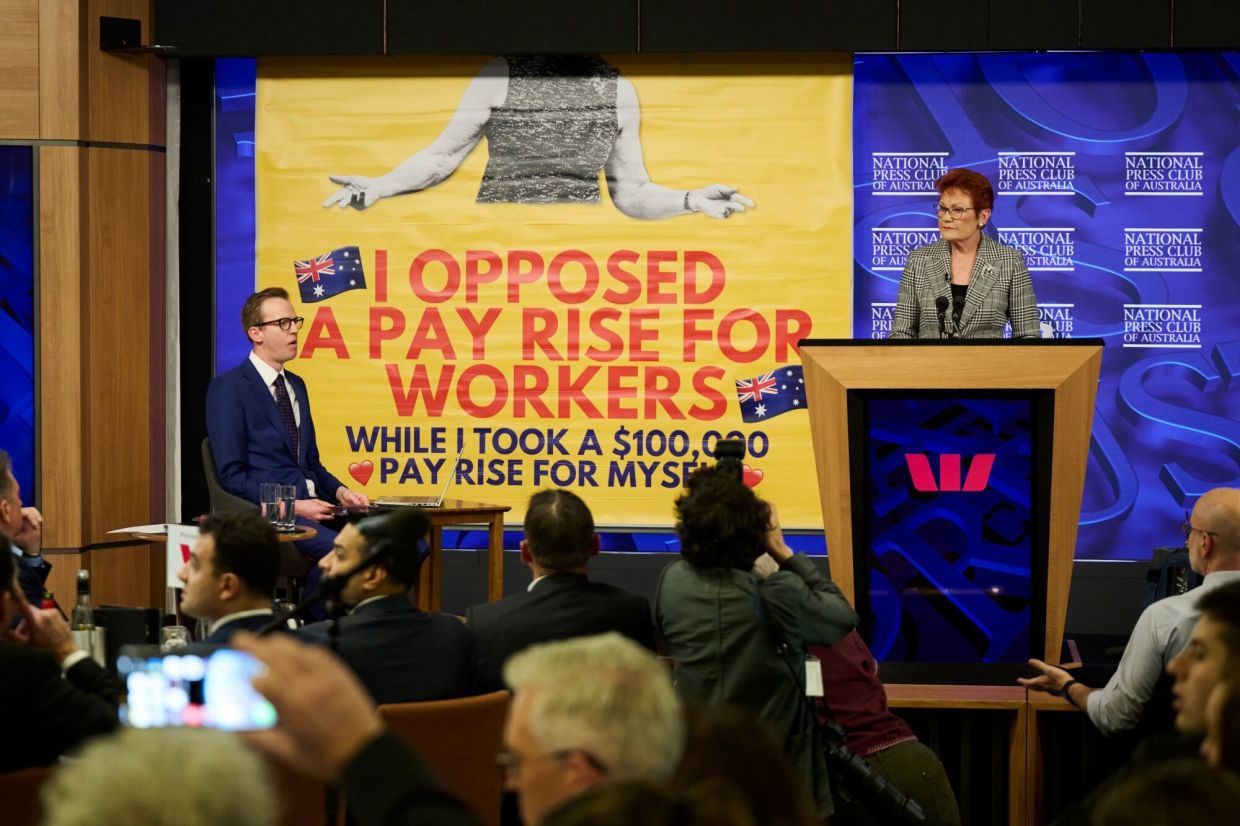
Pauline Hanson, leader of Australia's hard-right One Nation party, has publicly rejected decades of multicultural policy, instead calling for the nation to embrace a monocultural identity. Speaking at the National Press Club in Canberra on Wednesday, Hanson made the controversial pitch at what was her first appearance at the venue in a 30-year political career, signalling a shift in her party's messaging as it gains electoral traction.
Hanson's framing makes a critical distinction that has become central to her party's rhetoric: that while Australia must accept that it is a multiracial society, it cannot remain multicultural. This conceptual split—acknowledging racial diversity whilst rejecting cultural pluralism—attempts to navigate between demographic reality and cultural nationalism. "We cannot be a multicultural society," she declared. "We are a multiracial society, but we must be monocultural. Australians must live under the one cultural umbrella." The language positions cultural assimilation as a prerequisite for national cohesion, a formulation that echoes nationalist movements across the developed world.
The One Nation leader's intervention on immigration policy has come at a moment when the issue commands significant public attention in Australia. Housing affordability has emerged as a defining political challenge, with property prices and rental costs straining household budgets across the country. Hanson directly attributed this crisis to what she characterised as "extremely high levels of immigration," positioning restrictive migration policy as a solution to residential unaffordability. Her proposed remedies include substantially reducing migration intake and implementing stricter entry criteria for applicants from regions she described as "immersed in extremism like radical Islam"—language that carries explicit religious and geopolitical implications.
The political context for Hanson's remarks involves broader economic pressures affecting Australian voters. The nation has experienced a resurgence of inflation, climbing interest rates that have increased mortgage repayment obligations, and elevated fuel costs partly attributable to regional instability in the Middle East. These converging economic headwinds have created an environment where grievances about cost-of-living have become politically potent, providing fertile ground for populist messaging. One Nation's polling numbers have strengthened considerably over the past year, a trajectory that accelerated following the electoral collapse of the centre-right Coalition government in May of the previous year.
Prime Minister Anthony Albanese's Labor government has attempted to address some of these economic pressures through targeted interventions. The government implemented a temporary reduction in fuel excise duty to ease petrol prices at the pump, a direct if temporary measure aimed at providing household relief. Beyond immediate fiscal responses, the Labor administration has pursued broader tax reform initiatives with the stated objective of improving housing affordability, acknowledging that structural barriers prevent many Australians from entering or advancing within the property market.
Albanese has framed the rise of One Nation and similar movements within a broader analysis of political economy. Rather than accepting Hanson's causal chain linking immigration to housing and cost-of-living crises, the Prime Minister has attributed the surge in populist sentiment to what he describes as an economy that has ceased functioning effectively for ordinary people. In his interpretation, simplistic grievance-based politics emerges as a symptom of deeper economic dysfunction, not as a response to immigration per se. This represents a fundamental disagreement about both diagnosis and cure: whether population policy or economic restructuring should take priority.
The distinction matters significantly for Malaysia and other Southeast Asian nations that maintain substantial migration corridors with Australia. Malaysia has historically sent skilled workers, students, and professionals to Australia, whilst Australian investment and business interests extend throughout the region. Immigration policy frameworks in destination countries fundamentally affect these transnational flows. If One Nation's influence over Australian policy-making increases, changes to migration settings could reshape these established economic and social networks that have developed over decades.
Moreover, Hanson's explicit reference to "radical Islam" as a screening criterion for immigration carries implications that extend beyond Australia's borders. Malaysia, as a Muslim-majority nation with significant diaspora communities in Australia, occupies a particular position relative to such rhetoric. The framing of Islam as inherently associated with extremism echoes global political debates that affect how Muslims are perceived and treated in Western nations, influencing everything from employment discrimination to community relations. Malaysian policymakers and civil society have reason to monitor how such rhetoric translates into administrative practice.
The housing affordability crisis that Hanson invokes is genuinely pressing and commands legitimate policy attention. However, academic research on immigration and housing markets presents a complex picture that resists simple causal narratives. Population growth does increase demand for residential property, but supply constraints, zoning restrictions, development finance, and investor behaviour also profoundly shape housing markets. Attributing Australia's residential unaffordability primarily to immigration oversimplifies multifactorial problems and potentially misdirects policy solutions away from structural issues in planning and property markets.
One Nation's electoral rise reflects genuine anxieties about economic security and social change, sentiments that deserve serious policy engagement rather than dismissal. However, the party's proposed remedies—cultural homogenisation and immigration restriction—operate at the level of cultural nationalism rather than material economic reform. The distinction matters because it suggests that polling gains for One Nation may reflect voter frustration with incumbent parties' economic management rather than genuine demand for monocultural policy frameworks.
For Australia's regional partners, the evolution of Australian domestic politics carries practical significance. Trade relationships, migration pathways, security cooperation, and people-to-people exchanges all depend partly on political environments in Canberra. Sustained attention to how populist movements reshape immigration and integration policy will help regional governments understand evolving operating environments for their nationals and businesses in Australia.