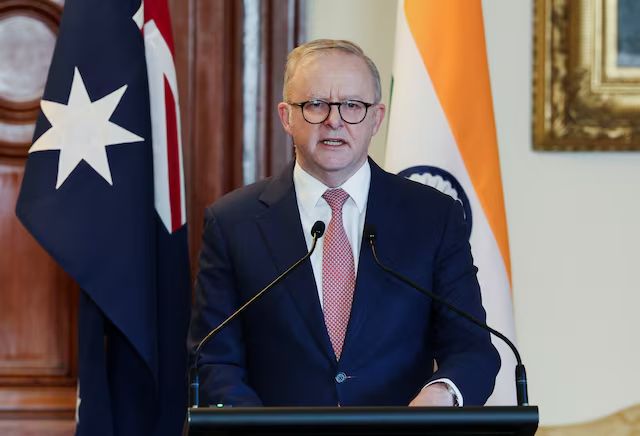
Australian Prime Minister Anthony Albanese has signalled his government will pursue a sustained diplomatic campaign against recently announced United States tariffs that directly impact Australian exporters. Speaking publicly on Sunday, Albanese confirmed he intends to take up the tariff question with President Trump through multiple official channels, underscoring the issue's prominence in the bilateral relationship and Australia's determination not to accept the measures without contestation.
The Trump administration imposed the tariffs on Friday, applying new duties across goods sourced from approximately 60 trading partners worldwide. Washington justified the action by asserting that these nations have been inadequate in preventing the trade and incorporation of forced labour goods into international commerce. The timing coincided with the expiration of a temporary 10% global tariff that had previously applied across all imports, creating uncertainty about America's trade direction under Trump's second term.
Under the specific tariff schedule now in place, Australian exporters face a 12.5% duty on goods entering the United States market. This places Australia alongside 37 other nations in the highest-tariff category. Seventeen additional countries face a 10% rate, while five nations fall under a mixed tariff arrangement depending on product classification. The graduated approach suggests Washington is differentiating among trading partners based on its assessment of their compliance with labour standards.
Albanese's government has rejected Washington's underlying premise, contending that the tariffs are unjustified and should be rescinded. The Labor administration characterises the duties as a misreading of Australia's actual position on modern slavery prevention and supply chain accountability. This response reflects both economic concern about market access for Australian goods and a deeper disagreement about the factual basis for the sanctions.
In television remarks, Albanese reaffirmed that Canberra will engage on tariffs "at every level in the Australia-U.S. relationship" and noted that diplomatic representations have already commenced. This language signals a comprehensive approach spanning ministerial discussions, trade negotiations, and executive-level conversations. The phrase "at every level" suggests Australia intends to maintain consistent pressure rather than relying on a single overture to yield results.
The Prime Minister pointed to Australia's existing legislative and regulatory framework as evidence that the tariff rationale lacks merit. He highlighted that Australia maintains "very strong provisions on modern slavery" and is actively "strengthening those even further" through targeted supply chain investigations. Albanese indicated that the government is moving to impose "substantial fines and penalties" on entities that breach these standards, demonstrating active governance in the area Washington cited as justification for the tariffs.
This supply chain enforcement agenda reflects broader international momentum toward corporate accountability on labour standards. Australia has positioned itself among developed nations taking forced labour seriously, yet the Trump administration's tariff decision effectively rejects Australian assurances. The divergence points to a deeper question about whether tariffs are truly about labour practices or represent a broader protectionist strategy using labour standards as a rhetorical device.
For Southeast Asian exporters watching the situation unfold, the Australian experience carries significant implications. If Washington is willing to apply tariffs against a developed ally with strong institutional frameworks around labour compliance, similar countries across the region face equivalent vulnerability. The tariff methodology could establish a precedent affecting how trade policy is wielded globally and which countries find themselves grouped in higher-duty brackets.
Albanese's emphasis on "free and fair trade" reflects his government's broader economic philosophy and a deliberate contrast with what it views as Trump's protectionism. The Labor Prime Minister has previously made trade liberalisation a key talking point when engaging with the U.S. administration. That his government won a landslide electoral mandate last year provides domestic political capital for sustained advocacy against what Canberra views as unfair American trade practices.
The tariff controversy arrives amid broader recalibration of the Australia-U.S. relationship under Trump's second presidency. Both nations face questions about how their alliance will function when Washington prioritises unilateral trade protectionism. Australia's ability to challenge the tariff decision through diplomatic channels will test whether the bilateral relationship permits frank disagreement on economic matters without jeopardising security and strategic cooperation.
Canberra's response also signals to domestic constituencies that the government will defend Australian economic interests internationally. Farmers, manufacturers, and service exporters affected by the tariffs will scrutinise whether diplomatic efforts yield tangible results. The government's willingness to publicly commit to multilevel engagement suggests confidence in the bilateral relationship's resilience, even as trade tensions mount.
Longer term, the tariff dispute may prompt Australia to diversify its trade exposure beyond the United States market. While such reorientation takes time, the current tension could accelerate government and business focus on alternative markets within Asia and beyond, particularly given growing economic integration within Southeast Asia and the Indo-Pacific region more broadly.

