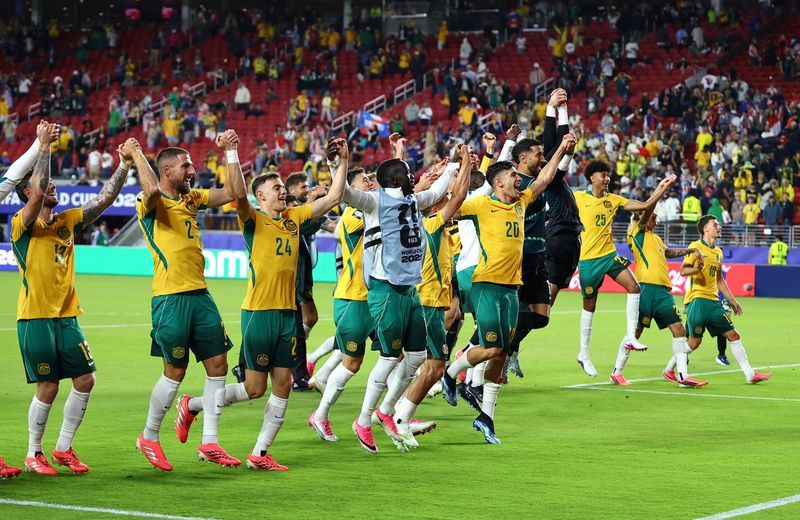
Australia has secured a spot in the World Cup's knockout phase for the third time in the tournament's history, advancing through a tightly contested 0-0 draw with Paraguay on Thursday evening at Santa Clara's stadium in the San Francisco Bay Area. The result sends the Socceroos into the round of 32 with their position cemented in second place within their group, a substantial achievement that caps a gruelling group stage campaign. For Paraguay, the outcome leaves the South American nation in an uncertain position heading into the final round of matches, requiring favourable results elsewhere to determine whether they can slip through as one of the tournament's best-performing third-place finishers.
The encounter between the two nations proved to be a physical, hard-fought affair characterised more by defensive solidity than attacking flair. Neither side managed to break through in what observers described as a cagey contest where clear-cut opportunities remained frustratingly rare. Australia's dominance during the opening stages suggested they might find the breakthrough, yet Paraguay's growing influence as the match progressed kept the scoresheet blank. The draw ultimately served Australia's advancement ambitions while leaving Paraguay anxiously awaiting outcomes from parallel fixtures scheduled over the coming days.
Australian coach Tony Popovic demonstrated tactical boldness by implementing six alterations to his starting lineup, a significant reshuffling that signalled his intention to pursue attacking options despite the stakes involved. The reinstatement of dynamic midfielder Nestory Irankunda and the inclusion of Cristian Volpato in the forward contingent reflected Popovic's willingness to take calculated risks. This attacking-minded approach contrasted with the cautious football that sometimes characterises knockout-stage preparation, instead prioritising the pursuit of victory that would have secured top spot in Group D.
Australia's attacking thrust initially emanated predominantly through the right flank, where fullback Jordan Bos had been repositioned from his customary left-back role to compensate for the absence of injured Jacob Italiano. Early in the encounter, Volpato created an inviting opportunity for Jackson Irvine, whose angled effort from the penalty area's right side flew directly at Paraguay goalkeeper Orlando Gill without troubling him. Both Bos and Volpato generated further openings late in the opening half that warranted saves from Gill, though neither attempt represented a genuine examination of the goalkeeper's capabilities or concentration.
Paraguay operated with notable caution during the initial stages, mustering merely a single shot attempt before the interval. Coach Gustavo Alfaro responded to his team's passivity by introducing Mauricio at halftime, the Brazilian-born attacker immediately unleashing an ambitious long-range effort that drifted harmlessly away from the target zone. As the second period progressed, the South Americans progressively asserted themselves, with energetic winger Julio Enciso becoming an increasingly disruptive presence in Australia's defensive third. Enciso's directness and pace repeatedly created dangerous situations, exploiting gaps in Australia's rearguard with threatening incisions that prompted defensive reorganisation.
The most promising opportunity for Paraguay arrived eight minutes from fulltime when Enciso found shooting space but his low attempt flew considerably wide of the left goalpost, wasting what represented their clearest chance to alter the scoreline. Australia's resilience during this period of Paraguayan pressure proved crucial to their advancement, with their defensive line absorbing repeated attacks without capitulating. The contest descended into an end-to-end affair during the closing stages, both teams creating half-chances that neither could capitalise upon with the precision required to break the deadlock.
Bos momentarily galvanised Australian supporters in the 89th minute when he orchestrated a promising run from the right flank, splitting two defenders and charging into the penalty area before his shot drifted narrowly past the far post. Mauricio provided a subsequent scare for Australian goalkeeper Thomas Beach, discovering a pocket of space near the area's perimeter from which he dispatched a low, tepid effort that Beach comfortably gathered. These late exchanges highlighted both teams' determination to secure victory, yet neither possessed the attacking cutting edge required to unlock their opponent's defensive organisation.
Australia's advancement into the knockout round represents the nation's third qualification for this tournament phase, continuing a participation streak in World Cup knockouts that stretches back to their last 16 appearance in Qatar four years prior. The accomplishment provides Australian football considerable satisfaction, particularly given the competitive nature of their group and the challenges posed by Paraguay and other fixtures. Securing second place in Group D means the Socceroos will face the runner-up from Group G, a fixture that remains genuinely open pending the completion of matches involving Egypt, Iran, Belgium, and New Zealand scheduled for Friday.
Paraguay's position remains precarious as they await determination of their fate. The 2010 quarter-finalists have accumulated four points from their group matches, a total that may prove sufficient to advance as one of the eight highest-finishing third-placed teams depending on results elsewhere. Their path to the knockout stages now rests in the hands of other competitors, a frustrating scenario for a team that competed with genuine commitment against their Australian opponents. The 0-0 result, while securing Australia's progression, has left the South American nation in limbo, highlighting the tournament's complex mathematical combinations that determine advancement.
Popovic's decision to prioritise attacking personnel in his team selection ultimately proved vindicated by the outcome, though the Socceroos' inability to convert possession advantages into goals prevented them from claiming outright group honours. The draw demonstrates that qualification, whilst guaranteed for Australia, came through resilience and organisation rather than scintillating football. As Australia now turns attention to preparing for their knockout fixture against Group G's second-place finisher, the Socceroos carry momentum into the business end of the tournament, having navigated a challenging group stage without defeat. The path forward presents fresh opportunities to demonstrate the attacking football Popovic's selection changes suggested he craves, with elimination now a single-match prospect rather than a group-stage concern.

