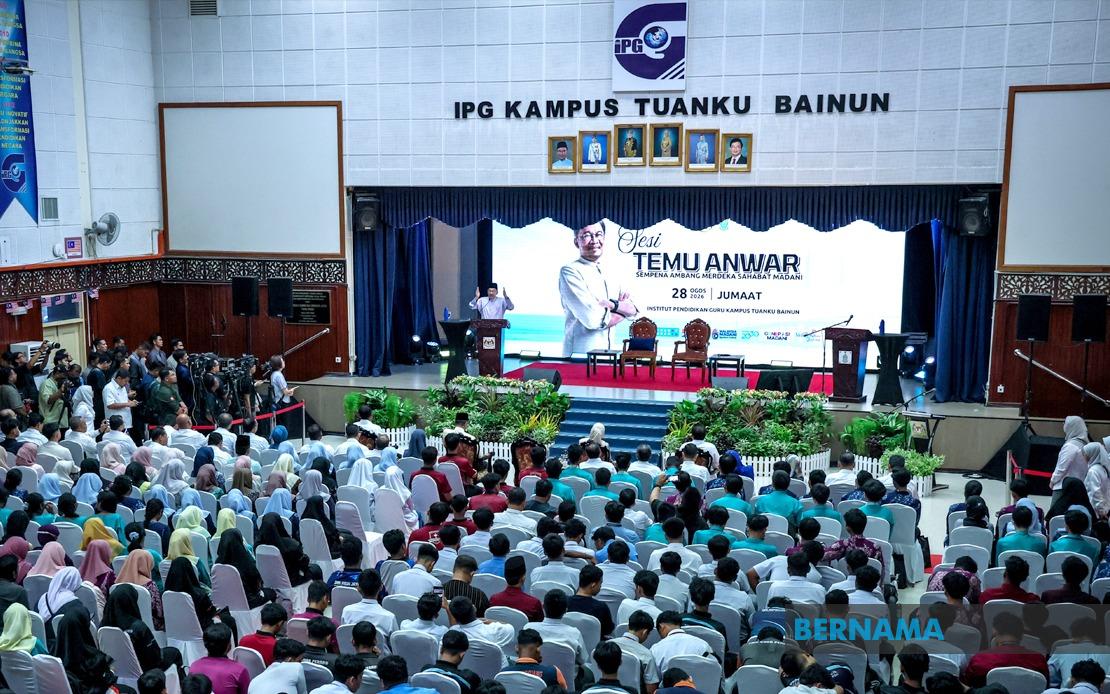
Prime Minister Datuk Seri Anwar Ibrahim has set out a compelling rationale for dismantling the Universities and University Colleges Act 1971 (AUKU), framing the controversial law's abolition as essential to nurturing an intellectually engaged generation of Malaysian youth. Speaking at a Temu Anwar session in Bukit Mertajam on August 28, Anwar positioned the repeal as a deliberate pivot away from paternalistic governance toward a model that trusts students with the autonomy to think independently and voice their convictions without fear of institutional reprisal.
The Prime Minister's argument rests on a fundamental tension that has long troubled Malaysian education policy: the inconsistency of treating 18-year-olds as civically mature enough to participate in democratic elections whilst simultaneously restricting their right to political expression on campus. By highlighting this contradiction, Anwar challenged the underlying assumption embedded in the 1971 legislation—that universities exist primarily as spaces of controlled learning rather than as laboratories for intellectual freedom. His comments underscore a broader recognition within government circles that Malaysia's reputation as a knowledge economy depends on fostering university environments where students can engage with complex ideas without self-censoring.
The abolition of AUKU represents a significant symbolic and practical shift in Malaysian higher education governance. Originally enacted in 1971, the law was designed to depoliticise campuses during a turbulent era in the nation's post-independence history. However, critics have long argued that the sweeping restrictions on student activism, political engagement, and public advocacy stifled the development of a generation equipped to navigate nuanced policy debates and complex social questions. For decades, student unions operated under severe constraints, and student publications were subject to administrative oversight that many viewed as censorship by another name.
During his remarks, Anwar explicitly acknowledged the paternalistic logic underpinning the original legislation, noting that governments in 1971 felt justified in imposing such restrictions. Yet he reframed this historical moment as one where Malaysia must break with that model. The emphasis on creative capacity and critical judgement suggests Anwar's administration believes that suppressing student expression ultimately produces graduates less equipped to solve the country's most pressing challenges—from economic complexity to environmental sustainability to social polarisation. This logic aligns with international research demonstrating that university students who engage in robust intellectual debate and political discourse develop superior problem-solving capabilities and civic competence.
Crucially, Anwar acknowledged that student voices will not always be correct. This nuance is important, as it frames the repeal not as an endorsement of all student opinions but rather as confidence in an educational ecosystem where ideas can be tested, refined, and sometimes rejected through open dialogue. This approach assumes that the cure for bad speech is more speech—a fundamentally different philosophy from one that seeks to prevent certain speech entirely. By allowing students to express themselves freely, even when mistaken, universities can create conditions where misconceptions are challenged through evidence and reasoned argument rather than suppressed through administrative fiat.
Education Minister Datuk Seri Fadhlina Sidek's presence at the session underscores government coordination on this policy shift. The education ministry's participation signals that the AUKU repeal is not a standalone act of liberalisation but part of a coherent vision for restructuring Malaysian higher education. This coordination matters because implementing the repeal effectively will require new guidelines, institutional policies, and cultural shifts within universities themselves. Without clear ministerial support and coherent implementation frameworks, universities might struggle to navigate the transition from restrictive governance to more permissive models.
The practical implications of AUKU's abolition extend beyond symbolic freedom. Malaysian universities currently operate under regulations that have made student political clubs rare, student newspapers cautious, and campus activism genuinely risky for individuals with ambitions beyond university. Removing these legal constraints removes a layer of institutional fear that has historically depressed student engagement in intellectual and political life. Students who can organise without fear of university sanctions, who can publish their views without pre-publication review, and who can debate controversial topics without risking disciplinary action will develop fundamentally different habits of mind than their predecessors.
For Malaysia's regional standing, the AUKU repeal sends important signals about the country's commitment to intellectual openness. Singapore and Thailand, regional competitors in higher education, have already cultivated reputations—deserved or not—as destinations where intellectual conformity is rewarded. If Malaysia can genuinely implement a more liberal campus environment, it may attract regional and international students seeking authentic intellectual freedom. This competitive dimension matters as Malaysian universities increasingly compete globally for talent and research funding, both of which flow to institutions known for intellectual vitality and openness.
The timing of this announcement also reflects broader political currents within Malaysia. The Anwar administration has emphasised reform across multiple policy domains and has positioned itself as more progressive on social and democratic issues compared to its predecessor. The AUKU repeal aligns with this messaging and may resonate particularly strongly with younger voters and urban constituencies concerned about democratic backsliding. However, the policy also carries risks: if student activism accelerates dramatically or if campus discourse becomes perceived as destabilising, political opponents may criticise the repeal as reckless.
Implementing this transition successfully will require substantial attention to institutional culture. University administrators who have operated within restrictive frameworks for decades will need retraining and clear guidance on how to balance freedom with institutional order. Student leaders will need to develop the maturity to exercise new freedoms responsibly. And Malaysian society more broadly will need to adjust to the reality of more vocal, more publicly visible student activism on political and social questions. These adjustments will not occur automatically simply because a law has been repealed.
The philosophical underpinning of Anwar's argument—that young adults deserve intellectual freedom and that society benefits when they exercise it—represents a significant departure from the approach that has governed Malaysian universities for half a century. Whether the government's commitment to this principle endures will depend on how institutions navigate the inevitable controversies that arise when students speak more freely. The repeal itself is decisive; the harder work lies in building sustainable practices and norms that honour intellectual freedom whilst maintaining the civil discourse necessary for productive campus environments.

