Renewed military escalation in the Middle East has rattled Asian financial markets, weakening emerging-market currencies and triggering sharp sell-offs in regional equities on Monday. The geopolitical flare-up sent crude oil prices climbing 4% higher, reviving investor concerns about inflationary pressures across the region and prompting speculation that central banks may be forced to maintain elevated interest rates for longer than previously anticipated. The U.S. dollar, buoyed by these safe-haven flows and expectations of persistently higher rates, gained ground against a broad basket of major currencies, putting downward pressure on regional peers.
The shock reverberated most severely through South Korea's financial market, where the benchmark KOSPI index plummeted 7.96% to its lowest level in ten weeks, breaching circuit-breaker thresholds that temporarily halt trading. The selloff was particularly concentrated in semiconductor stocks, with SK Hynix—the world's pre-eminent manufacturer of artificial-intelligence memory chips—nosediving 13% as institutional investors rushed to lock in profits following the company's successful U.S. debut on Friday. The broader chipmaking sector remains vulnerable to shifting sentiment over the sustainability of earnings growth tied to accelerating AI infrastructure deployment and the consolidating purchasing patterns of major technology firms.
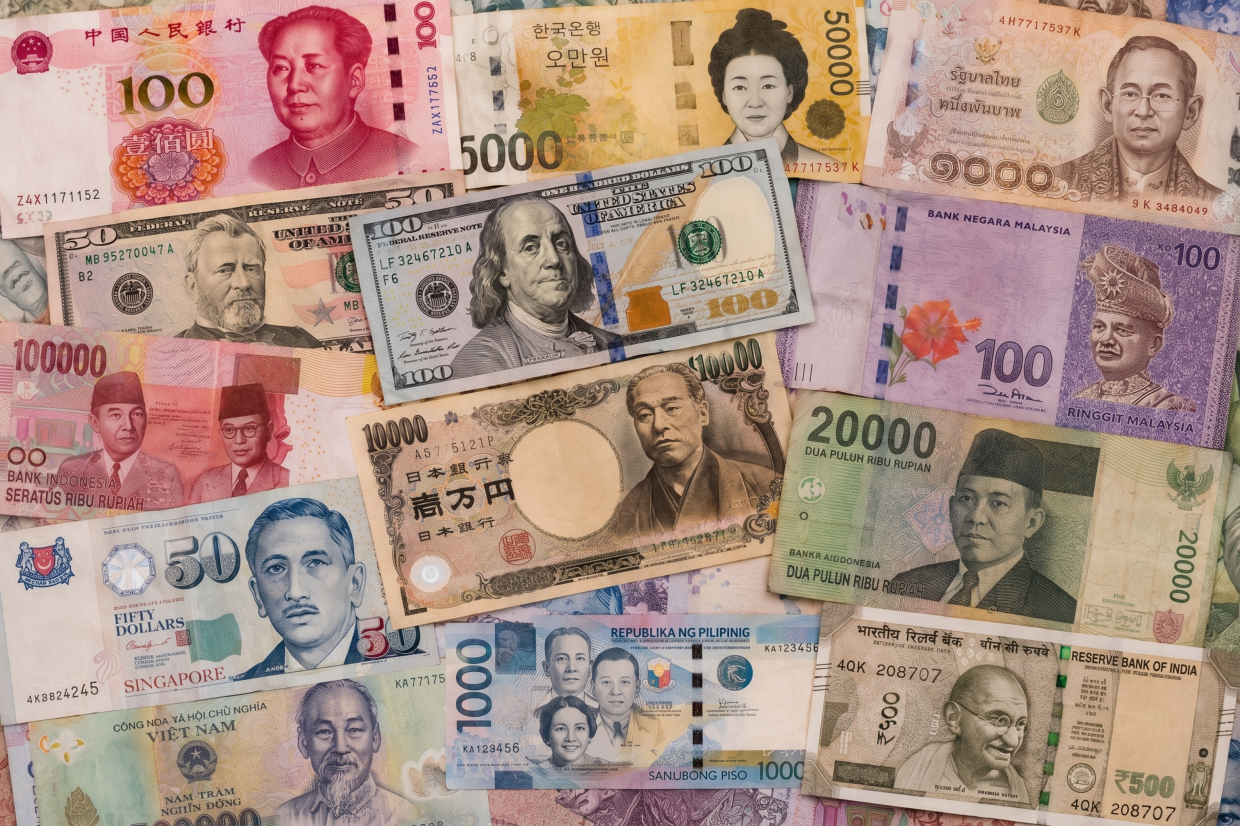
Currency depreciation rippled across the emerging markets of Asia on the first trading day of the week. Indonesia's rupiah touched 18,140 per U.S. dollar, marking its weakest level in more than a month, while South Korea's won depreciated to 1,507.9 against the greenback. Malaysia's ringgit fell to 4.0780 per dollar, adjusting downward despite a paradoxical rise in local equity prices to three-week highs. This disconnect between currency weakness and stock-market strength in Kuala Lumpur reflects the complex interplay of competing forces shaping investor behaviour.
The Malaysian equity market's resilience deserves closer examination, as it stands in contrast to broader regional weakness. While the currency weakened, the Bursa Malaysia actually advanced, suggesting that domestic investors and some offshore funds saw value in local securities even as foreign-exchange traders grew more cautious. However, this buoyancy masks underlying political turbulence that could fundamentally alter Malaysia's economic trajectory. Prime Minister Anwar Ibrahim's ruling coalition suffered a significant electoral setback in Saturday's Johor state elections, losing ground to a key alliance partner in a vote that has triggered fresh debate about the strength of federal governance and the government's ability to deliver on its economic reform agenda.
Analysts at Goldman Sachs have sounded a warning about the political dimensions of Malaysia's current market dynamics. The investment bank noted in a research note that further deterioration in federal coalition unity or renewed uncertainty about economic policy continuity could erode the premium that markets have assigned to Malaysia's governance stability and institutional strength. While Malaysia's underlying macroeconomic fundamentals—including current-account positions, forex reserves, and fiscal parameters—remain comparatively sound, the political risk is real and could prove costly if federal elections are called prematurely. The unexpected state-level defeat raises the prospect of early national elections, a scenario that typically introduces policy uncertainty and dampens long-term investment.
The Malaysian central bank's recent efforts to encourage foreign-exchange inflows offer some insulation against excessive currency depreciation, according to Goldman's analysis. In June, Bank Negara Malaysia implemented measures designed to attract foreign capital and stabilize the ringgit, and these steps should theoretically help contain volatility even as political risk sentiment persists. However, the durability of these stabilization efforts depends on whether political developments remain contained or escalate into broader questions about coalition sustainability. If federal coalition stability becomes a genuine electoral issue, the ringgit could face sustained depreciation pressure regardless of technical interventions.
Beyond Malaysia, regional equity markets displayed mixed performance on the day. Stocks in the Philippines edged higher, buoyed perhaps by haven flows to larger regional economies with clearer political trajectories. Indonesia's exchange gained a modest 0.5%, suggesting that the direct oil-price impact on regional markets may be less dramatic than historical patterns would suggest. Taiwan's equity market inched downward, reflecting the broad semiconductor-sector weakness that emanated from Seoul. Singapore's benchmark index declined 0.7%, snapping an impressive seven-day streak of record closing levels, indicating that even the region's most stable and developed financial hub was not immune to the broader risk-off sentiment.
The Middle East tensions and their market consequences arrive at a critical juncture for Asian monetary policy. The Bank of Korea is scheduled to announce an interest-rate decision within the week, and officials will be weighing the implications of weakening domestic equity sentiment against inflationary pressures from higher oil prices. Singapore is set to release advance second-quarter economic growth figures, providing fresh data on whether the city-state's economy can maintain its recovery momentum. Malaysia will publish its latest inflation and output figures, offering crucial insights into whether the domestic political turbulence is likely to translate into weaker economic performance. The U.S. inflation print will be closely monitored across Asia, as it will substantially influence expectations for dollar strength and Fed policy.
The 25% decline in the KOSPI since its June 22 peak may appear dramatic in isolation, but it merits contextualization within a longer-term narrative of exceptional Korean equity performance. Despite the recent pullback, the benchmark index remains up approximately 63% for the calendar year to date, positioning South Korea among the world's best-performing major markets. This year-to-date strength reflects the extraordinary demand for AI-related chips and the comparative advantages that Korean manufacturers possess in memory-chip production. Yet the recent volatility reveals the risks inherent in markets heavily concentrated on single thematic drivers and underscores the vulnerability of AI-related equities to profit-taking and sentiment shifts.
The semiconductor sector's current travails also reflect deeper questions about the structural sustainability of AI-driven earnings growth. Investors and analysts have grown increasingly concerned about the durability of record profitability among memory chipmakers, particularly as hyperscaling technology firms become more disciplined and selective in their capital-allocation decisions. Some observers worry that the dramatic build-out of AI infrastructure may face demand constraints or that competition could intensify as rival manufacturers scale production. Additionally, highly leveraged single-stock exchange-traded funds have amplified volatility, as automatic rebalancing mechanisms and forced liquidations can exacerbate price swings in both directions.
Looking ahead, the combination of geopolitical tension and policy uncertainty creates a complex backdrop for Asian markets. Central banks face a delicate balancing act between supporting growth in the face of equity-market weakness and maintaining vigilance against inflation risks that could persist if oil prices remain elevated. The political developments in Malaysia add a domestic layer of uncertainty that could constrain capital inflows and dampen investment sentiment. For Malaysian investors and policymakers, the week ahead will be critical in determining whether recent electoral shifts portend major changes in federal governance or prove to be localized setbacks that do not fundamentally alter the coalition's trajectory.

