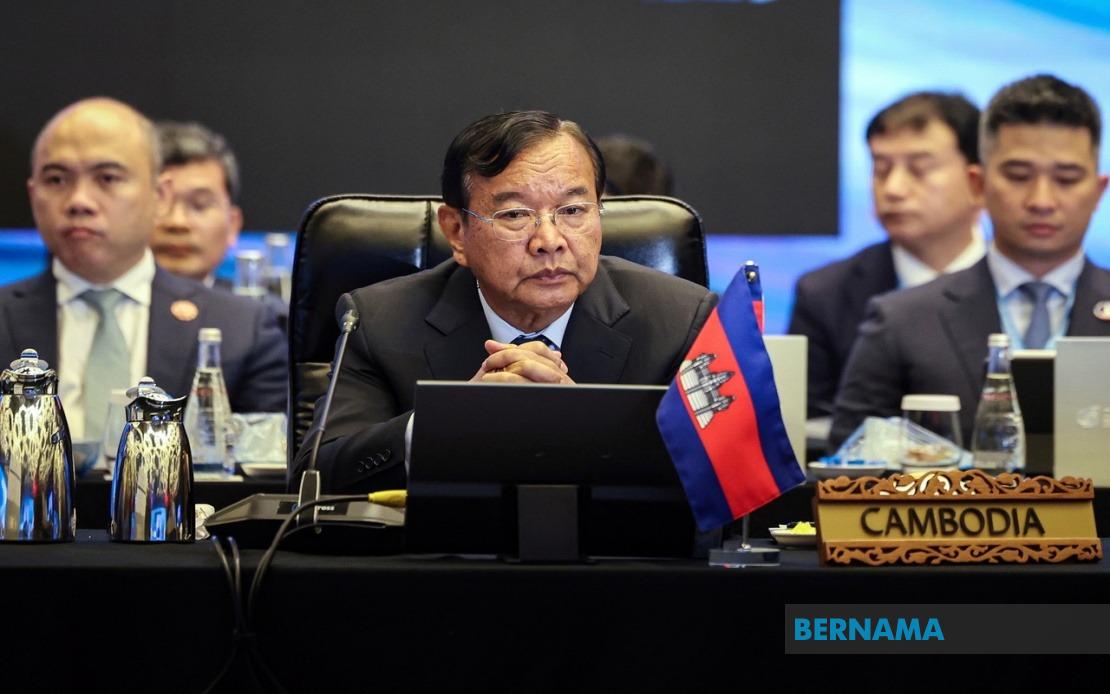
As the Association of Southeast Asian Nations marked its 59th anniversary, Cambodian Foreign Affairs and International Cooperation Minister Prak Sokhonn delivered a sobering assessment of the regional bloc's evolving role in an increasingly turbulent world. Speaking on Friday, the senior official stressed that ASEAN remains essential to preserving peace and stability in Southeast Asia, even as the ten-member organization confronts unprecedented external pressures and internal challenges stemming from a more volatile global environment.
Sokhonn's remarks underscore a fundamental tension facing the region: while ASEAN has successfully maintained its centrality through nearly six decades of existence, the external forces threatening the region's equilibrium have grown substantially more complex. The transformation from a zone of conflict and mistrust to one characterized by dialogue and mutual prosperity represents one of the 20th century's most remarkable diplomatic achievements, yet that accomplishment now appears increasingly fragile against the backdrop of resurgent great-power competition and regional military buildups.
The Cambodian minister identified several interconnected threats confronting the bloc. Armed conflicts are re-emerging with greater frequency and intensity across Asia and beyond, while geopolitical rivalries between major powers show unmistakable signs of intensification. Simultaneously, the international legal order that underpinned ASEAN's founding principles faces mounting challenges, as established norms of multilateral cooperation and respect for established treaties come under sustained pressure from various quarters. This convergence of challenges has created what Sokhonn characterized as an environment demanding active engagement rather than passive acceptance.
Central to Sokhonn's message is the conviction that ASEAN must transition from a reactive posture to a proactive one. Rather than simply adapting to changes imposed by external actors, the organization should work to influence the trajectory of regional development and shape outcomes in accordance with its stated principles. This ambitious framing reflects a growing awareness among ASEAN members that the bloc's future relevance depends on demonstrating capacity to address challenges originating both within and beyond Southeast Asia's borders.
The Cambodian Foreign Minister, who also serves as Deputy Prime Minister, positioned Cambodia as a committed stakeholder in ASEAN's institutional framework. Since joining the association in 1999, Cambodia has transitioned from a regional pariah state to an active member, though its relationship with the bloc has occasionally been complicated by tensions over Myanmar's political crisis and other divisive issues. Sokhonn's emphasis on Cambodia's contributions reflects Phnom Penh's desire to maintain relevance within the ten-member organization despite periodic disagreements over how ASEAN should respond to member state crises.
The foundation of ASEAN's institutional architecture—the 1967 Charter establishing the organization and the Treaty of Amity and Cooperation serving as its diplomatic framework—received particular emphasis in Sokhonn's remarks. These twin pillars embody commitments to non-interference in internal affairs, peaceful settlement of disputes, and respect for sovereignty. Yet both documents have come under strain as ASEAN members have struggled to respond collectively to challenges such as Myanmar's military coup, the South China Sea territorial disputes, and cross-border humanitarian crises.
For Malaysian observers, Sokhonn's rhetoric carries particular relevance. Malaysia, as a founding member and regular ASEAN chair holder, has long championed the organization's centrality to regional security architecture. The emphasis on ASEAN unity resonates with Malaysia's diplomatic tradition of building consensus among diverse stakeholders, though Kuala Lumpur has sometimes found itself at odds with other members over specific policy responses. Cambodia's reaffirmation of commitment to ASEAN principles reflects broader regional sentiment that despite its limitations, the organization remains preferable to alternative arrangements that might fragment Southeast Asia along geopolitical lines.
The composition of ASEAN itself has evolved since its founding in 1967 by Indonesia, Malaysia, the Philippines, Singapore, and Thailand. The addition of Brunei, Vietnam, Laos, and Myanmar expanded the bloc geographically and economically, though it also increased the heterogeneity of interests and political systems within the organization. Timor-Leste's admission represented the most recent expansion, creating a Southeast Asian organization of genuinely continental scope. This expansion has simultaneously strengthened ASEAN's regional weight while complicating consensus-building on contentious issues.
Sokhonn's insistence that ASEAN cannot afford passivity in the current environment reflects recognition that the regional security landscape has shifted fundamentally since the Cold War's conclusion. The rise of China as a major regional power, India's expanding Asian profile, Japan's more assertive security posture, and renewed United States engagement in Southeast Asia have created a multipolar dynamic that earlier ASEAN thinkers did not anticipate. The South China Sea disputes exemplify how external great-power competition intersects with ASEAN members' bilateral interests, sometimes creating divergent positions within the organization.
The challenge facing ASEAN leaders lies in translating rhetorical commitments to unity and centrality into concrete diplomatic outcomes. The Myanmar crisis has exposed limitations in ASEAN's capacity to impose collective positions on wayward members, while the South China Sea remains a zone of ambiguity where ASEAN consensus masks underlying disagreements about how aggressively to confront Chinese assertions. Sokhonn's call for active shaping of regional outcomes suggests frustration with the status quo, yet achieving such transformation requires overcoming structural obstacles embedded in ASEAN's consensus-based decision-making processes.
For Southeast Asian governments and observers, Sokhonn's message encapsulates both the aspiration and the predicament that characterize contemporary ASEAN diplomacy. The organization remains valued as a venue for dialogue and cooperation, yet its capacity to address major regional challenges remains constrained by the principle of non-interference and the requirement for consensus among ten diverse member states with varying strategic interests. As geopolitical competition intensifies, the pressure on ASEAN to evolve its operational frameworks while maintaining fidelity to founding principles will only increase.

