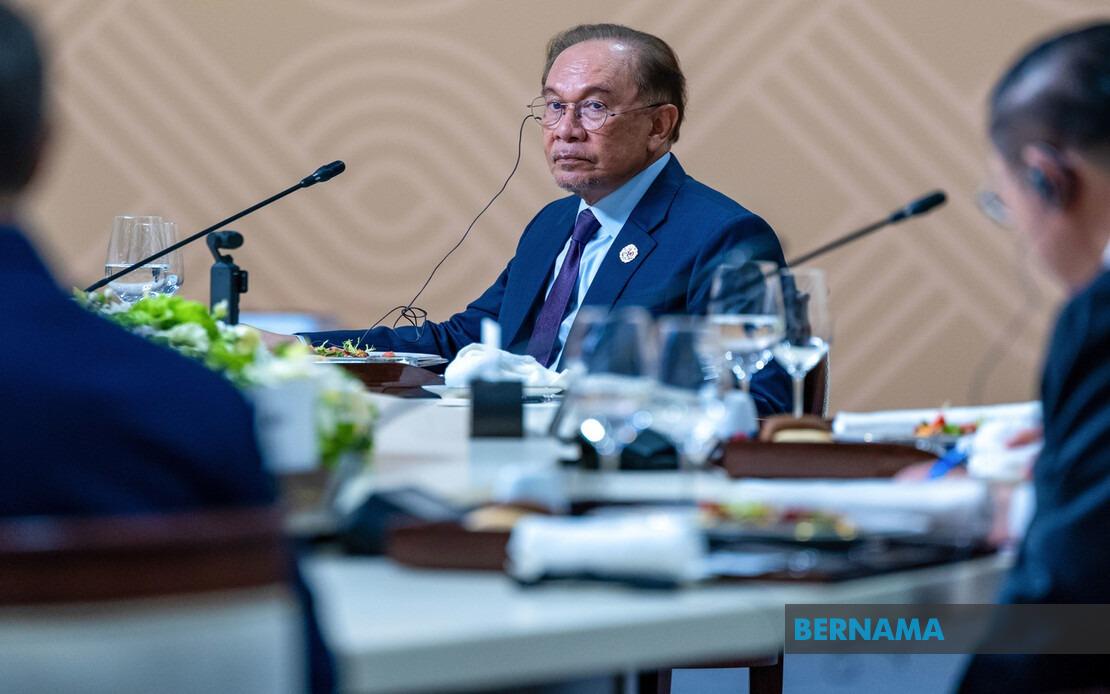
Prime Minister Datuk Seri Anwar Ibrahim has called for the Association of Southeast Asian Nations and the Shanghai Cooperation Organisation to combine their capabilities in addressing transnational crime and developing regional energy strategies, addressing challenges that demand coordinated regional responses. Speaking during the ASEAN-Russia working lunch in Kazan on June 18, the Prime Minister emphasised that neither bloc can effectively tackle these interconnected issues alone, requiring instead a unified approach drawing on their collective strengths and resources.
The case for deepened cooperation between the two bodies is well-established, Anwar noted, given that a memorandum of understanding signed in 2005 already provides a solid platform for joint activities. This foundational agreement encompasses counter-terrorism initiatives, coordinated drug and narcotic control measures, mechanisms to combat money laundering, and frameworks for economic, financial, and energy collaboration. Rather than building entirely new structures, Anwar stressed that both organisations should capitalise on this existing infrastructure by directing concentrated effort toward areas where concrete gains can be demonstrated within realistic timescales.
The urgency of the challenge became evident in Anwar's depiction of modern criminal enterprises that operate across borders with alarming speed. Online deception schemes, clandestine financial transfers, and human smuggling networks have grown increasingly sophisticated, exploiting gaps between national jurisdictions faster than individual countries can respond. The Prime Minister argued that intelligence sharing and capacity building among ASEAN and SCO members would substantially improve each nation's ability to detect, investigate, and counter these threats. This approach recognises that criminal networks do not respect borders, making coordinated enforcement mechanisms and shared knowledge essential.
On the energy dimension, Anwar highlighted the distinct advantages the SCO membership brings to the table. The ten-member bloc—comprising Belarus, China, India, Iran, Kazakhstan, Kyrgyzstan, Pakistan, Russia, Tajikistan, and Uzbekistan, plus observer states Afghanistan and Mongolia—represents a concentration of energy production capacity and technological expertise unmatched elsewhere. This positioning creates practical opportunities for ASEAN nations to engage directly with leading energy producers and innovators on strategic initiatives that enhance regional security and support the transition to sustainable power sources.
Malaysia's energy vision, articulated through its Finance and Prime Minister, extends beyond conventional resource management to encompass a comprehensive modernisation agenda. The country actively supports practical and technology-driven cooperation spanning efficiency improvements, grid strengthening, liquefied natural gas development, broader renewable energy integration, and institutional knowledge transfer regarding operational safety and system resilience. These priorities reflect Southeast Asia's broader challenge of meeting growing energy demand while reducing carbon intensity, objectives that benefit considerably from partnership with SCO members who possess relevant expertise and infrastructure.
Apart from the SCO framework, Anwar identified parallel opportunities within the Eurasian Economic Union, suggesting that ASEAN should similarly leverage existing cooperative structures with this bloc. The existing bilateral frameworks contain underutilised potential for strengthening commercial ties and boosting business confidence across both regions. By activating these dormant mechanisms, ASEAN and the EAEU could unlock considerable trade and investment potential that currently remains largely untapped.
The Prime Minister identified three interconnected priorities that should guide this renewed commercial engagement. First among these is establishing regular dialogue channels between private sector representatives from both regions. Encouraging corporate participation in each other's prominent trade exhibitions and investment forums—including the ASEAN-EAEU Business Dialogues held alongside the Eastern Economic Forum and St Petersburg International Economic Forum—would create genuine networking opportunities and tangible deal-making platforms. These meetings must move beyond ceremonial gestures to facilitate real commercial relationships.
Small and medium enterprises constitute the second critical focus area. Malaysian and Southeast Asian smaller firms often struggle to compete in unfamiliar international markets, lacking not merely market access but also the technological capacity and human skills necessary for successful expansion. ASEAN and EAEU cooperation should explicitly address this gap through targeted support mechanisms that democratise access to both markets and technological capabilities. Without such assistance, the potential of smaller enterprises to contribute to regional integration remains constrained by structural disadvantages.
The third dimension encompasses emerging economic domains where ASEAN and EAEU interests are beginning to converge meaningfully. Digital economy development, artificial intelligence applications, cybersecurity safeguards, and food security assurance represent frontier areas where regional cooperation could yield substantial mutual benefits. These sectors demand knowledge sharing and coordinated standard-setting that transcend traditional cooperation models. Pursuing joint initiatives in these areas would position both blocs as collaborative partners in shaping the technologies and systems that will define the coming decades.
Anwar's visit to Kazan for the two-day ASEAN-Russia Commemorative Summit underscores the importance both sides place on deepening institutional relationships. The timing and venue reflect Russia's interest in strengthening ties with Southeast Asia, while ASEAN's participation demonstrates recognition that engagement with Eurasian partners serves regional interests. For Malaysia specifically, these dialogues represent opportunities to advance national priorities in energy diversification and security while contributing to ASEAN's broader strategic positioning.
The proposals advanced during these discussions carry implications extending well beyond diplomatic pleasantries. Effective implementation of intelligence-sharing mechanisms could meaningfully disrupt transnational criminal operations affecting Southeast Asian citizens. Energy cooperation could enhance regional energy security during periods of global supply volatility. Commercial ties could redirect investment flows and create employment opportunities across ASEAN economies. The challenge now lies in translating these ambitious statements into concrete institutional mechanisms with adequate funding, technical capacity, and political commitment from all participating nations.

