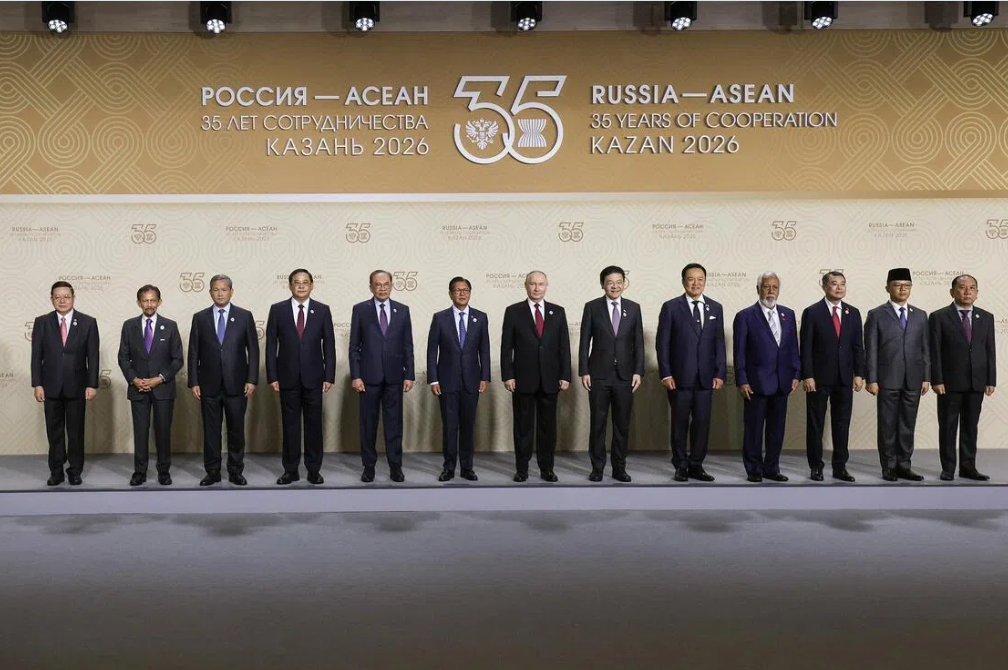
Asean and Russia have reaffirmed their commitment to broadening ties across multiple sectors at a commemorative summit held in Russia's Kazan region on June 17 and 18, marking three and a half decades of diplomatic relations and three decades of formal dialogue partnership between the bloc and Moscow. The gathering produced a slate of binding documents designed to structure cooperation between the 10-member regional grouping and Russia through 2030, signalling both sides' intention to maintain engagement despite broader geopolitical tensions affecting their respective regions.
The Asean-Russia Commemorative Summit, hosted by Russian President Vladimir Putin, resulted in adoption of the Kazan Declaration, a comprehensive review of bilateral progress over the past 35 years that simultaneously outlines the trajectory for future collaboration. The declaration identifies several priority areas—maritime affairs, commerce and investment, energy resources, physical and digital connectivity, security matters, educational initiatives, and cultural preservation—as fields where the two sides possess sufficient alignment to advance mutual objectives. Beyond this overarching framework, both parties endorsed a Joint Statement on Cultural Cooperation emphasizing people-to-people connections and cultural exchange programmes, alongside the Asean-Russia Comprehensive Plan of Action covering the 2026–2030 period to operationalize practical initiatives.
Singapore's Prime Minister Lawrence Wong, attending on behalf of Asean, struck a careful diplomatic balance in his remarks, acknowledging areas of convergence while addressing underlying tensions. He emphasised that Asean and Russia should concentrate their efforts on domains where shared interests are demonstrable, whilst simultaneously strengthening confidence-building mechanisms and dialogue platforms that foster regional peace and stability. Wong expressed appreciation for Russia's recognition of Asean Centrality—the bloc's leadership principle in regional architecture—and noted Moscow's consistent participation in Asean-led forums including the ASEAN Regional Forum and the East Asia Summit, platforms Moscow has utilised to maintain influence within Southeast Asia's strategic discourse.
Wong looked ahead to Russia's expected attendance at both the ARF and EAS scheduled for the Philippines later in 2024, and signalled that Singapore, assuming Asean's rotating chairmanship in 2027, anticipates deepened Russian engagement during its tenure. This forward-looking approach underscores Asean's pragmatic strategy of maintaining Moscow as a stakeholder in regional mechanisms despite significant disagreements over international law and conflict resolution. The summit agenda encompassed practical cooperation domains such as disaster management and narcotics interdiction, where technical cooperation and capacity-building could proceed independently of broader political disputes.
Educational and civil service exchanges represent a longstanding pillar of Asean-Russia engagement, with Russian officials regularly attending training programmes across member states, including Singapore. Wong highlighted these people-to-people connections as essential infrastructure for sustaining bilateral goodwill and institutional understanding, particularly valuable when governments navigate disagreements on major international questions. Such exchanges create networks of individuals with direct experience of each other's systems, potentially moderating hardline positions and facilitating future reconciliation efforts.
Wong's public remarks reflected Singapore's consistent position of principled pragmatism regarding international disputes. He articulated that Asean's twin priorities—deepening internal integration while expanding external partnerships—had become increasingly critical amid rising geopolitical volatility and unpredictability. He underscored the centrality of international law and the rules-based global order, framing these not as anti-Russian positions but as foundational principles applicable to all nations regardless of alignment. This rhetorical positioning allows Singapore and Asean to maintain principled stances without appearing to take sides in great-power competition.
On specific conflict zones, Wong articulated nuanced positions grounded in international legal principles rather than ideological alignment. Regarding the Middle East, he welcomed the peace agreement between the United States and Iran, hoping such arrangements could facilitate permanent conflict resolution and restore freedom of navigation in the Strait of Hormuz—an issue of direct concern to maritime-dependent Southeast Asia whose trade routes depend on reliable passage through that waterway. His mention of Ukraine followed similar logic: Singapore has condemned Russia's invasion as violating international law and has maintained sanctions since 2022, yet Wong framed this opposition around sovereignty and territorial integrity principles applicable universally, not as anti-Russian positioning.
The bilateral meeting between Wong and Putin, initiated at the Russian president's request, provided opportunity for private discussion of issues where Asean and Russia diverge substantially. According to Singapore's Ministry of Foreign Affairs, the leaders exchanged perspectives on bilateral matters alongside regional and international developments, though specific contentious topics remained undisclosed. Wong's subsequent social media commentary emphasised that dialogue and engagement retain value even when nations fundamentally disagree, reflecting a Southeast Asian diplomatic tradition that prioritises relationship maintenance and conflict avoidance over confrontational positioning.
Wong also conducted separate discussions with Rustam Minnikhanov, the Rais (president) of the Republic of Tatarstan, continuing a relationship trajectory initiated by Singapore's then-Minister Mentor Lee Kuan Yew during his 2007 visit to that Russian region. These exchanges covered cultural cooperation, educational partnerships, and people-to-people development, demonstrating how Asean states cultivate relationships across different administrative levels within Russia rather than limiting engagement to the federal government alone. Such multi-level diplomacy reduces dependence on any single bilateral relationship whilst expanding opportunities for collaboration.
The significance of the Kazan summit extends beyond symbolic reaffirmation of ties. The five-year Comprehensive Plan of Action establishes concrete benchmarks and timelines for cooperation, transforming vague expressions of goodwill into institutionalised mechanisms with measurable outcomes. This structured approach reflects maturation in Asean-Russia relations, moving from episodic diplomatic engagement toward sustained programmatic cooperation covering trade facilitation, energy security, scientific research, and educational mobility. For Malaysia and other Southeast Asian nations, such frameworks create opportunities for participation in projects spanning infrastructure development, renewable energy transition, and academic exchange.
The summit also demonstrates Russia's continued strategic interest in maintaining influence within Southeast Asia's regional architecture despite Western sanctions and diplomatic isolation following the Ukraine invasion. By hosting the Asean summit and securing commitment to expanded cooperation through 2030, Moscow signals that it remains a consequential regional player deserving continued engagement from Asean governments. Conversely, Asean's participation illustrates the bloc's commitment to strategic autonomy—maintaining relationships across multiple great powers rather than aligning exclusively with Western or Chinese interests—a posture increasingly vital as regional tensions intensify.
For Southeast Asian observers, the Kazan outcome reflects both the constraints and possibilities of contemporary diplomacy in an era of geopolitical contestation. Asean countries cannot ignore Russia's actions in Ukraine or pretend fundamental disagreements have dissolved, yet neither can they afford to abandon diplomatic channels or exclude Moscow from regional forums. The challenge lies in compartmentalising disagreements—condemning violations of international law while cooperating on maritime security, energy transition, and disaster response—a balancing act that Singapore's articulation of consistent principles rather than selective alignment makes somewhat more achievable.
Moving forward, the practical realisation of the 2026–2030 plan will test both parties' commitment to deepening ties. Energy cooperation assumes particular importance as Southeast Asia seeks reliable, diversified suppliers amid global energy transition pressures, whilst Russia requires alternative markets for energy exports given Western sanctions. Maritime security cooperation addresses shared concerns about piracy, trafficking, and freedom of navigation without requiring either party to compromise on larger geopolitical disputes. Success in these functional domains could gradually expand the space for broader cooperation, whilst failure would underscore the limits of engagement amid fundamental disagreement.

