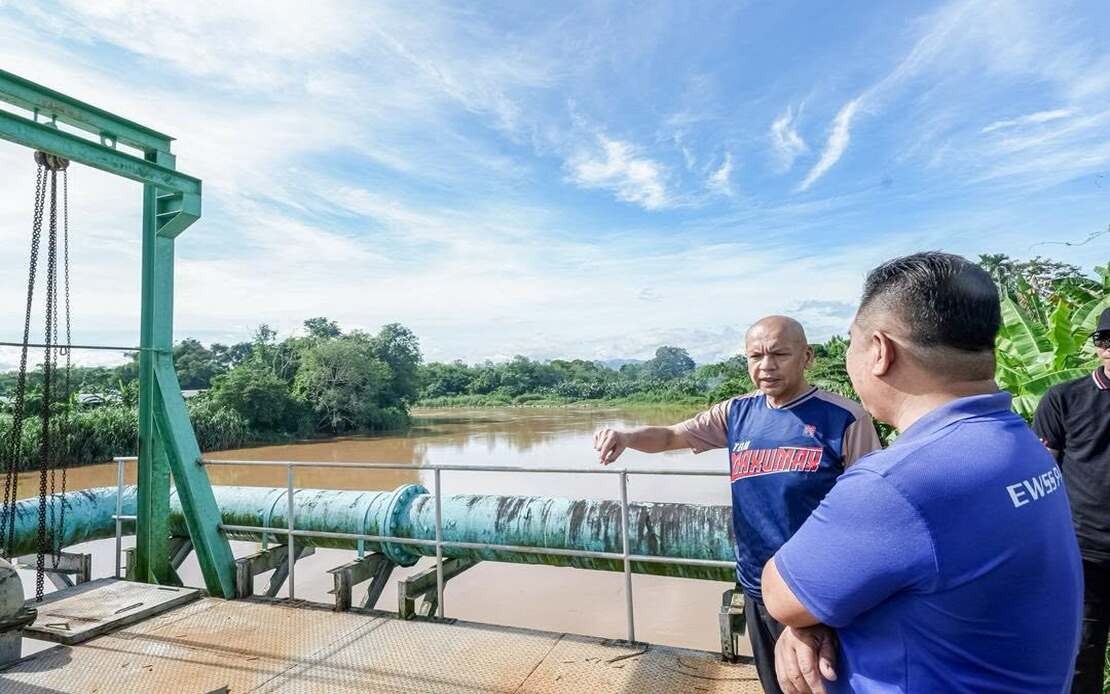
Datuk Armizan Mohd Ali, Malaysia's Domestic Trade and Cost of Living Minister, conducted an inspection of Papar's water infrastructure this week to assess the progress of critical stabilisation initiatives designed to resolve recurring supply shortages across the district. The visit followed a coordinating meeting held on June 15 to evaluate implementation timelines and identify bottlenecks in what has become an increasingly urgent issue for residents facing mounting water demands.
Two major projects form the centrepiece of the district's capacity expansion strategy. The Kogopon Water Treatment Plant is undergoing a substantial upgrade to nearly double its output from 40 million litres per day to 80 million litres per day, while simultaneously the Kampung Kabang intake facility is being enhanced to improve raw water acquisition. These parallel investments underscore recognition among authorities that Papar's existing infrastructure has become severely strained by population growth and economic development, making incremental improvements insufficient.
Beyond the capital projects, Armizan's inspection revealed persistent operational crises affecting two major treatment facilities. Both the EWSS Plant and the JETAMA Limbahau Plant have experienced forced shutdowns during the past week triggered by elevated nephelometric turbidity unit (NTU) readings in incoming raw water—a technical measure indicating suspended sediment and particulate contamination that exceeds treatable thresholds. These unscheduled closures directly reduced treated water availability to consumers at precisely the moment when demand peaks, exacerbating public frustration.
The turbidity problem highlights a critical vulnerability in Papar's water sourcing strategy. Raw water quality depends substantially on catchment conditions upstream, meaning that seasonal variations, erosion, agricultural runoff, or industrial discharge can rapidly degrade inlet water quality and disable treatment processes. Operators must temporarily cease operations until natural settling occurs or upstream conditions improve, leaving communities without reliable supply and underscoring the need for both better source protection and more resilient treatment design.
Armizan's emphasis on direct field monitoring reflects a strategic shift toward operational transparency and real-time problem-solving. Rather than relying solely on reports from subordinate agencies, the minister's personal inspection signals government commitment to accountability while gathering unfiltered intelligence on systemic challenges. This hands-on approach has become increasingly common among Malaysian federal ministers seeking to understand ground-level implementation gaps between policy intention and delivery reality.
For Papar residents and businesses, these disruptions carry tangible economic and social consequences. Water supply interruptions affect agricultural productivity in surrounding rural areas, disrupt commercial operations dependent on consistent supply, and create public health risks if alternative sources prove contaminated. Schools and healthcare facilities face particular vulnerability, as does the broader livelihood security of communities where subsistence farming remains prevalent. The psychological toll of unpredictable supply cannot be underestimated in daily life planning.
The Kogopon upgrade represents the most substantive response to structural undersupply, essentially acknowledging that demand will continue rising and that supply-side expansion remains the primary policy lever available. A doubling of capacity from one major plant cannot resolve all shortages, however, particularly if population growth or industrial development accelerates. Complementary demand management strategies—including leak reduction, efficiency standards, and water conservation messaging—would strengthen the overall approach but appear secondary in current planning.
Paramount in Armizan's visit is the implicit acknowledgment that Papar's water crisis reflects broader patterns across Malaysian urban and semi-urban areas where infrastructure development has lagged behind demographic pressures. Sabah state, encompassing Papar, faces particular challenges given its rapid urbanisation in towns like Kota Kinabalu, constrained budget allocations, and the complexity of delivering services across geographically dispersed communities. Solutions implemented in Papar may therefore offer instructive lessons for policymakers addressing similar challenges elsewhere.
The timeline for completing these stabilisation projects remains unclear from the minister's statement, creating ongoing uncertainty for affected residents. Procurement delays, contractor performance issues, or unforeseen technical complications could extend implementation well beyond initial schedules, meaning communities may endure supply instability for months or years. Transparency regarding realistic timelines would help residents adapt their own water management practices accordingly.
Moving forward, the effectiveness of these interventions will depend not merely on infrastructure completion but on integrated management addressing source protection, treatment capacity, distribution efficiency, and demand moderation simultaneously. Single-focus solutions addressing only pipe capacity or plant throughput typically prove insufficient in water-stressed regions. Armizan's inspection and the projects themselves suggest Malaysian authorities recognise this complexity, though success will ultimately hinge on sustained political will and budgetary commitment extending beyond current election cycles.

