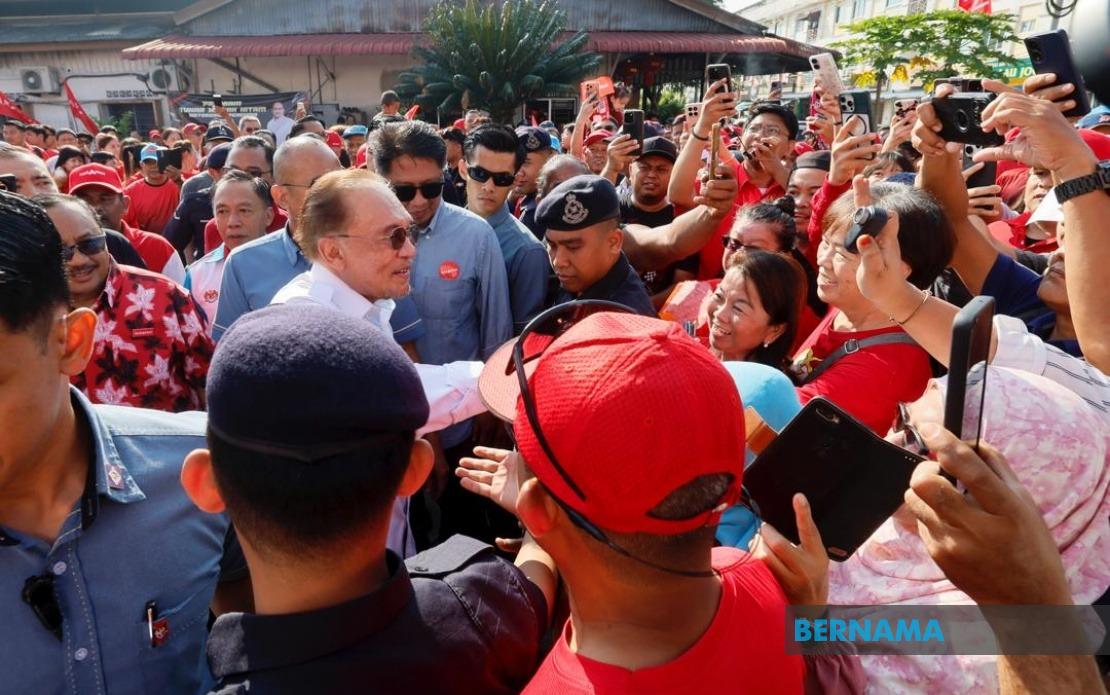
Prime Minister Datuk Seri Anwar Ibrahim injected fresh momentum into the Pakatan Harapan campaign machinery during a visit to Johor's Simpang Renggam parliamentary constituency on July 5, marking a strategic show of force as the coalition pressed its case to voters ahead of the July 11 state election. The visit to the Machap and Layang-Layang state seats demonstrated the ruling coalition's determination to consolidate support in a state where electoral fortunes remain contested and ground organisation remains critical to electoral success.
Nur Hafiz Roslan, contesting the Machap seat under the PH banner, characterised the Prime Minister's presence as a watershed moment for campaign morale. Beyond the ceremonial aspects of a senior leader's visit, Nur Hafiz emphasised that Anwar's attendance at the grassroots breakfast gathering reinforced the coalition's messaging around service delivery and community welfare. The PH candidate stressed that Anwar, speaking both as coalition chairman and PKR president, had reiterated the importance of ethical governance and dedication to public interest—themes designed to position the coalition as focused on substantive governance rather than partisan advantage or factional score-settling.
The messaging conveyed during the visit centred on a deliberate reframing of electoral competition. Nur Hafiz quoted the Prime Minister's emphasis that the campaign should not revolve around creating social division but rather on demonstrating the coalition's capacity to serve all communities equitably. This framing carries particular weight in a multiethnic state like Johor, where electoral outcomes often hinge on the ability of political coalitions to maintain cross-communal appeal and convince voters of their commitment to inclusive governance. The invocation of 'amal soleh'—righteous deeds—introduced a values-based dimension to the campaign message, attempting to elevate political competition beyond transactional calculations.
Guna Balakrishnan, the PH candidate for Layang-Layang, similarly reported heightened confidence flowing from the Prime Minister's engagement. Guna's account revealed that Anwar had delivered specific guidance regarding developmental priorities should the candidate secure voter endorsement, suggesting that the party leadership is framing this election not merely as a test of popularity but as a mandate for targeted infrastructure and community investment. The emphasis on localised development reflects the coalition's recognition that state-level elections ultimately turn on voters' assessment of which political forces can deliver tangible improvements to their immediate living conditions and economic prospects.
The broader context of this Johor campaign cannot be divorced from national political dynamics. The state represents a crucial testing ground for PH's capacity to maintain voter confidence after assuming national office, and electoral setbacks in Johor could reverberate through the federation, emboldening opposition forces and potentially destabilising the current federal coalition. Conversely, a strong PH performance would validate the coalition's claim to represent a viable alternative government and reinforce its legitimacy following its 2022 return to power.
The event attracted over one thousand residents to the casual breakfast engagement, a scale suggesting significant public interest in the election. This turnout becomes particularly significant when measured against the relatively modest population bases of individual state constituencies. The size of the gathering indicates that the Prime Minister's personal profile continues to exercise considerable pull with voters, notwithstanding the various challenges and controversies that have marked his tenure since late 2022. The ability to mobilise such crowds in an informal setting suggests underlying wellsprings of support that the coalition can potentially translate into votes.
Resident responses captured during the event reflected the emotional and symbolic dimensions of electoral participation. Chuan Chee Mei, a 48-year-old voter, characterised the Prime Minister's personal engagement as decisive in confirming her voting intention toward PH candidates. Similarly, Noor Takiyudin Salleh highlighted the accessibility and approachability that Anwar's casual demeanour conveyed, contrasting this informal engagement style with more distant or formalistic political performances. These voter reflections underscore that electoral choice operates not solely through rational policy evaluation but also through affective dimensions—the extent to which voters feel that political leaders genuinely connect with them and prioritise their concerns.
The timing of this campaign visit, occurring on the ninth day of the formal campaign period with polling still two days distant, reflects strategic calculations regarding when to deploy the party leader's time most effectively. The coalition evidently judged that concentrating leadership presence and resources in specific constituencies during the final campaign week maximised the likelihood of translating motivational effects into votes. This tactical approach assumes that late-stage campaign activities do influence voter behaviour, an assumption supported by electoral research indicating that late-deciding voters constitute a meaningful proportion of the electorate.
The Johor state election encompasses 172 candidates competing for 56 state assembly seats, a ratio indicating that multiple candidates are contesting each seat and that electoral outcomes depend on complex multi-way contests rather than simple two-party competition. This configuration increases the importance of on-the-ground campaign machinery and volunteer mobilisation, since marginal victories become more likely and ground organisation can disproportionately influence outcomes. The PH's focus on reinvigorating its campaign machinery through high-profile leadership visits directly addresses this structural reality, seeking to ensure that organisational capacity translates voter sympathy into actual votes cast.
Early voting scheduled for July 7 provided an additional tactical consideration for campaigns. The availability of early voting mechanisms means that campaigns must accelerate their outreach activities earlier than they would in contexts where all voters cast ballots on a single day. The Prime Minister's visit thus occurred within a window where early voters had already commenced voting, rendering it essential for parties to maintain campaign intensity and momentum across the entire pre-election period rather than front-loading activities toward election day itself.
For Malaysian observers and regional analysts, this Johor election serves as a crucial indicator of whether the PH coalition can sustain electoral momentum and public confidence following its transition from opposition to government. The coalition assumed power following a period of intense political turbulence and public disillusionment with previous administrations. Whether that initial mandate remains intact, particularly in a significant state like Johor with its substantial federal representation and economic importance, will significantly influence the trajectory of Malaysian politics over coming years. The grassroots engagement approach exemplified by Anwar's campaign visit suggests the coalition remains cognisant of the necessity to maintain active connection with voters rather than assuming incumbency advantage provides automatic electoral immunity.

