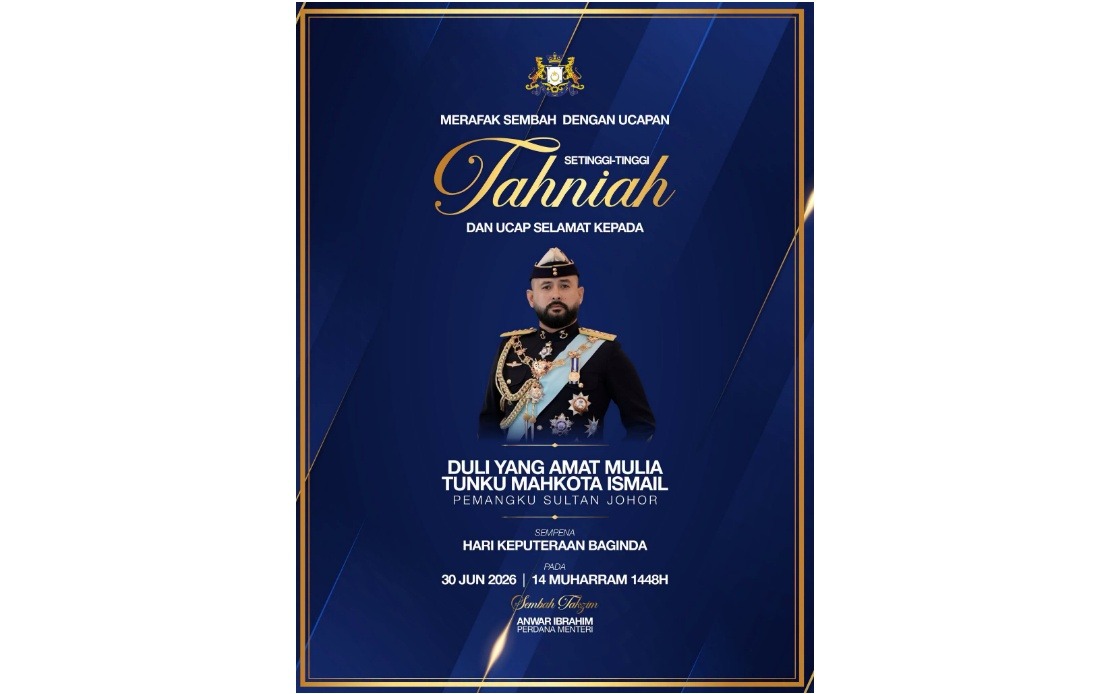
Prime Minister Datuk Seri Anwar Ibrahim has marked the birthday of the Regent of Johor, Tunku Mahkota Ismail, with warm congratulations extended through his Facebook page on June 30. The gesture reflects the protocol and courtesy traditionally observed by Malaysia's federal leadership towards members of the royal households, particularly those who hold significant constitutional positions within their respective states.
In his birthday message, Anwar expressed his hopes that Tunku Mahkota Ismail would enjoy continued robust health and wellbeing in the years ahead. The Prime Minister's remarks also invoked blessings of divine grace, a common element in Malaysian ceremonial greetings that acknowledge both the spiritual dimensions of well-wishing and the cultural norms prevalent across the nation's diverse society. The message was shared publicly, ensuring that the greeting reached a broad audience of citizens and public figures monitoring the Prime Minister's official social media channels.
Deputy Prime Minister Datuk Seri Dr Ahmad Zahid Hamidi similarly acknowledged the occasion through a separate Facebook post, where he offered his own prayers for the Regent's continued good health and prosperity. Zahid's remarks emphasised the importance of divine protection and blessing, framing the Regent's wellbeing within a spiritual context while simultaneously recognising his role as a significant figure within Johor's governance structure.
Tunku Mahkota Ismail holds a position of considerable importance within Malaysia's constitutional monarchy system. As heir to the Johor throne, his role carries both ceremonial significance and influence over state-level matters affecting the people of Johor Darul Ta'zim. The position represents a bridge between traditional monarchical institutions and modern governance, requiring the holder to balance historical responsibilities with contemporary administrative requirements.
The exchange of birthday greetings between federal leaders and members of the royal households represents more than mere formality in Malaysian political culture. These interactions underscore the constitutional relationship between the monarchy and the executive branch of government, demonstrating respect for the institution and acknowledging the ceremonial role that members of royal families continue to play in national life. Such gestures are particularly significant in a federal system like Malaysia, where state rulers retain substantial authority over matters affecting their respective territories.
Johor's position as one of Malaysia's most economically significant states adds another layer of importance to the protocol observed towards its regent. The state's development initiatives, business environment, and role as a gateway to regional commerce make its leadership's profile particularly prominent. The Regent's visibility and public presence therefore carry implications for state-level decision-making and regional economic engagement that extend beyond ceremonial functions.
The use of social media platforms for these greetings reflects the modernisation of state communication practices within Malaysia's political establishment. By posting on Facebook, both the Prime Minister and Deputy Prime Minister ensured their messages reached citizens directly, bypassing traditional media filters and allowing the public to witness these diplomatic courtesies in real time. This approach has become standard practice across Malaysia's federal leadership, demonstrating how technological platforms have reshaped the mechanics of political expression and public communication.
Zahid's specific reference to the Regent's ongoing role in governing Johor Darul Ta'zim and serving the broader Bangsa Johor emphasised the substantive dimensions of the position beyond ceremonial protocol. This framing acknowledges that the birthday marking coincides with active responsibilities in state governance, suggesting that the well-wishes carry implicit recognition of the workload and expectations that accompany the role. The emphasis on wisdom needed for leadership further elevates the greeting from simple courtesy to an acknowledgment of the Regent's duty to serve his state effectively.
The timing of these greetings on June 30 marks a day of celebration for the Johor court and those connected to its administration. In the Malaysian political calendar, such occasions provide opportunities for high-ranking officials to reaffirm their commitment to cooperative governance and respect for constitutional institutions. The public nature of these exchanges sends broader signals about the stability of federal-state relations and the continuation of established protocols that have governed Malaysia's political interactions across different administrations.
For Malaysian citizens and observers of regional politics, these moments offer insights into the functioning of Malaysia's unique constitutional arrangements. The system requires careful navigation of relationships between elected federal leaders and hereditary state rulers, a balancing act that differs from purely presidential or purely parliamentary monarchies found elsewhere in the world. The continuity of these greetings across different political cycles and administrations demonstrates the resilience of these institutional relationships as foundational elements of Malaysia's political stability and governance framework.

