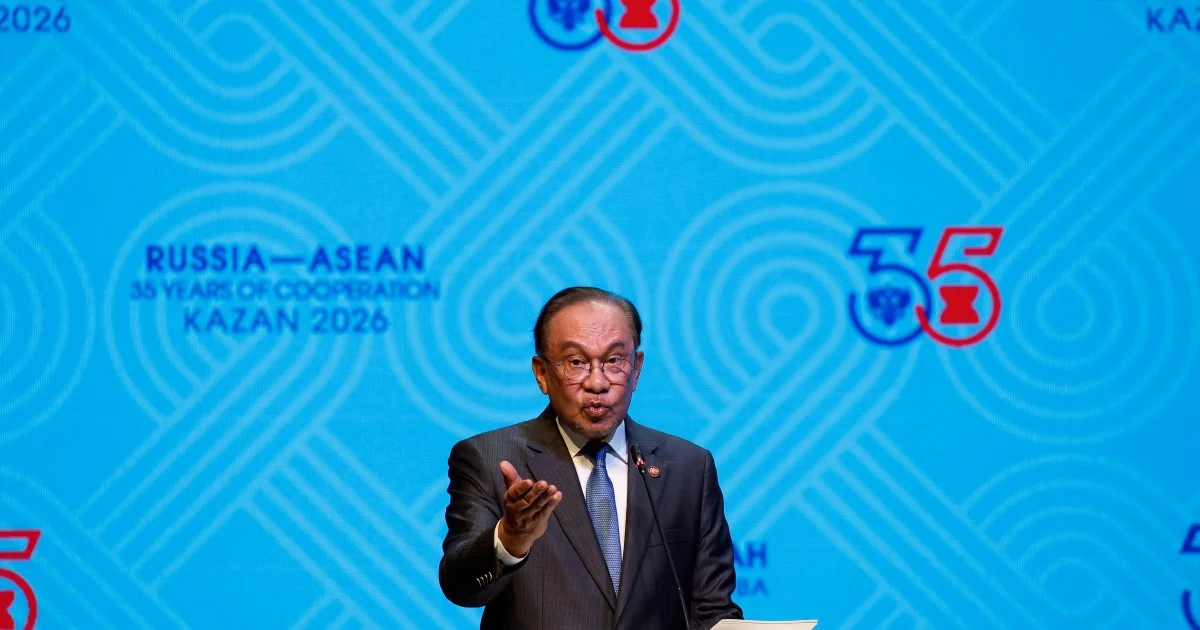
Prime Minister Datuk Seri Anwar Ibrahim has characterised the completion of the Asean-Russia Strategic Programme on Trade and Investment Cooperation 2026-2035 as a meaningful development that could reshape economic dynamics across the broader Asia-Pacific region. Speaking in Kazan, Anwar framed the 10-year roadmap as a decisive moment rather than a mere administrative conclusion, signalling Malaysia's commitment to multilateral trade frameworks even as geopolitical currents grow increasingly unpredictable.
The programme represents a formal commitment by the ten-member Association of Southeast Asian Nations to deepen commercial and strategic linkages with Russia across multiple sectors. For Malaysia specifically, this framework carries substantial weight given the country's positioning as a crucial economic hub within Asean and its historical emphasis on non-aligned foreign policy principles. The roadmap's emphasis on trade and investment cooperation opens potential pathways for Malaysian businesses seeking diversification beyond traditional markets, particularly in a period of shifting global supply chains and protectionist pressures.
However, Anwar's measured optimism reflects a sophisticated understanding of what actually distinguishes successful multilateral trade agreements from those that languish unfulfilled. His insistence that an enabling environment remains critical suggests recognition that formal blueprints, however carefully negotiated, require substantive political will and institutional infrastructure to generate tangible results. This distinction proves particularly relevant in Asean-Russia relations, where implementation has historically been complicated by divergent strategic priorities and external pressures on member states.
The strategic programme's 10-year timeframe positions it as a medium to long-term commitment rather than a quick-fix arrangement. For Malaysian policymakers and business leaders, this extended horizon permits more methodical planning regarding investment allocations, sector-specific partnerships, and workforce development initiatives. Industries ranging from energy and natural resources to agricultural exports and manufacturing could potentially benefit from improved market access and reduced trade barriers outlined in the framework.
Anwar's characterisation of the agreement as a launching pad rather than a destination underscores the complex realities facing contemporary regional cooperation. Geopolitical tensions, particularly those stemming from international sanctions regimes affecting Russian trade, create substantial headwinds that even well-intentioned multilateral frameworks cannot easily overcome. Member states must navigate carefully between economic opportunities and political sensitivities, balancing domestic interests against regional consensus.
The timing of this announcement carries particular significance given the evolving multipolar global order. By securing agreement on a comprehensive Asean-Russia trade programme, Southeast Asian nations demonstrate capacity for maintaining economic relationships with diverse partners despite international polarisation. This approach aligns with Asean's long-standing principle of non-alignment and strategic autonomy, principles that Malaysia has consistently championed throughout Anwar's tenure.
Implementation mechanisms will prove crucial to transforming the roadmap from policy document into economic reality. The framework presumably includes provisions for dispute resolution, tariff schedules, rules of origin for manufactured goods, and mechanisms for sectoral cooperation. Malaysian negotiators would have focused heavily on provisions protecting sensitive industries while maximising market access for competitive sectors where Malaysia holds comparative advantages.
Regional integration within Asean itself becomes a prerequisite for leveraging external trade partnerships effectively. The programme's success depends partly on how cohesively Asean members coordinate their approach to Russian partners and how effectively they implement consistent trade facilitation measures across member economies. Malaysia's role as a developed emerging market within Asean positions it as a potential bridge between less industrialised members and the broader Eurasian economic sphere.
Sector-specific opportunities warrant particular attention for Malaysian stakeholders. Energy cooperation represents an obvious area given Russia's resource wealth and Southeast Asia's substantial import needs. Similarly, agricultural trade could expand significantly, particularly given Russia's food security concerns and Asean's productive agricultural base. Technology transfer and joint investment in manufacturing could create employment opportunities and drive productivity gains across participating economies.
The broader strategic context cannot be overlooked. By strengthening ties with Russia through formalised trade arrangements, Asean maintains diplomatic flexibility and demonstrates commitment to pragmatic economics regardless of geopolitical tensions. This positioning reflects Anwar's broader vision of Malaysian foreign policy centred on economic pragmatism and strategic independence rather than zero-sum alliance politics.
Yet challenges remain substantial. Implementation requires harmonising regulations, reducing non-tariff barriers, and building business confidence in long-term partnership viability. Currency fluctuations, international sanctions complications, and political volatility could all impede progress toward the framework's ambitious objectives. Malaysian businesses will need government support through export credit facilities, market information services, and diplomatic backing to navigate these obstacles effectively.
Anwar's careful language—acknowledging achievement whilst emphasising ongoing requirements—reflects mature appreciation for multilateral cooperation's complexities. The Asean-Russia Strategic Programme 2026-2035 represents genuine progress, yet realising its potential demands sustained commitment, institutional excellence, and willingness to address obstacles pragmatically as they emerge.