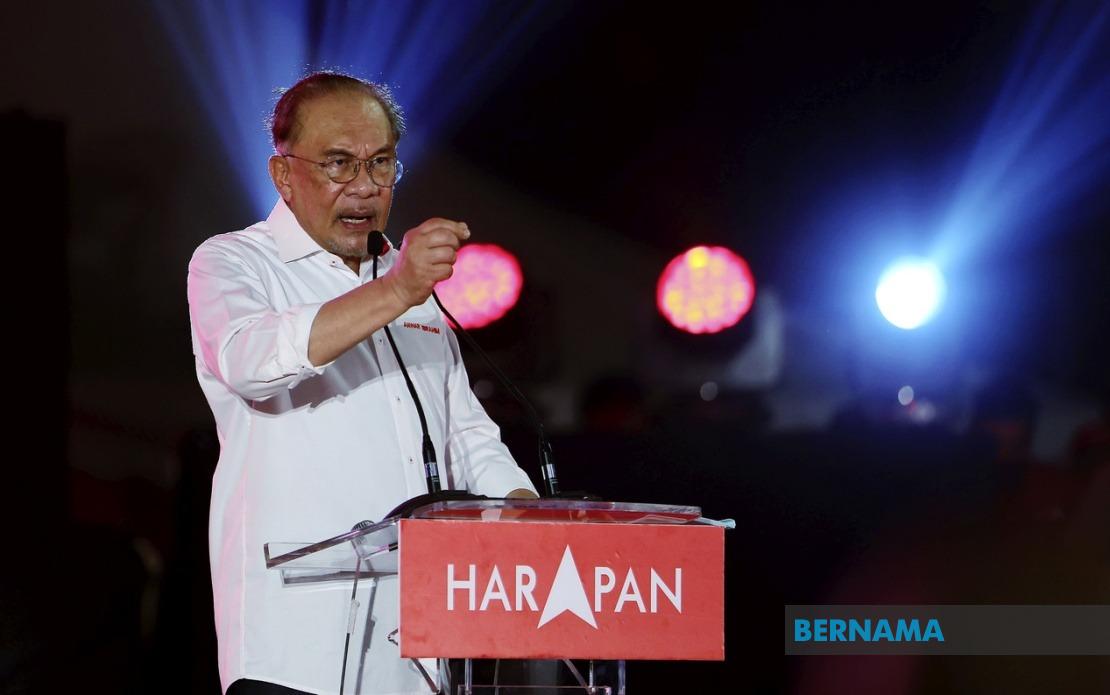
Prime Minister Datuk Seri Anwar Ibrahim has drawn a clear line for political contestants in the upcoming 16th Negeri Sembilan State Election, cautioning all parties to steer clear of inflammatory rhetoric concerning the monarchy and fundamental constitutional questions. Speaking at a candidate announcement event in Kuala Pilah on July 14, the Pakatan Harapan chairman stressed that while electoral competition is inherent to democracy, it must proceed within bounds of responsibility and respect for the nation's foundational pillars.
Anwar's intervention reflects growing concern within the federal government about maintaining social cohesion during state-level campaigns, a pattern evident across Malaysia's electoral landscape where national leaders increasingly supervise regional contests. His remarks signal that Putrajaya intends to maintain close oversight of the Negeri Sembilan campaign to prevent politically opportunistic parties from weaponising sensitive institutional questions. The timing of his statement—at the formal launch of PH's candidacy—underscores the centrality of this message to the coalition's electoral strategy.
The Prime Minister articulated a distinction between legitimate political contestation and corrosive discourse, framing the election as an opportunity to demonstrate Malaysia's democratic maturity. He acknowledged that diverse viewpoints naturally emerge during campaigns, but drew a firm boundary around attacks on national institutions. This formulation attempts to position PH as the custodian of constitutional order whilst remaining open to robust policy debates on development, governance, and service delivery.
Among those flanking Anwar at the ceremony were DAP secretary-general Anthony Loke, Amanah president Datuk Seri Mohamad Sabu, and senior party operatives including communications director Datuk Seri Fahmi Fadzil and election director Datuk Seri Amirudin Shari. Their collective presence underscored the unity message the coalition sought to project, even as internal tensions between component parties occasionally surface in state-level politics. The gathering represented a rare moment of visible cohesion among PH's three main components.
Anwar pivoted from cautionary language to positive framing, calling for clean leadership rooted in integrity and capable of advancing Negeri Sembilan's economic prospects. His emphasis on development narratives reflects PH's broader electoral calculus: positioning the coalition as competent administrators focused on tangible improvements rather than divisive identity politics. For Negeri Sembilan voters, this messaging attempts to redirect campaign discourse toward bread-and-butter concerns—employment, infrastructure, education—where PH hopes to demonstrate comparative advantage.
The Prime Minister expressed confidence in the continuity of state leadership under incumbent Menteri Besar Datuk Seri Aminuddin Harun, describing him as a pragmatic administrator capable of productive collaboration with federal authorities. This endorsement carries particular weight given Anwar's position and suggests potential friction with opposition coalitions should they seek to position the current state leadership as inadequate. The characterisation also implicitly acknowledges that state and federal coordination remains essential for delivering the developmental outcomes PH promises.
At the event, PH unveiled a slate of 36 candidates representing a calculated balance between newcomers and seasoned figures from PKR, DAP, and Amanah. Prominently featured were Aminuddin contesting the Linggi seat and Loke taking on the Chennah constituency, demonstrating the national party apparatus's commitment to retaining control of this central Malaysian state. The candidate mix reflects ongoing negotiations within the coalition about factional representation and regional strongholds.
Negeri Sembilan's electoral significance extends beyond the state itself, offering the first major electoral test of PH's cohesion and public support following the federal government's formation. The state has historically served as a bellwether for broader peninsular political trends, and its outcome will likely influence calculations within opposition coalitions considering their positioning for the next general election. For PH, loss of the state would represent a substantial setback to claims of restored political momentum.
Anwar's warning against raising royal and constitutional matters also reflects sensitivity around specific ongoing debates within Malaysian politics. Recent years have witnessed renewed scrutiny of institutional arrangements, particularly regarding the relationship between elected governments and traditional rulers, as well as fundamental constitutional provisions. By pre-emptively cautioning against these topics, Anwar signalled that PH intends to maintain consensus on institutional questions whilst competing vigorously on policy grounds.
The broader context reveals how Malaysian state elections increasingly become platforms for articulating national political narratives rather than purely local contests. Anwar's direct intervention in the Negeri Sembilan campaign, coupled with his elevation of constitutional and institutional matters, demonstrates the federation's persistent sensitivities around these questions. For voters in the state, the campaign will likely revolve around standard competitive terrain: economic management, infrastructure investment, and administrative competence, with established guardrails limiting discussion of institutional matters.
Looking ahead, the PH machinery's emphasis on unified messaging and positive development narratives will be tested by grassroots campaign dynamics, where opposition parties may attempt to introduce the very topics Anwar discouraged. The election will reveal whether Anwar's injunction carries sufficient weight across the party apparatus and among voters to maintain the boundaries he articulated, or whether electoral competition ultimately overwhelms such constraints.

