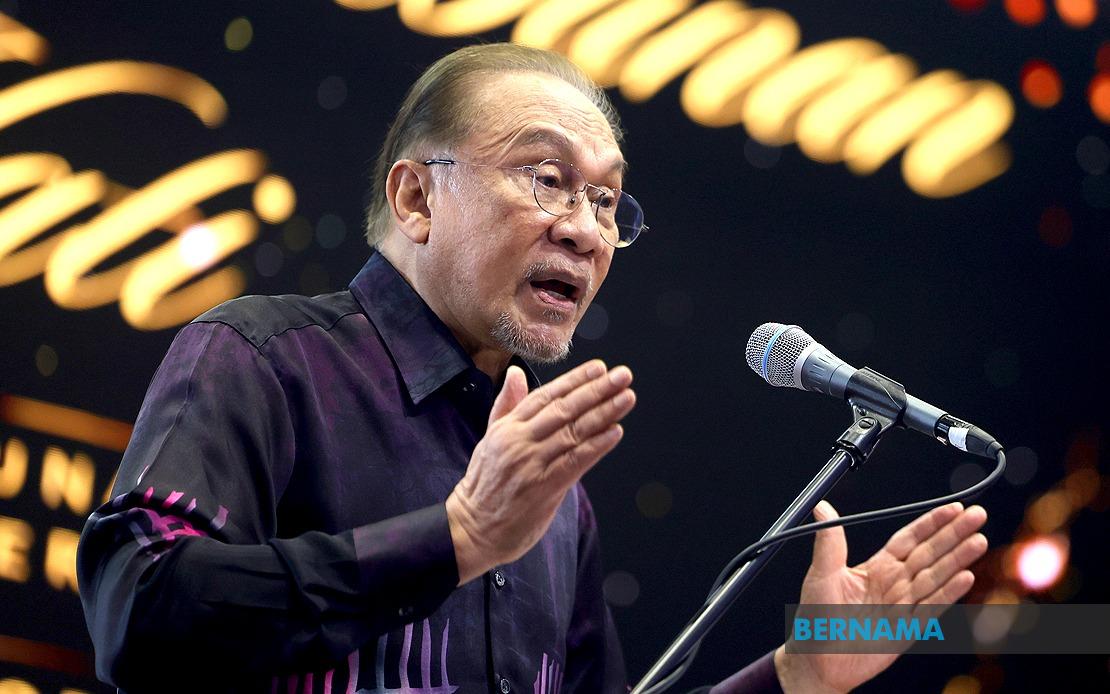
Prime Minister Datuk Seri Anwar Ibrahim delivered a forceful appeal for national cohesion at a gathering in Seremban, calling on Malaysians across all ethnic backgrounds to resist attempts by certain political figures to foster racial discord. Speaking at a dinner hosted by Pertubuhan Lima Generasi Malaysia, Anwar emphasised that the nation's capacity to function as a unified whole depends fundamentally on citizens refusing to allow divisive rhetoric to take root.
Anwar articulated his argument by directly confronting the mechanics of racial polarisation. He identified a dangerous pattern wherein leaders deliberately attempt to manufacture antagonism between different communities—positioning Malays against Chinese, Chinese against Indians, and Indians against Malays. By naming this tactic explicitly, the Prime Minister signalled that such divisions do not emerge organically from genuine cultural differences but are instead constructed and weaponised by political actors pursuing narrow interests. His call for Malaysians to "rise above this" framed unity not as a passive cultural norm but as an active choice requiring conscious resistance to manipulation.
The Prime Minister grounded his appeal in Malaysia's foundational strength, characterising ethnic diversity as a defining asset rather than a liability. This reframing carries particular weight in a Southeast Asian context where demographic pluralism has historically been viewed with suspicion by some actors. By inverting the narrative—treating diversity not as a problem requiring management but as a resource requiring cultivation—Anwar positioned proponents of racial division as actually weakening rather than strengthening the nation. This argument operates at both practical and philosophical levels: practically, inter-ethnic conflict and institutional paralysis harm economic development and social services; philosophically, it asserts that Malaysian identity transcends and encompasses individual ethnic identities.
Crucially, Anwar stipulated that maintaining unity demands more than passive tolerance of difference. He identified the necessity for "strong mutual understanding and cooperation," suggesting that genuine cohesion requires active engagement across communities. This distinction matters significantly for policymakers and civil society actors, as it implies that combating divisive rhetoric alone proves insufficient without simultaneous investment in mechanisms fostering positive inter-ethnic interaction and shared purpose.
The event itself carried symbolic weight, with over one thousand members of Pertubuhan Lima Generasi Malaysia in attendance alongside Negeri Sembilan Menteri Besar Datuk Seri Aminuddin Harun. The involvement of state-level leadership underscored that unity messaging carries importance across multiple levels of governance. For a regional perspective, such calls from Malaysia's federal executive retain particular significance, as the nation's experience managing multi-ethnic democracy remains instructive for neighbouring countries grappling with similar challenges.
Anwar's remarks reflected an implicit acknowledgement that racial tensions periodically surface in Malaysian public discourse, whether through political campaigns, media commentary, or social media amplification. By directly addressing these currents rather than ignoring them, the Prime Minister demonstrated a communication strategy acknowledging that divisions exist while simultaneously rejecting their inevitability. This approach differs markedly from either ignoring racial tensions or validating them as natural expressions of cultural difference.
The framing of a coalition—"Malays, Chinese, Indians, Kadazans and others"—united as "one strong force" presented a positive formulation of Malaysian national identity. The inclusion of indigenous peoples alongside immigrant-origin communities reflected constitutional recognition of Malaysia's full demographic reality. This comprehensive listing countered potentially exclusionary narratives that sometimes treat Malaysian identity as belonging primarily to one community.
For Malaysian business and investment communities, Anwar's emphasis on unity carries direct implications. International and regional investors monitor political stability and institutional cohesion as risk factors; messages emphasising national division create uncertainty and potentially trigger capital flight or reluctance to commit resources. Conversely, clear commitment to inter-ethnic cooperation from the federal government provides reassurance that the institutional environment will remain stable and predictable.
The gathering in Seremban also illustrated how civil society organisations function as platforms for national messaging. Pertubuhan Lima Generasi Malaysia provided a venue and audience for articulating values the government wishes to promote, suggesting that multiple stakeholders share interest in preserving communal harmony. This alliance between government messaging and civil society engagement strengthens the reach and perceived legitimacy of unity appeals beyond what official pronouncements alone might achieve.
Anwar's intervention enters a broader regional context. Southeast Asia encompasses multiple multi-ethnic democracies navigating similar tensions, and Malaysia's approach—explicitly rejecting ethno-nationalist frameworks—remains consequential for regional stability and development. Should Malaysia successfully sustain institutional practices and political cultures resisting racial division, it provides a model for neighbouring societies facing comparable pressures. Conversely, any perception that Malaysia's political system enables or rewards racial polarisation would carry implications for regional governance standards.
The substantive challenge confronting Malaysia involves translating rhetorical commitment to unity into institutional mechanisms and policy frameworks that actively counteract divisive incentives. While prime ministerial appeals carry symbolic importance and reinforce societal norms, they prove most effective when coupled with institutional reforms, inclusive economic policies, and educational initiatives deliberately strengthening cross-community bonds. The Prime Minister's speech constitutes necessary but not sufficient action toward the unity goals he articulated.

