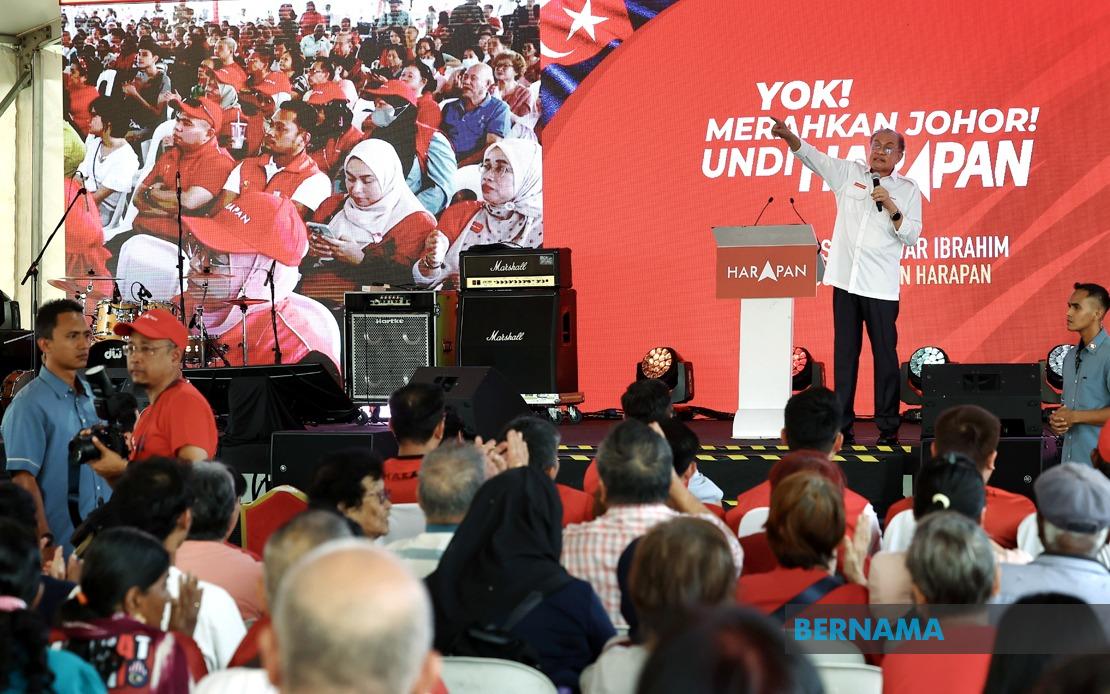
Prime Minister Datuk Seri Anwar Ibrahim has explicitly told political contenders in the Johor state election to cease weaponising the imprisonment of former Prime Minister Datuk Seri Najib Razak during their campaign activities. Speaking at an election rally in Kulai on Wednesday, Anwar argued that continued politicisation of Najib's status serves no constructive purpose, particularly given that the former leader is currently serving a custodial sentence. Rather than relitigating historical figures and their legal circumstances, Anwar stressed that campaign messaging should centre on tangible governance priorities that directly affect Johorean voters.
The timing of Anwar's intervention is significant, coming as multiple political coalitions mobilise their ground machinery ahead of the Johor state ballot. By explicitly calling for a cessation of this line of attack, the Prime Minister appeared to be addressing internal competition within the Pakatan Harapan coalition itself, where different member parties have occasionally diverged in their rhetorical strategies. The move reflects a broader strategic calculation that dwelling on past controversies—no matter how serious their financial implications—has limited electoral utility compared to forward-looking policy platforms.
Anwar's most compelling argument centred on the tangible fiscal consequences of the 1Malaysia Development Berhad scandal. The government currently carries a RM51 billion debt burden inherited from the misappropriated 1MDB funds, a figure that represents a substantial portion of annual federal budget allocations. According to Anwar's framing, this extraordinary liability directly constrains the government's capacity to invest in foundational infrastructure and social programmes that ordinary Malaysians rely upon. The lost opportunity costs are staggering: those billions could theoretically fund extensive school construction, hospital expansions, road networks, and welfare initiatives instead of servicing debt incurred through corporate malfeasance.
This argument carries particular resonance in Johor, a state that has historically competed with other major states for federal development allocations. Johor voters—especially those in rural constituencies—are keenly aware of infrastructure gaps and healthcare access limitations. By reframing the 1MDB discussion from individual culpability to collective fiscal burden, Anwar positioned the issue as one affecting everyone's material circumstances rather than merely as a vehicle for political scoring. This rhetorical shift may prove strategically shrewder than continued emphasis on criminal accountability, particularly if polling data suggests voter appetite for retrospective blame has diminished.
The Prime Minister's comments carried an implicit acknowledgment that Najib's incarceration has become a polarising symbol within Malaysian politics. Some constituencies view his imprisonment as vindication of post-2018 reform efforts and accountability mechanisms, while others have begun to question the proportionality of extended custodial sentences or have simply moved on to contemporary concerns. By urging competitors to abandon this angle, Anwar may have been attempting to depolarise campaign discourse and avoid reopening wounds that could mobilise opposition voters in unexpected ways.
The event itself featured several senior Pakatan Harapan figures, including Youth and Sports Minister Mohammed Taufiq Johari and Deputy Investment, Trade and Industry Minister Sim Tze Tzin, underscoring the federal government's investment in the Johor campaign. The gathering also featured PKR Youth leadership and the coalition's candidate for the Bukit Batu seat, reflecting the organisational intensity that Pakatan Harapan is directing toward this contest. The presence of multiple cabinet-level representatives alongside youth wing leaders indicated efforts to mobilise both ground-level activism and higher-level campaign messaging.
For Malaysian observers and regional analysts, Anwar's intervention illustrates the evolving nature of political discourse in the post-2018 reform era. Where initial campaigns emphasised criminal accountability and governance failures, subsequent contests have increasingly pivoted toward economic management and service delivery narratives. This reflects both the maturation of post-transition politics and pragmatic recognition that voters ultimately judge governments primarily on performance metrics and livelihood improvements rather than on retrospective judgments about predecessor regimes.
The RM51 billion debt figure underscores why this transition matters operationally. Every quarter that Putrajaya allocates resources to servicing 1MDB-related obligations represents capital unavailable for current priorities. This creates a kind of permanent infrastructure deficit that affects development trajectories across all states, though particularly in less-developed regions already struggling with insufficient funding. Johor, despite its relative prosperity, has significant portions of the population in suburban and rural zones where infrastructure development remains uneven.
Anwar's characterisation of the 1MDB legacy as an ongoing burden rather than a closed historical chapter reveals how post-scandal governance continues to shape Malaysian political economy. Unlike many corruption scandals that fade from policy discourse once prosecutions conclude, the 1MDB debt functions as a live constraint on government capacity. This dynamic differentiates the Malaysian case from patterns in other democracies where fiscal consequences of historical mismanagement typically receive less sustained political attention.
The Prime Minister's appeal for campaign focus on welfare and economic management represents a deliberate repositioning of Pakatan Harapan's electoral messaging. Rather than running primarily on a platform of anti-corruption rectification or institutional reform—the coalition's dominant themes in 2018—contemporary campaigns increasingly emphasise bread-and-butter governance. This reflects both the coalition's evolution from a reform movement to an incumbent administration and implicit acknowledgment that voters' primary concerns centre on employment, cost of living, healthcare access, and educational opportunity.

