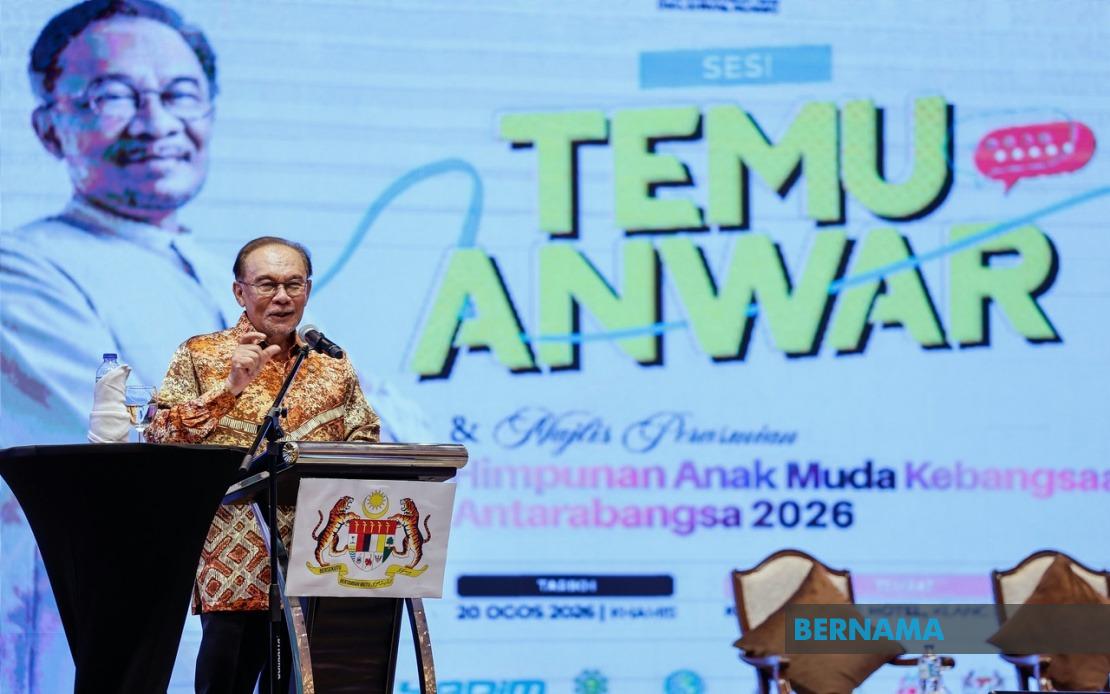
Prime Minister Datuk Seri Anwar Ibrahim has signalled that Malaysia will see a series of major policy announcements rolled out across key national dates, beginning with an important declaration on the eve of National Day on August 30, followed by another during Malaysia Day celebrations on September 16, and a third during the Budget tabling in early October. Speaking at the Temu Anwar session held during the opening ceremony of Himpunan Anak Muda Antarabangsa (HAMKA) 2026 in Klang, the Prime Minister declined to elaborate on the specific content of these announcements, maintaining an air of anticipation ahead of the country's key commemorative periods.
The sequential timing of these announcements suggests a deliberate strategy to anchor policy initiatives within the national calendar, leveraging the heightened civic engagement that accompanies National Day and Malaysia Day celebrations. By spacing announcements across August, September, and October, the government appears intent on maintaining momentum on its reform agenda while capitalising on periods when Malaysians are particularly receptive to national narratives. This approach reflects a calculated political communication strategy designed to maximise media coverage and public attention.
The Prime Minister's remarks came in response to a student's question about government efforts to protect the welfare and financial security of young workers in the gig economy, a sector that has expanded rapidly across Malaysia and the wider Southeast Asian region. The gig economy, encompassing ride-hailing, food delivery, freelancing, and other flexible work arrangements, has become increasingly significant to youth employment but raises persistent concerns about worker protections, income stability, and social security coverage. Anwar's willingness to address this issue publicly at a youth-focused forum underscores the government's recognition of gig workers' concerns and their electoral importance among younger voters.
To address these concerns, the government has established the Malaysian Gig Economy Commission (SEGiM) and is introducing new legislation focused on protecting small business interests and gig economy participants. SEGiM represents an institutional effort to create dedicated governance structures for this emerging sector, moving beyond ad hoc policy adjustments. The commission's establishment signals recognition that gig work requires tailored regulatory frameworks distinct from traditional employment relationships, reflecting global trends in countries grappling with similar workforce transformations. However, the commission's effectiveness will depend critically on its capacity to influence actual working conditions and income security for millions of Malaysians engaged in platform-based work.
Anwar acknowledged that existing government assistance programmes for gig economy workers remain contested, with many participants arguing that current support is inadequate relative to their vulnerabilities. Rather than dismissing these concerns, the Prime Minister adopted a consultative stance, promising to evaluate current provisions and consider enhancements where fiscal capacity permits. This measured approach reflects the tension governments face between responding to legitimate welfare concerns and managing budgetary constraints, particularly in an economic environment marked by inflationary pressures and competing demands on public resources.
Beyond gig economy protections, the government is pursuing complementary initiatives to support youth entrepreneurship and economic participation. The Prime Minister highlighted efforts to improve financing access for young graduates through the National Entrepreneurial Group Economic Fund (TEKUN), recognising that employment insecurity and limited capital access remain significant barriers to youth economic mobility. TEKUN's role in facilitating entrepreneurship is particularly relevant given Malaysia's growing emphasis on supporting self-employment and small enterprise creation as economic diversification strategies.
A significant policy review under consideration involves the existing requirement that TEKUN applicants must demonstrate prior business experience before accessing financing. This criterion, while intended to reduce lending risk, potentially excludes many young graduates eager to launch their first ventures but lacking track records. Anwar indicated willingness to revisit this requirement, suggesting that government policy might evolve to accommodate changing employment realities where conventional career pathways are less viable. Such flexibility could unlock entrepreneurial potential among younger demographics, though it would require careful risk management to protect public funds.
The Prime Minister's framing of these issues reveals a government attempting to navigate complex trade-offs between supporting vulnerable workers and maintaining fiscal prudence. By repeatedly emphasising that the government "will listen and look into the matter" and commit to doing "our best for the youth," Anwar signalled openness to recalibrating policies while managing expectations about the pace and scope of change. This rhetoric appeals particularly to younger voters concerned about their economic futures, a demographic coalition that has gained prominence in Malaysian politics.
The confluence of announcements across the August-October period also suggests linkage between these youth and gig economy initiatives and broader economic policy direction. The Budget tabling in early October provides an obvious platform for translating these policy commitments into concrete allocations, funding mechanisms, and legislative vehicles. The sequencing allows the government to build narrative momentum, establishing principles and commitments in August and September before detailed fiscal implementation in October.
For Malaysia's broader economic policy, these developments reflect international recognition that traditional employment structures are fragmenting, necessitating new social protection models and support ecosystems. Southeast Asia more broadly is grappling with similar challenges as gig economy participation grows, making Malaysia's policy innovations potentially instructive for neighbouring countries. The region's governments face comparable pressures to balance employer flexibility with worker protections, a tension unlikely to resolve easily.
Anwar's engagement with youth concerns at the HAMKA forum also underscores the government's awareness that younger demographics increasingly expect direct responsiveness to their priorities. Rather than delegating youth issues to subordinate ministers, the Prime Minister's personal involvement signals their salience within the cabinet's political calculus. This approach may reflect lessons learned from electoral cycles where youth mobilisation and engagement have proven decisive.

